
Beyond Individual Scores: Why Collaboration Reputation is the Key to Trustworthy Service Selection
Collaboration reputation for trustworthy Web service selection in social networks
The paper introduces a novel Collaboration Reputation framework for trustworthy Web service selection in social networks. It leverages a Web Service Collaboration Network (WSCN) to measure trustworthiness through two new metrics: Invoking Reputation (recommendation-based) and Invoked Reputation (interaction-frequency-based).
TL;DR
Individual reputation scores are no longer enough for complex systems. This paper argues that Web Service Selection must transition from "selecting the best individuals" to "selecting the best collaborators." By building a Web Service Collaboration Network (WSCN), the authors propose a dual-metric system—Invoking and Invoked Reputation—that boosts selection success rates by 20% while efficiently filtering out malicious actors.
The Problem: The "Strangers in a Team" Paradox
In modern social networks, we often build composite services by stitching together multiple APIs or Web Services. The status quo is to pick services with the highest individual Quality-of-Service (QoS) or reputation ratings.
However, the authors identify a critical flaw: High-reputation services that have never interacted often fail in tandem. When services are "strangers" to each other, the unknown interaction risks lower the total trustworthiness of the composite service. Prior work treated services as isolated islands; this work treats them as a connected ecosystem.
Methodology: Mining the Social Network of Services
The core of the paper is the Web Service Collaboration Network (WSCN). The authors treat service invocations like scientific co-authorships—if two services work together, a "social" link is formed.
1. The Dual Pillars of Reputation
To measure trust, the system looks at two directions:
- Invoking Reputation: How important is this service as a "nominator"? Using community detection, the authors identify Trust Recommendation Vertices (TRVs). If a service is closely connected to these high-trust nodes, its reputation increases.
- Invoked Reputation: Inspired by Google's PageRank, this metric tracks interaction frequency. The more a service is invoked by other reputable services, the higher its score.
2. Eliminating Deceptive Nodes
Malicious providers often fake QoS data. To counter this, the authors implement a Neighbor Update Strategy. Using a Gossip Algorithm, the network spreads information about underperforming services. Unlike flooding, which slows down the system, the Gossip mechanism ensures that "bad service" alerts circulate efficiently, allowing healthy nodes to prune their neighbor lists.
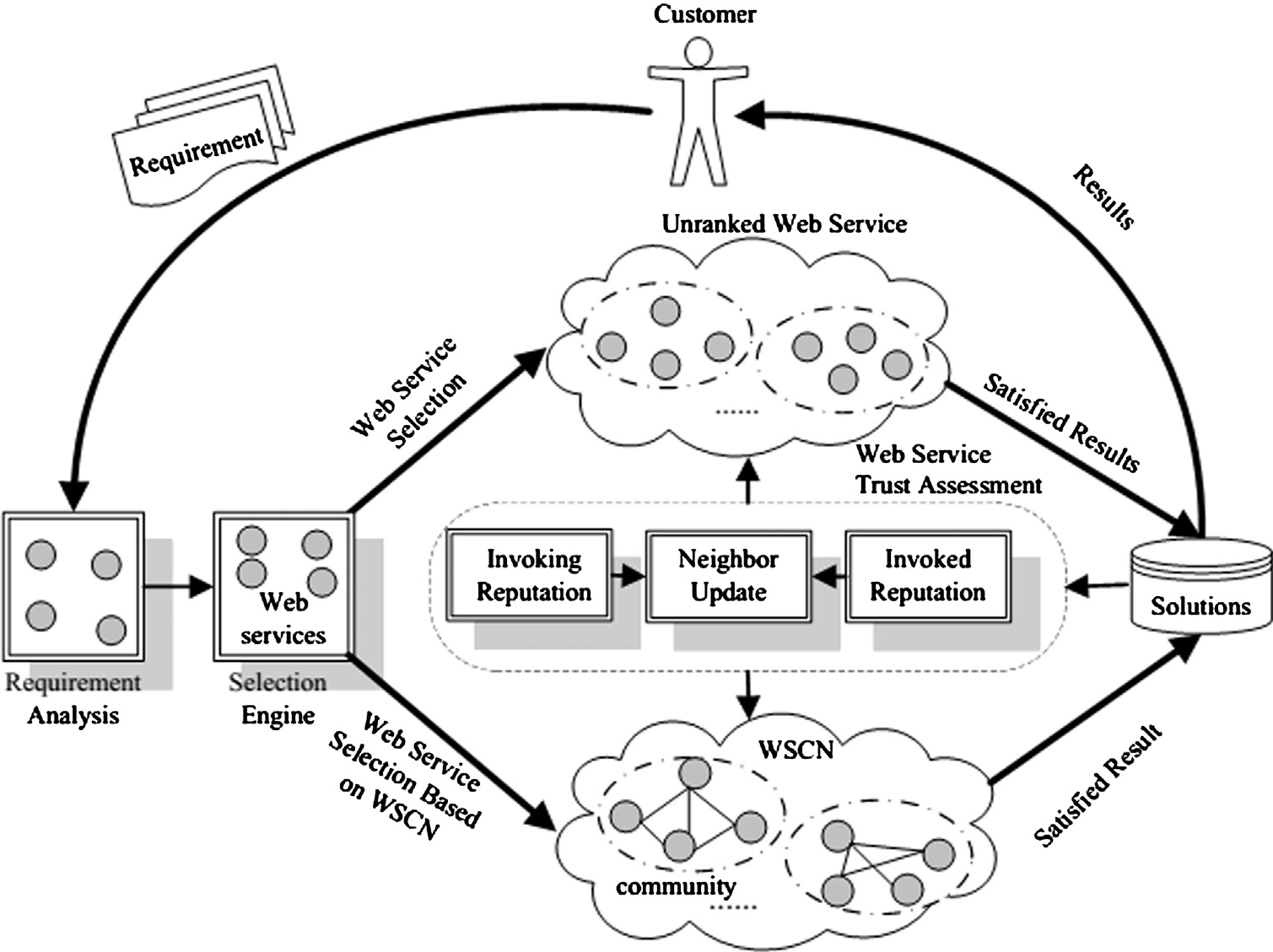 Figure 1: The framework for trustworthy Web service selection, illustrating the cycle from requirement analysis to trust assessment.
Experiments & SOTA Comparison
The authors tested their approach against traditional trustworthy selection (TTWSS) and AI planning-based selection (WSSW).
- Trustworthiness Boost: The proposed method reached a significantly higher success rate than TTWSS. While TTWSS picks the "stars" regardless of their chemistry, the collaboration model picks "teams" that have a proven track record of working together.
- Efficiency: By limiting the search space to "neighbors" in the WSCN rather than checking every service in the global directory, the system manages to stay computationally efficient despite the overhead of trust calculation.
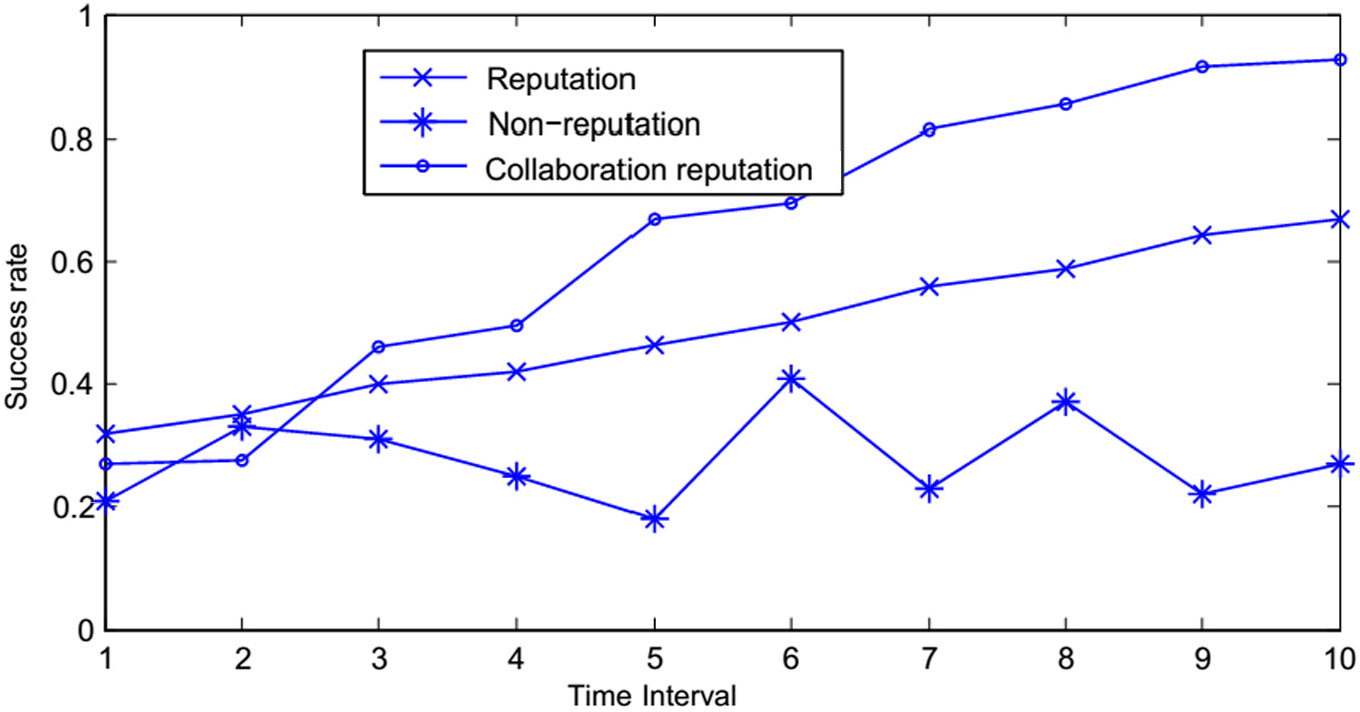 Figure 2: Success rate of collaboration reputation versus other mechanisms over multiple time intervals.
Critical Analysis: A Step Toward "Relational AI"
The strength of this work lies in its Inductive Bias: the belief that history repeats itself in service interactions. It moves the needle from static reputation to dynamic, collaborative trust.
Limitations to Consider:
- Cold Start Problem: The paper admits that new services, which have no interaction history, are at a disadvantage compared to established ones.
- Community Size: The model requires a sufficiently large community to accurately detect TRVs; in sparse networks, the reputation values may converge too slowly.
Conclusion
This research proves that in a networked world, trust is a network property. By shifting from a service-centric view to a collaboration-centric view, we can build composite systems that are not just fast, but fundamentally reliable.
For engineers and architects, the takeaway is clear: when building middleware or orchestration layers, track the interaction success between nodes—it is a better predictor of future performance than any single-service SLA.