
eDiaMoND: Rethinking Trust and Collaboration in the Era of Health Grids
Collaboration and Trust in Healthcare Innovation: The eDiaMoND Case Study
This paper presents the eDiaMoND case study, an e-Science Grid infrastructure designed for digital mammography and breast cancer screening. It transitions physical film workflows into a federated digital environment, integrating ethnographic fieldwork to evaluate how trust, accountability, and "practical ethical action" are maintained in distributed clinical settings.
TL;DR
The eDiaMoND project represents a landmark study in e-Science, attempting to modernize the UK's breast cancer screening through a Grid-based digital infrastructure. Beyond the technical feat of federating medical images, the study highlights a critical socio-technical insight: trust in healthcare is not just a matter of encryption and access rights; it is a "practical accomplishment" rooted in familiar work practices and the visibility of colleagues' actions.
The "Invisible College" vs. The Digital Grid
The grand vision of e-Science is to erode organizational boundaries, creating "virtual organizations" where data flows seamlessly. However, the eDiaMoND study found that clinical work—specifically mammography—relies heavily on local, informal networks or "invisible colleges."
Current screening practices involve a deep biographical familiarity. A radiologist doesn't just read a mammogram; they read it knowing which specific X-ray set was used, which mobile unit it came from, and even the "styles" of their colleagues who performed the double-reading. These nuances allow them to distinguish between a technical artifact (like a "whiter film" due to processor chemistry) and a genuine pathological lesion.
Methodology: The Ethnographic Lens
The researchers didn't just build a database; they embedded themselves in Breast Care Units (BCUs). By observing "practical ethical action," they discovered that medical ethics is not a static rulebook but a series of situated professional decisions.
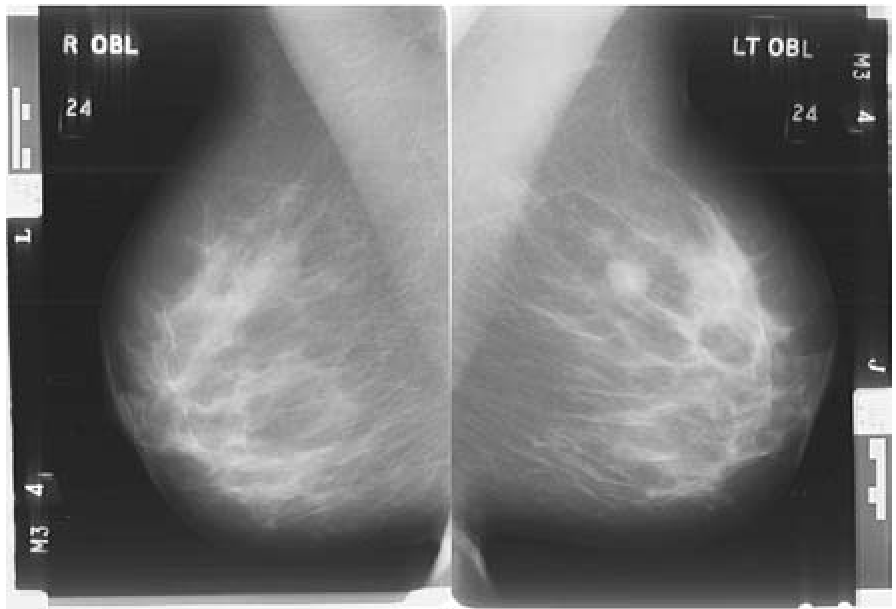 Figure 1: Traditional mammography reading involving physical film and lightboxes.
The Core Challenge: Distributed Reading
One of eDiaMoND’s primary goals was to enable "distributed reading"—sending cases from overloaded clinics to those with spare capacity. While technically feasible, this creates a contextual vacuum:
- Loss of Hindsight: How can a remote reader trust their partner's decision if they don't know their "biographical" track record (e.g., are they a "calcium king" who excels at spotting micro-calcifications)?
- The Problem of "Black-Boxing": When data is stripped of its local production context, radiologists lose the ability to account for technical variances in image acquisition.
- Formalization vs. Informality: Co-located clinicians often resolve doubts through happenstance meetings. Grids, by nature, tend to formalize communication, which can make a simple query feel like a formal audit of professional competence.
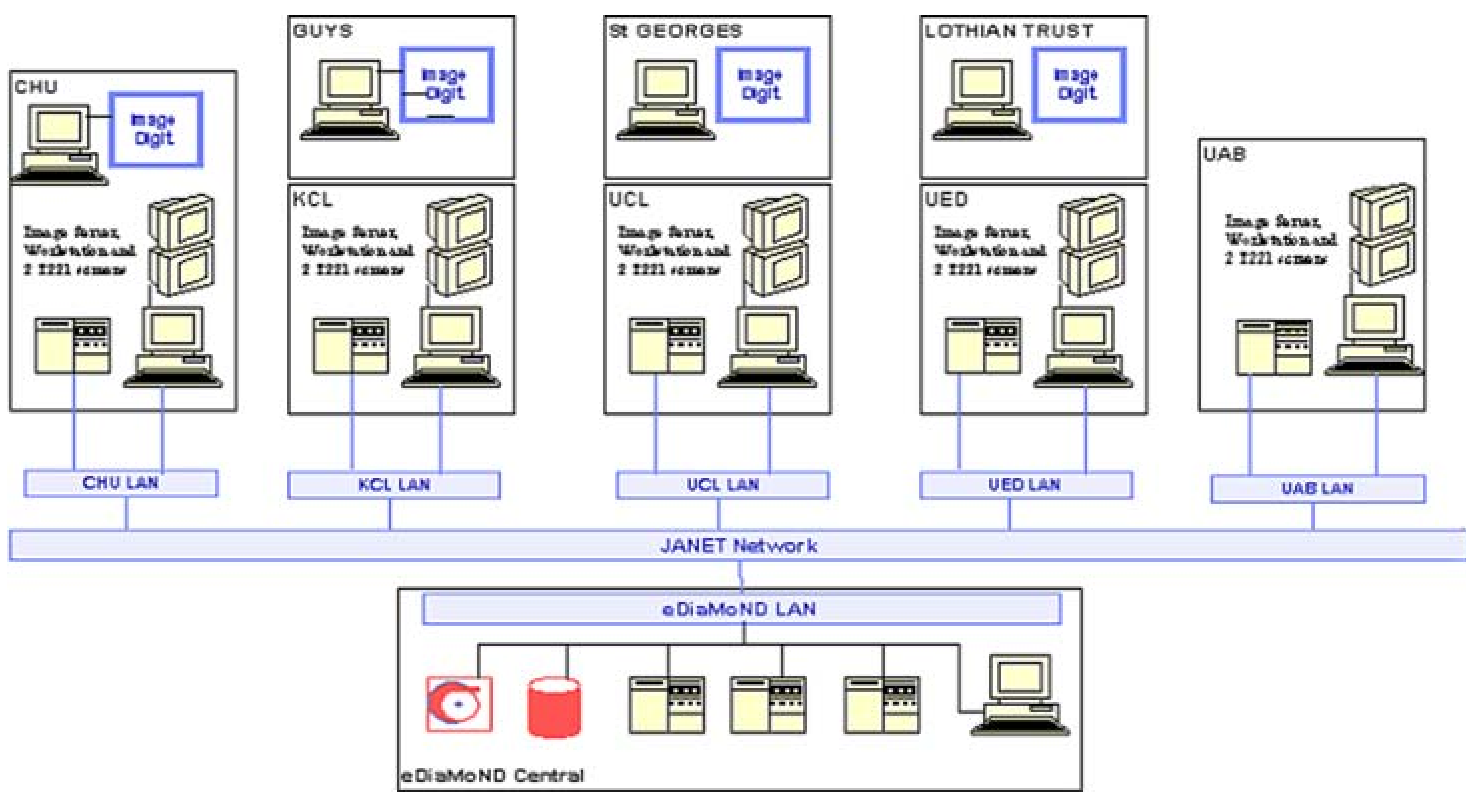 Figure 2: The eDiaMoND system architecture, illustrating the federation of local BCU databases into a global resource.
Deep Insight: Data is Not a Commodity
The study challenges the "commodity" view of information. In medical science, data is dynamic. Its meaning is reshaped by its source and its purpose. To address the trust gap, the authors suggest:
- Providing Translations: Using physics-based models (like the Standard Mammogram Form) to normalize images across different hardware, so they look "familiar" to remote readers.
- Supporting Visibility: Designing interfaces that allow remote collaborators to see each other's historical decision-making patterns, recreating "biographical familiarity" digitally.
- Situated Role-Based Access: Moving away from rigid central policies to a model where a clinical team lead can delegate access dynamically based on immediate clinical need.
Critical Analysis & Conclusion
The eDiaMoND project serves as a cautionary tale for those who believe that scaling technology in healthcare is purely a matter of throughput and security. The "safety culture" of clinical units is built on open access to information within a trusted circle.
Takeaway: Future e-Health and e-Science systems must recognize that "trustable" systems are not just those that are secure, but those that are compatible with the way human trust is diachronically achieved. For the e-Science vision to succeed, it must support the "informality" and "situatedness" of expert work rather than trying to engineer it away through rigid standardisation.
Limitations: The study focuses heavily on the UK’s NHS context, which has specific legal frameworks for patient consent. Applying these findings to private healthcare systems or different regulatory environments (like the US HIPAA) may require additional layers of consideration regarding the tension between clinical autonomy and institutional liability.