
Beyond Single-Owner Privacy: A Trust-Based Collaborative Approach for Social Networks
Collaborative Access Control Mechanism for Online Social Networks
This paper introduces the Collaborative Access Control Mechanism (CACM), a trust-based privacy framework for multi-party resources in Online Social Networks (OSNs). The authors developed "msecure," a Facebook application that implements this logic, achieving over 90% user satisfaction in privacy effectiveness during a pilot study.
TL;DR
In modern social media, a single photo often belongs to everyone tagged in it, yet current platforms only allow the uploader to control who sees it. This paper proposes CACM (Collaborative Access Control Mechanism), a system where all stakeholders collectively decide access based on "Trust Scores." It moves away from binary "Friend/Public" settings toward a weighted, multi-party consensus model.
The "Stakeholder" Dilemma in Privacy
Most Online Social Networks (OSNs) treat data as a single-owner entity. If Alice uploads a photo of Bob and Charlie, Bob and Charlie's privacy preferences are often ignored by default system settings. Prior research has attempted to solve this, but these solutions were either too restrictive (blocking everything if one person disagreed) or too loose.
The authors identify a critical missing link in existing SOTA (State Of The Art) models: Trust Levels. In real life, we don't just share based on "relationships"; we share based on the intensity of those relationships.
Methodology: Engineering Social Trust
The CACM model quantifies trust on a scale of 0 to 100, categorized into groups:
- Family: 100–76
- Close Friends: 75–51
- Normal Friends: 50–26
- Public: 25–0
The Access Algorithm
When a requester tries to access a multi-party resource , the system evaluates two conditions:
- Average Strength: The average trust all stakeholders have in must exceed the aggregate threshold .
- Veto Power: The trust has with any individual stakeholder must not fall below a minimum safety threshold .
Even if is not a direct friend, the system calculates trust via mutual friends, using a transitive trust formula: where is the mutual connection with the highest trust.
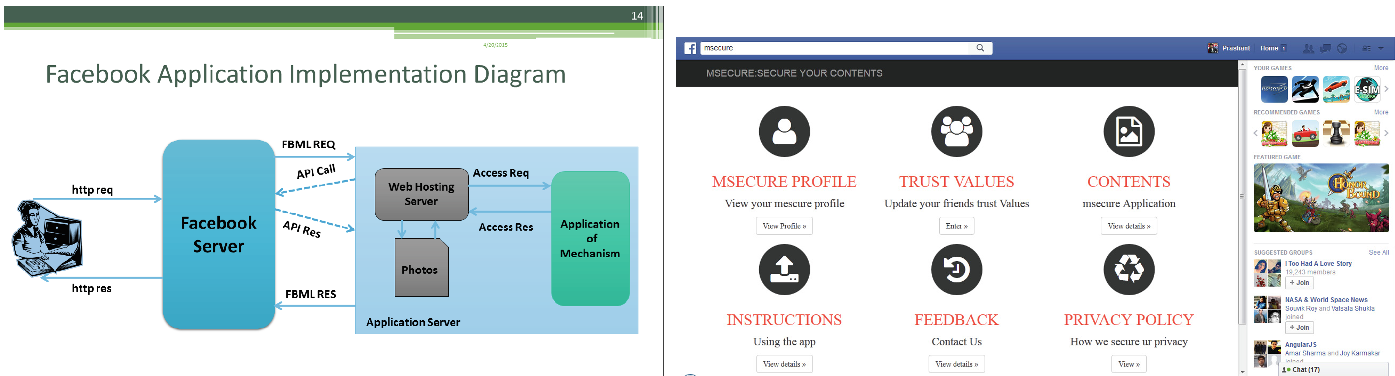 Caption: The architecture of the "msecure" app (a) and its user-facing dashboard (b).
Experimental Results & User Perception
The authors validated CACM via msecure, a Facebook Canvas application. The study focused on photo sharing—the most common multi-party privacy conflict.
Key Findings:
- Effectiveness: 82% of users (41/50) strongly agreed that the app protected their photographs better than standard Facebook settings.
- Usability: Despite the underlying mathematical trust models, 92% of users found the interface friendly, proving that complex privacy logic can be abstracted for novice users.
- Real-time Performance: 80% of the policy evaluation is processed in real-time, making it viable for high-traffic social environments.
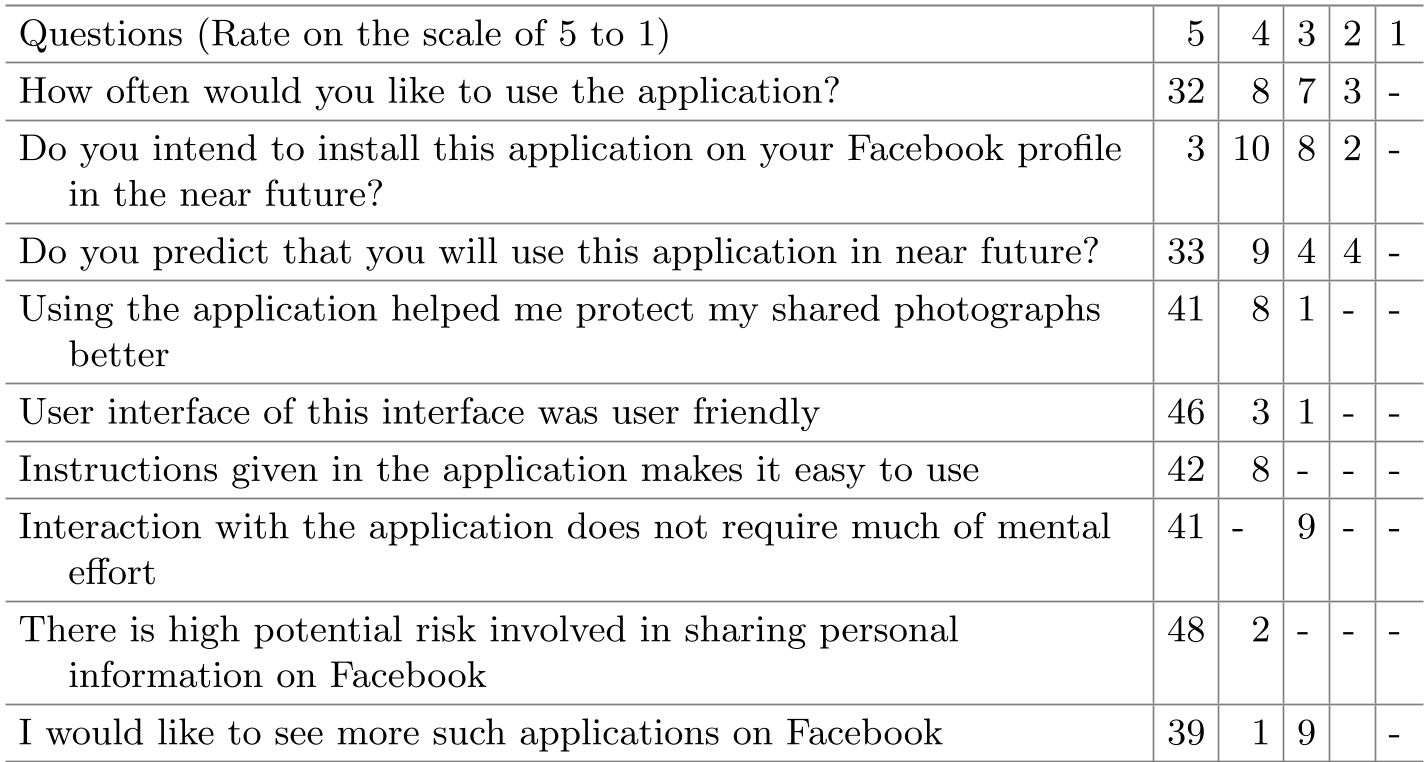 Caption: Detailed survey results showing high user intent to adopt trust-based privacy tools.
Critical Insight: Why This Matters
The shift from identity-based access (who are you?) to trust-based access (how much do I value you?) is a major leap in Privacy-Enhancing Technologies (PETs).
Limitations: The current model relies on users manually segmenting friends into trust groups. As social circles grow, this becomes a "cold start" problem. Future iterations would benefit from semi-automatic trust assignment—using interaction frequency, common interests, or sentiment analysis to suggest trust values.
Conclusion
CACM proves that collaborative privacy doesn't have to be a zero-sum game. By quantifying trust and allowing stakeholders to set individual minimums, we can create a social web that respects everyone in the frame, not just the person holding the camera.