
The End of Black-Box Hardware: Collaborative Governance via Blockchain Chips
Collaborative and Accountable Hardware Governance Using Blockchain
This vision paper proposes a decentralized framework for hardware governance and lifecycle management using blockchain technology. The core method introduces the "Blockchain Chip," a hardware-level root of trust that monitors internal states (voltage, temperature, performance) and leverages smart contracts to ensure accountability and multi-vendor collaboration.
Executive Summary
TL;DR: This vision paper addresses the increasing complexity of modern hardware systems by proposing a transition from a "black-box" to a "white-box" governance model. By integrating Blockchain Chips directly onto motherboards, the authors envision a system where hardware components are continuously monitored, verified against smart contracts, and held accountable through an immutable, decentralized ledger.
Background: Positioned at the intersection of Hardware Security and Distributed Ledger Technology, this work provides a roadmap for securing the complex supply chains of IoT and cloud infrastructures by moving beyond centralized, OS-dependent monitoring.
The "Black-Box" Crisis: Why Current Hardware Fails Us
In our current ecosystem—ranging from self-driving cars to massive datacenters—we treat hardware as a closed system. When a chip fails or a security breach (like a hardware Trojan) occurs, identifying the culprit is notoriously difficult.
The authors identify several critical pain points:
- Heterogeneity: Components from Company A, B, and C are integrated by Company D, but no unified monitoring fabric exists.
- Lack of Provenance: There is no immutable record of how a component behaved before it failed, making legal and technical accountability impossible.
- Security Vulnerabilities: Current systems lack the "Compositional Security" needed to detect malicious backdoors embedded deep within circuitry.
Methodology: The Blockchain Chip Architecture
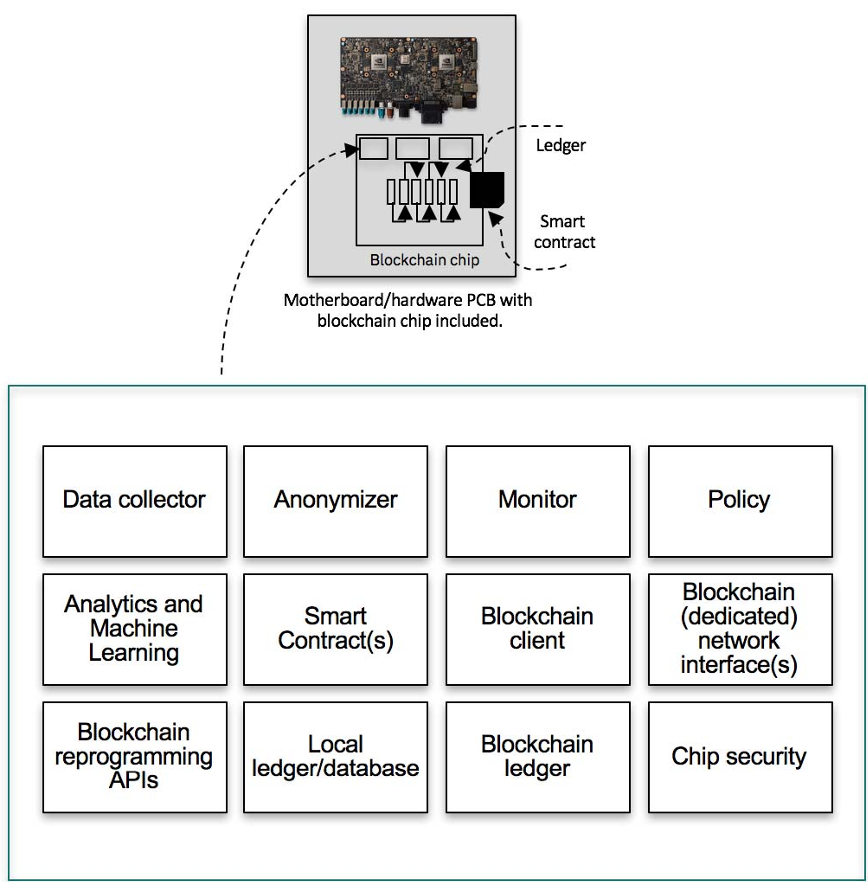
The proposed solution centers on a specialized Blockchain Chip embedded on the motherboard. This chip acts as a persistent monitor and a gateway to a wider blockchain network.
1. Chip-Level Logic
The Blockchain Chip performs local data collection, covering parameters like core temperatures, power usage, and clock speeds. Crucially, it includes:
- Local Private Ledger: To maintain a trusted history of internal events.
- Privacy & Anonymization Statistics: Ensures that sensitive internal operational data is scrubbed before being shared externally.
- Dynamic Policies: The granularity of monitoring can be scaled up automatically if suspicious patterns are detected.
2. Hierarchical Blockchain Ecosystem
The architecture operates on two levels:
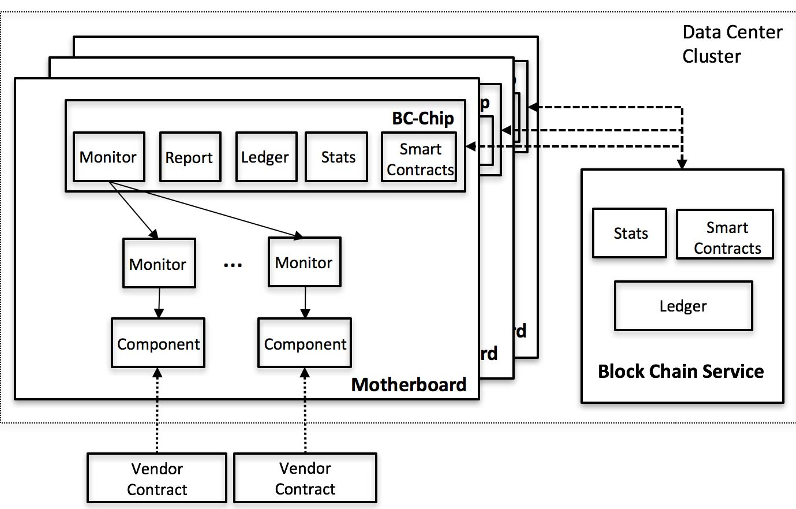
- Motherboard-level: Handles immediate consensus between components/vendors on a single board.
- System-wide: Aggregates data across entire datacenters or IoT clusters, allowing for large-scale analytics and auditing.
Smart Contracts as Technical Specifications
One of the paper's most innovative insights is the use of Smart Contracts to encode technical datasheets. Instead of a static PDF, a vendor provides a smart contract that defines the expected operational bounds (e.g., "Voltage must stay within 1.1V-1.3V"). If the Blockchain Chip detects a violation, the smart contract automatically triggers an alert or an insurance claim, ensuring Accountability-by-Design.
Critical Insight: Trust vs. Privacy
A recurring theme in the work is the tension between detailed monitoring and data privacy. The authors suggest that by using Physically Unclonable Functions (PUFs) and digital signatures, the system can verify the identity of a chip without necessarily exposing the intellectual property of the computations being performed. This "need-to-know" policy is vital for industry-wide adoption where vendors are competitors.
Conclusion and Future Outlook
This vision represents a paradigm shift. By making hardware governance collaborative and accountable, we move closer to systems that are self-healing and inherently secure.
Key Challenges remains:
- Performance Overhead: How much power does a dedicated Blockchain Chip consume?
- Standardization: Will competing vendors like Intel, AMD, and ARM agree on a unified monitoring protocol?
Ultimately, the paper argues that for mission-critical systems like SpaceX rockets or autonomous vehicles, the cost of not having this level of transparency is far higher than the cost of implementation.