
FCS: Revolutionizing Healthcare Coordination via Functional Collaboration
A collaborative approach for future ICT based healthcare services
This paper introduces the Functional Collaboration System (FCS), a service framework designed to optimize communication in complex healthcare environments. By integrating XMPP-based instant messaging with a social network paradigm, FCS streamlines "skill searches" and task assignments, achieving significantly higher efficiency than traditional telephony-based workflows.
TL;DR
The paper introduces the Functional Collaboration System (FCS), an ICT framework that replaces cumbersome phone-based coordination in hospitals with a streamlined, social-network-inspired messaging architecture. By shifting toward role-based automated routing, it reduces request acknowledgment times by nearly 90%, slashing inefficiency and professional interruptions.
Background: The "Right Person" Problem
In a high-stakes healthcare environment, the bottleneck is rarely the lack of skill, but the latency of discovery. Finding an available anesthetist or a specific piece of equipment often involves a "telephone game"—calling multiple departments, being put on hold, and interrupting active staff. This manual search process is the primary driver of organizational friction.
Methodology: From Phone Lines to Functional Nodes
The core innovation of the FCS is the Functional Collaboration paradigm. Instead of calling a person, a user "calls" a function or a role.
1. System Architecture
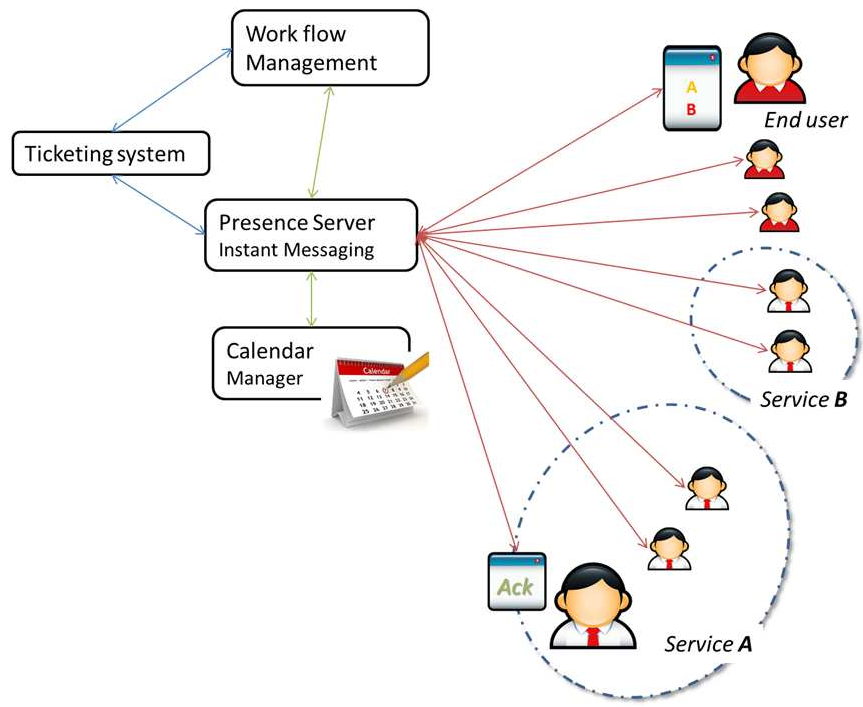
The architecture relies on three pillars:
- XMPP Server: Acts as the "nervous system," tracking the presence and availability of all human operators and automated systems.
- Workforce Management Unit: Routes requests based on competencies, shifts, and real-time expertise.
- Social Network Paradigm: Users manage their own profiles and skills, reducing the administrative burden (TCO) on ICT departments.
2. The Efficiency Equation
The authors provide a mathematical model to quantify the leap in performance. While traditional calls () are subject to a probability () of requiring multiple attempts (), the FCS time () is a direct linear function of request volume and a significantly lower acknowledgment time.
The improvement () is modeled as:
Experimental Results: The 90% Leap
The team conducted a pilot at a care center, comparing Private Branch Exchange (PBX) call data against the FCS implementation:
- Traditional Call Acknowledgment (): 43 seconds (often requiring ~2.2 additional contacts).
- FCS Acknowledgment (): 12 seconds.
- Measured Efficiency Gain: 89.88%.
Beyond raw speed, the FCS provides a "historical repository" of all activities, allowing management to perform capacity planning and audit trails—features largely absent in traditional voice communications.
Deep Insight: Beyond the Hospital Walls
The paper extends the FCS concept to Ambient Assisted Living (AAL). By integrating GPS data and IoT sensors (accelerometers, infrared), the same architecture can monitor elderly patients at home. If a sensor detects a fall, the FCS doesn't just sound an alarm; it automatically identifies and routes the emergency to the nearest available social worker or ambulance based on real-time presence data.
Critical Analysis & Conclusion
Takeaway
The FCS demonstrates that the future of ICT in healthcare isn't just about faster connections, but smarter routing. By treating medical staff as "functional nodes" in a searchable network, the system minimizes the "noise" of modern hospital communication.
Limitations & Future Work
While the paper proves the efficiency of the protocol, it touches only briefly on Privacy and Data Security. In a post-GDPR world, the social-network paradigm's self-managed profiles must be balanced against strict HIPAA/GDPR constraints. Future iterations of this work could explore how Differential Privacy or Blockchain might secure the activity logs while maintaining the system's inherent agility.
Keywords: ICT, Healthcare Services, Functional Collaboration (FCS), XMPP, Efficiency Modeling.