
Collaborative Articulation: Making the "Tacit" Visible in Healthcare Interaction Design
Collaborative articulation in health care settings : Towards increased visibility, negotiation and mutual understanding
The paper introduces the concept of "Collaborative Articulation" in healthcare, specifically for hand surgery rehabilitation. It presents a framework and technological interventions (video recordings, annotated X-rays, and physical docking stations) to transform medical consultations from one-way information delivery into a shared, negotiated dialogue that promotes patient empowerment and SOTA-level mutual understanding.
TL;DR
This research moves beyond the "conduit" model of medical communication—where doctors simply hand out leaflets—to a model of Collaborative Articulation. By using video recordings of physical therapy, annotated X-rays, and tangible docking stations for mobile devices, the authors demonstrate how interaction design can turn a recovery process into a shared, visible, and negotiated journey between the clinician, the patient, and their social network.
Context: The Problem with the "Educated Patient"
In modern healthcare, there is a push for "patient empowerment." However, this often translates to dumping generalized biomedical information on patients through pamphlets or websites.
The authors argue that this fails because:
- Medicine is Situated: Every hand injury is unique; a professional athlete's recovery is different from a manual laborer's.
- The Conduit Fallacy: Information isn't just "transmitted"; it is "reconstructed."
- Invisibility of Practice: The most valuable information—how a therapist moves a patient's finger or the specific metaphors used to explain a tendon's "piston-like" movement—is often lost the moment the patient leaves the room.
Methodology: The Core of Collaborative Articulation
The authors conducted two steps to bring "visibility" back into the clinic.
Step 1: Capturing "Hand Talk"
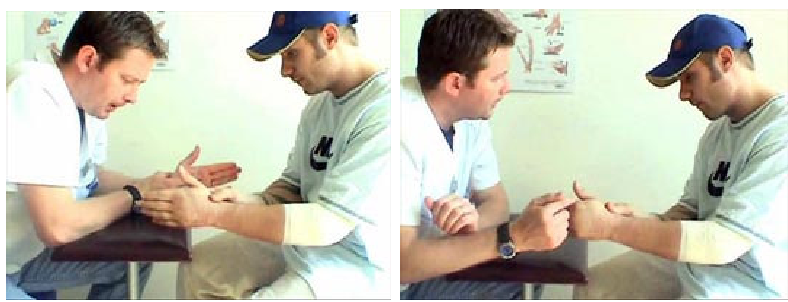
Medical staff use their own hands as "stand-ins" for the patient's injury. They draw on X-rays. They use towels to explain tactile sensitivity. The researchers used off-the-shelf DV cameras and screen-capturing software to record these specific, situated moments.
Step 2: Explicit Interaction & Tangibility
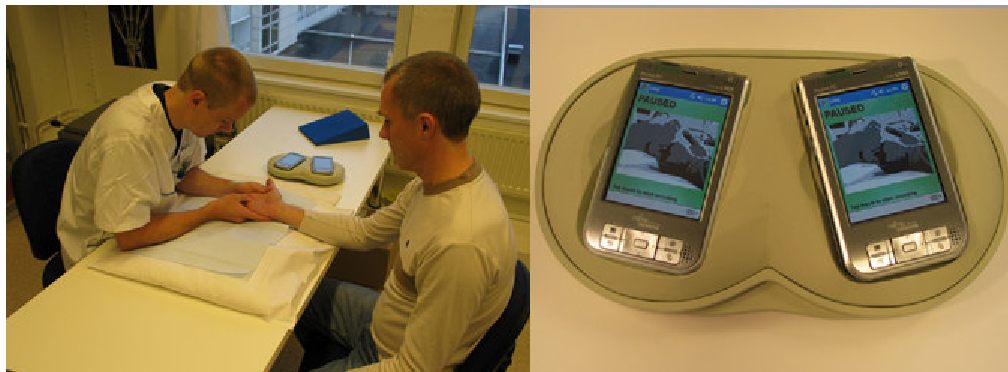
To solve the "social demassification" of digital media (the fact that digital files are invisible and feel "owned" by the system rather than the patient), the authors designed a Physical Docking Station.
- The Actor: A PDA (personal device) serving as a proxy for the patient.
- The Action: Placing the PDA into a physical slot triggers a video link with the clinic's camera.
- The Goal: Make the act of recording a "ritual" that requires mutual consent, making the tech visible to everyone in the room.
Insights: Why This Works
The researchers found that these digital artifacts functioned as Boundary Objects. A video of a physiotherapist explaining a "limit on carrying a liter of milk" is far more powerful than a generic instruction.
- Symmetry: The patient feels like a partner in the "articulation" of the injury.
- Extension: The patient takes this "situated knowledge" home to show family members, who often struggle to understand the slow pace of hand recovery.
- Alignment: It aligns the patient's "lived body" (their pain/work life) with the doctor's "medical body" (tendons/genetics).
Experimental Results
While this was an ethnographically-inspired design study rather than a large-scale clinical trial, the qualitative impact was significant:
- Adoption: The clinic immediately adopted DVD burners to continue providing these recordings.
- Patient Behavior: Patients used the recordings as a "mirror" to compare their current movement with their status weeks prior, providing a measurable sense of progress that is otherwise imperceptible.
- Social Coordination: The digital material became a tool for "re-aligning" the patient's workplace and family expectations.
Critical Analysis & Conclusion
The Takeaway
The value of technology in healthcare isn't just in "data storage," but in its ability to facilitate Explicit Interaction. When technology is tangible and its actions are "publicly available," it builds trust and mutual understanding.
Limitations
The authors rightly point out a potential "Panopticon" effect: constant recording might make staff feel the need to perform a "correct" professional persona, potentially stifling the casual, empathetic "free talk" that is vital for patient rapport.
Future Outlook
This work pre-dates the smartphone era but accurately predicted the need for "activity-based services" where our personal devices act as keys to physical spaces. The next frontier is moving from the clinic to the home, allowing patients to record their "life-world" challenges and bring them back to the doctor—closing the loop of collaborative articulation.