
Inside GECKOS: How Collaborative Crowdsourcing Can Fix Broken Bureaucracies
Leveraging Collaborative Crowdsourcing to Empower Workers to Improve Their Organizations
The paper introduces GECKOS (Generating Employee Crowdsourced Knowledge for Organizational Solutions), a collaborative crowdsourcing system designed to increase organizational efficiency. It transitions laboratory work-flow theories into a practical platform that empowers workers to identify, prioritize, and resolve internal inefficiencies.
TL;DR
Large organizations often rot from within due to invisible inefficiencies that management cannot see. GECKOS is a new collaborative crowdsourcing platform that empowers employees—the ones who actually see the problems—to anonymously identify, debate, and solve organizational hurdles. By moving beyond simple surveys and into structured collaboration, it turns "the crowd" into an internal engine for continuous improvement.
Background: Beyond the Suggestion Box
Traditional organizations spend billions on external consultants to fix internal friction. But consultants are outsiders. The real experts are the workers, yet they often stay silent due to fear of retribution or the belief that "nothing ever changes."
The researchers identified a critical gap: existing crowdsourcing is mostly independent (people working solo). To solve complex organizational problems, we need collaborative crowdsourcing—where workers build on each other's ideas without the system breaking when someone logs off.
Methodology: Designing for Resilience
The core of GECKOS lies in its transition from "Clinical Lab Workflows" to "Real-World Resilience."
Initially, the team tried rigid workflows like MicroTalk (structured argumentation) to ensure high-quality output. However, real workers don't have the time for 10-step experimental processes. The final GECKOS architecture pivoted to a more open, "self-selection" model.
Key Features:
- The "Bag of Lemons" Strategy: Instead of asking workers to find the "best" idea (which is cognitively hard), they use a workflow that identifies the "worst" ideas first to quickly clean the slate.
- Anonymity vs. Recognition: While GECKOS ensures workers can speak truth to power without fear, it explores the tension where some employees actually want credit for great ideas.
- Dynamic Visibility: Seeing what others have posted increases engagement, though the authors warn this requires careful design to avoid anchoring bias.
 Figure 1: The GECKOS concept focuses on a cycle of issue reporting, prioritization, idea generation, and solution synthesis.
Experiments & Results: Real Issues, Real Solutions
The team deployed GECKOS in a mid-sized organization (<1000 employees). They found that small-to-mid-sized orgs are the "sweet spot" for this research, as massive Fortune 100 companies often have legal bureaucracies that block the very tools meant to fix them.
Key Findings:
- Engagement > Perfection: Rigid structures meant to maximize "quality" actually killed participation. Flexible, open interfaces led to more sustained usage.
- Wisdom of the Worker: Using a "panel of judges," the researchers proved that the issues the crowd prioritized were statistically significant and reflected the grounded reality of the organization better than managerial intuition alone.
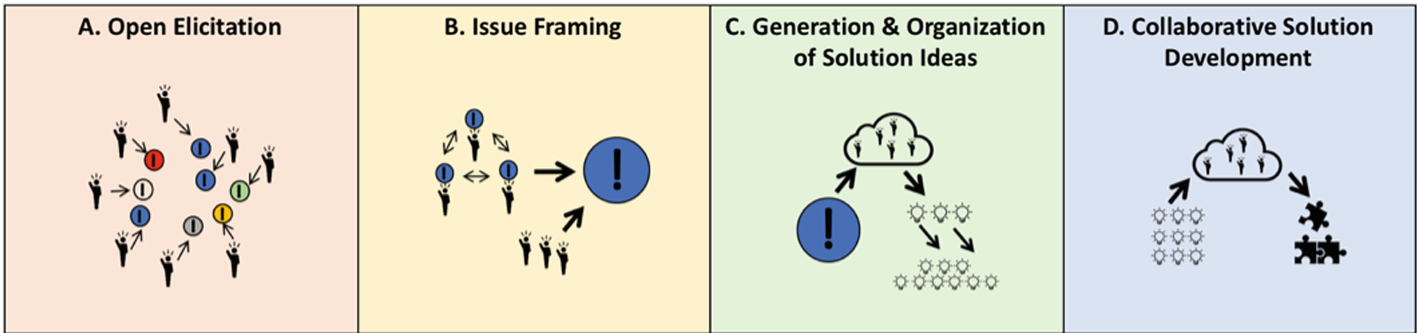 Figure 2: The GECKOS prototype interface, designed to allow workers to jump in and out of the collaboration at will.
Critical Insight: The "Fishbowl" Effect
The authors conclude with a poignant analogy: "Just like placing a fishbowl fish in a bathtub does not mean the fish is going to swim through the whole bathtub."
Workers are so used to being ignored (the fishbowl) that even when given a powerful tool like GECKOS (the bathtub), they are often hesitant to use it. The success of these tools depends less on the code and more on:
- Management Trust: Leaders must be willing to give up some control.
- Psychological Safety: Anonymity isn't just a feature; it's the foundation.
- Synthesis Gap: While the crowd is great at identifying problems and brainstorming, "synthesizing" those into one final executive plan still requires a "human-in-the-loop" (like a small delegate team).
Conclusion
GECKOS represents a shift toward Collective Intelligence as a management philosophy. It suggests that the future of the "Adaptive Organization" isn't found in a consultant's PowerPoint, but in the latent knowledge of the frontline workforce—if only we provide them a safe, collaborative space to share it.