
Collaborative Discovering Influences of News in Social Network Sites: A Quantitative Framework
Collaborative Discovering Influences of News in Social Network Sites
This paper introduces a formal framework for measuring the social influence of news media on Online Social Network (OSN) sites. It proposes three levels of measurement—Absolute, Relative, and Combined ()—to quantify how single news articles and entire media outlets induce and shape virtual community discussions.
TL;DR
How much of a Twitter or Reddit thread is actually caused by a news article, and how much is just people talking about a popular topic anyway? This paper proposes a tripartite measurement system (Absolute, Relative, and Combined Influence) to isolate the specific impact of news media on Online Social Networks (OSNs), moving beyond simple citation counting to understand the "Inductive Power" of external information.
Background & Motivation: The "External Influence" Gap
Most social network analysis treats the network as a closed system where information hops from User A to User B. However, the reality is that external catalysts—primarily professional news media—inject energy into these networks.
The authors identify a major gap: Prior work misses the "Implicit Linkage." When users discuss an issue mentioned in the news without explicitly hyperlinking the article, traditional metrics fail. This paper recognizes that messages can be related to news in two ways:
- Induction: The message exists because of the article (quoting, linking).
- Harmony: The message discusses the same topic but would likely have existed regardless of that specific news piece.
Methodology: The Three Levels of Influence
The core innovation lies in the mathematical separation of influence types.
1. Absolute Influence ()
This is a raw count of induced messages. While intuitive, it’s flawed—an article shared in a massive community might get 100 replies, while a higher-quality article in a niche community gets 10. would wrongly favor the former.
2. Relative Influence ()
This normalizes impact by comparing induced messages vs. the total volume of messages on that topic ("Harmony"). This measures the share of voice a specific article commands within the relevant topical discussion.
3. Combined Measurement ()
This is the "Goldilocks" metric. It uses to weight the importance of . It prevents a single article with one tweet (100% relative influence) from appearing more influential than a major reporting series with thousands of interactions.
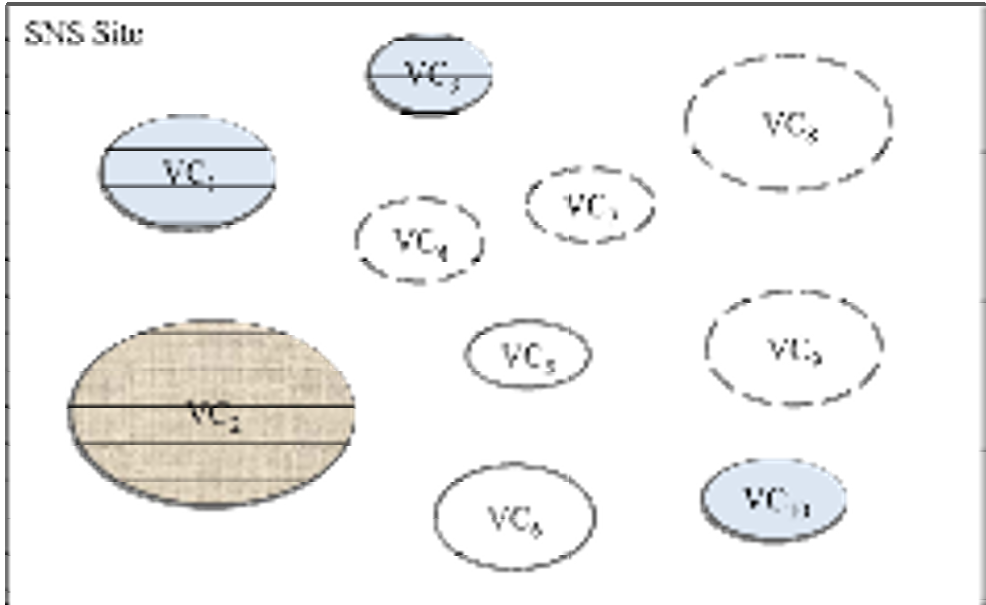 Figure 1: Conceptual model of news articles (shaded eclipses) inducing discussions within specific OSN virtual communities.
Experiments: Real-World News Tracking
The authors tracked Ming Pao (a Hong Kong newspaper) and uwants.com (a discussion forum) during the "Old Age Living Allowance" controversy. They analyzed 94 news articles and over 167,000 forum messages.
| Article Group | Pop. Density | (Absolute) | (Relative) | (Combined) |
|---|---|---|---|---|
| A2 (Peak) | 1.42 | 40 | 0.97 | 0.88 |
| A3 (Tail) | 4.5 | 4 | 1.0 | 0.09 |
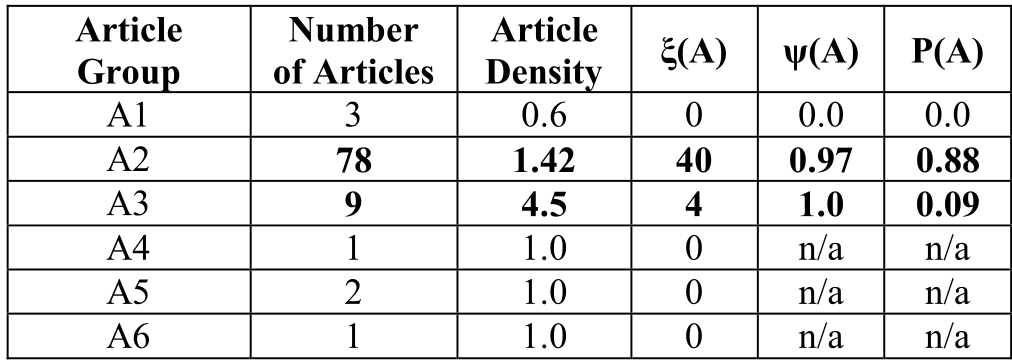
Insight from Results: In group A3, while the relative influence () was 1.0 (meaning every discussion on the topic was linked to the news), the combined score dropped significantly to 0.09. This reveals that the topic was "fading out"—even though the news was the only thing being cited, almost no one was talking about the issue anymore. Simple metrics would have missed this nuances of "fading influence."
Critical Analysis & Conclusion
Takeaway
The paper shifts the focus from "who is connected" to "what drives the conversation." By grouping articles into clusters based on publishing time and density, the authors provide a way to trace the "Life-cycle" of social influence.
Limitations
- Third-party hosting: The study assumes articles are shared from the original source. If a user shares a news summary from a blog instead of the newspaper, the "influence" isn't captured.
- Manual Selection: The current experiment relied on manual selection of articles related to a topic, which is not scalable for real-time applications.
Future Outlook
This framework lays the groundwork for automated systems that can tell newsrooms exactly which types of headlines "induce" the most meaningful debate versus those that simply get lost in the "harmonic" background noise of social media.