
Collaborative Face Recognition: Why Your Friends' Models are Better than Big Tech's Centralized AI
Collaborative Face Recognition for Improved Face Annotation in Personal Photo Collections Shared on Online Social Networks
This paper introduces a "Collaborative Face Recognition" (FR) framework specifically designed for auto-tagging photos in Online Social Networks (OSNs). By selecting a small set of expert FR engines from a user's social circle and merging their results using Bayesian or Majority Voting techniques, the system achieves SOTA performance in unconstrained social photo environments.
TL;DR
In the world of Online Social Networks (OSNs), recognizing faces is notoriously difficult due to "in-the-wild" photo quality. This paper shifts the paradigm from a single massive Centralized FR engine to a Collaborative FR framework. By intelligently selecting and fusing results from the personalized FR engines of a user's social contacts, the system achieves a massive 30%+ boost in accuracy while remaining efficient enough for decentralized deployment.
Contextual Motivation: The Failure of Centralization
Current automatic face annotation (name tagging) relies heavily on centralized systems. However, these systems face two major hurdles:
- High Variance: Personal photos suffer from extreme illumination changes, low resolution, and occlusions.
- Training Gap: Centralized models often lack sufficient high-quality samples of your specific friends and family.
The authors' core Insight is that OSNs are inherently personalized. Your profile likely has a "mini-expert" model trained specifically on you and your inner circle. If we could "collaborate" with these local experts, the accuracy should theoretically skyrocket.
Methodology: The Power of Social Context
The framework operates in two distinct phases: Engine Selection and Result Merging.
1. Social Graph Model (SGM) for Selection
Instead of querying every available engine in a network (which would be slow and noisy), the system builds a weighted Social Graph. The strength of a relationship () is derived from:
- Occurrence Probability: How often a specific contact appears in your photos.
- Co-occurrence Probability: How often you and that contact appear together in the same photo across the OSN.
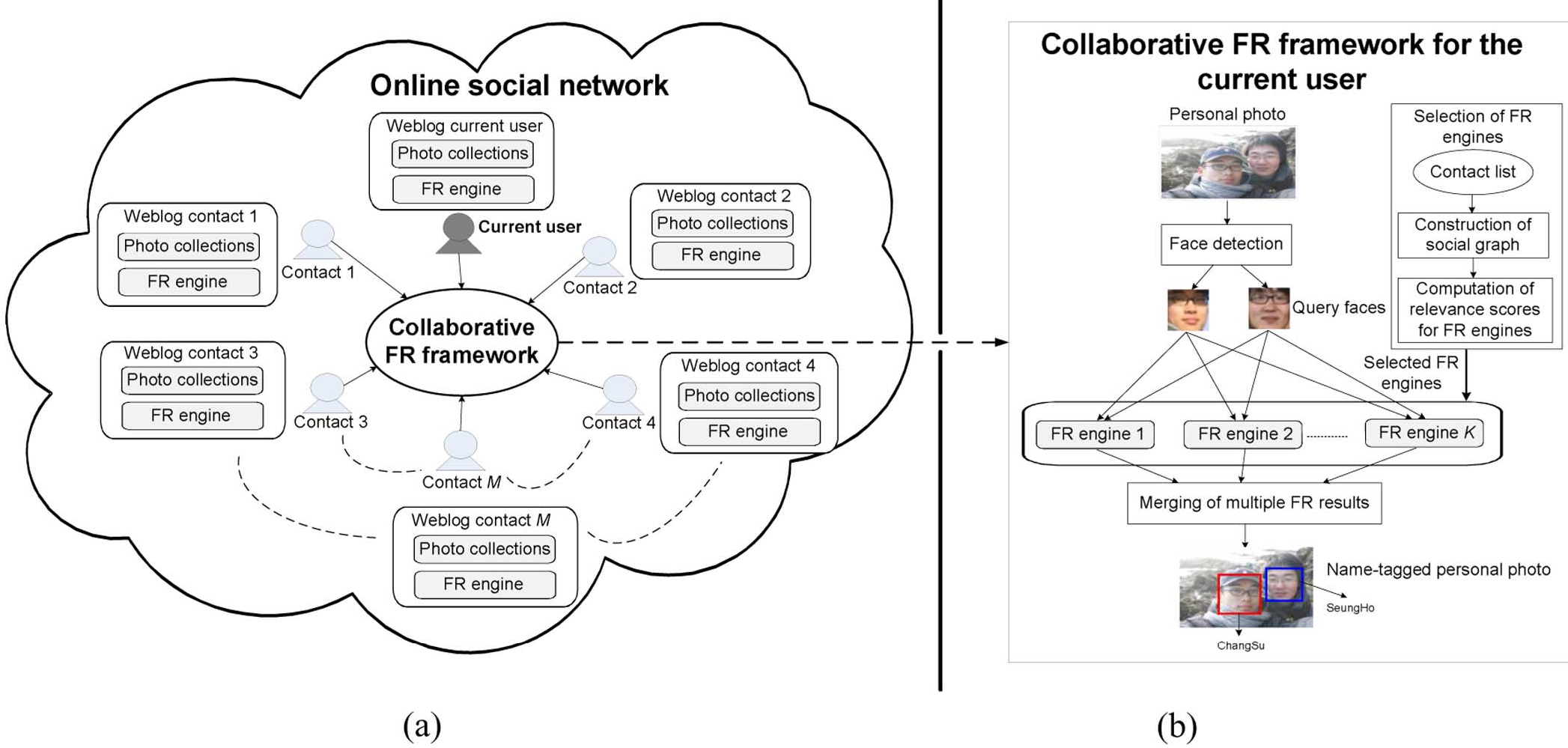 The workflow: from social graph construction to selecting "expert" engines.
2. Merging Results: BDRF vs. CMVF
Once the top expert engines are selected, the system must reconcile their differing opinions.
- BDRF (Bayesian Decision Rule Fusion): Operates at the measurement level. It converts distances to a-posteriori probabilities using a sigmoid function and applies the Sum Rule.
- CMVF (Confidence-based Majority Voting): Operates at the decision level. It counts "votes" but weights each vote by the engine's confidence and social relevance score.
Experimental Proof: A Massive Leap in Accuracy
The researchers tested this on a staggering dataset of 547,991 photos from Cyworld. They utilized heterogeneous engines (PCA, LDA, MFA, etc.) to simulate a real-world decentralized environment.
Key Findings:
- SOTA Breakthrough: Collaborative FR outperformed centralized methods consistently. For supervised algorithms like MFA and ERE, the gain was most pronounced.
- Efficiency: Despite using multiple engines, the selection process makes the runtime complexity (linear), meaning it scales gracefully.
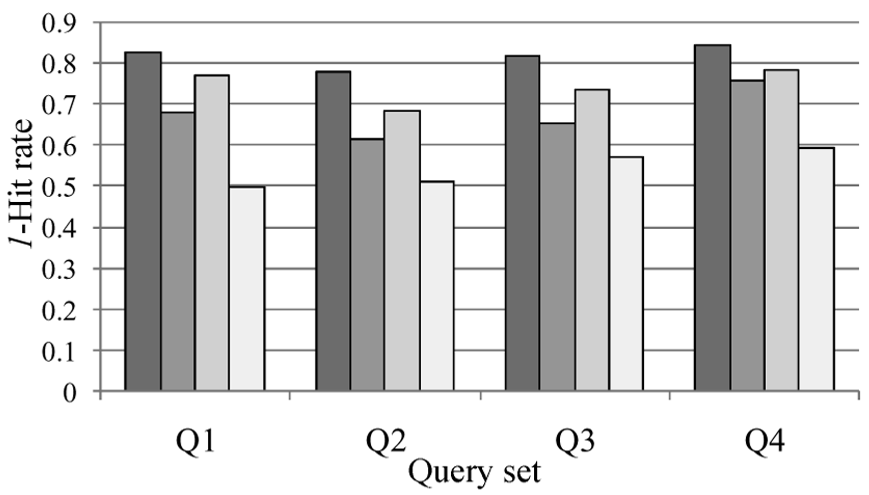 The impact is clear: selecting the right engines (with selection) significantly outperforms naive fusion or independent recognition.
Critical Insight: The Shift to Decentralized AI
The most profound takeaway is that Social Context is not just a metadata filter—it is a routing protocol for intelligence. This paper proves that in a decentralized OSN, where privacy might prevent a central server from seeing all photos, a collaborative approach is not just "as good as" but actually superior to centralized AI.
Limitations & Future Work
- Manual Tagging Dependency: The SGM currently requires some manually tagged photos to initiate. Future versions could use unsupervised clustering to build the graph.
- Privacy: While the paper suggests this is good for decentralized networks, the actual protocol for sharing model results without leaking face data remains an open area for security research.
Final Takeaway
By treating an OSN as a network of localized experts rather than a single database, we can solve one of the hardest problems in computer vision: recognizing faces in high-entropy, personal environments.