
UISA: Fusing Social Trust and Semantic Metadata to Break the Sparsity Barrier in Recommendation Systems
A collaborative filtering algorithm fusing user-based, item-based and social networks
The paper proposes UISA, a collaborative filtering (CF) algorithm that integrates user-based, item-based, and social network data (SNS). By fusing interpersonal trust relationships and item text similarities from social platforms, the model achieves SOTA-level precision and effectively addresses the cold-start problem.
TL;DR
The UISA (User-Item-Social-Algorithm) framework tackles the chronic "Data Sparsity" and "Cold Start" problems in collaborative filtering by injecting Social Network Service (SNS) data into the recommendation loop. By fusing trust relationships and item text similarities with traditional rating-based methods, it boosts recommendation accuracy (MAP@3) by over 61% compared to traditional baselines.
Problem & Motivation: The "Island" Assumption
Traditional Collaborative Filtering (CF) operates on a fundamental but flawed assumption: users are independent and identically distributed. In reality, our choices are heavily influenced by our social circles.
Current systems face three walls:
- Data Sparsity: With millions of items and users, the rating matrix is usually >99% empty, making similarity calculations statistically insignificant.
- Cold Start: New users with zero ratings are "invisible" to traditional CF.
- Missing Links: Real-life friends might not share rated items, leading to a zero-similarity score despite having similar tastes.
The authors' insight is to use SNS as a "glue" to connect these islands, using Trust to fill user-gaps and Textual Keywords to fill item-gaps.
Methodology: Multi-Dimensional Similarity Fusion
The UISA algorithm doesn't just add features; it redefines the neighbor selection process through a "Denoising" intersection strategy.
1. Social Trust & Item Semantics
- User Similarity (SNS): Instead of just looking at ratings, UISA uses a Gaussian Kernel (Eq. 7) to map the topological distance between users in a social graph to a trust value .
- Item Similarity (Text): It uses the Jaccard Coefficient (Eq. 9) to compare item keyword sets (descriptions typically provided by experts), ensuring that items are linked by content even if no user has rated both.
2. The Fusion Logic (The Denoising Mechanism)
The core of UISA lies in creating "Denoised" sets. For example, is the intersection of neighbors identified by ratings () and neighbors identified by social trust ().
Note: The algorithm calculates four distinct similarity matrices () and merges them using a hierarchical weighting system controlled by parameters .
The final prediction formula (Eq. 15) is a weighted ensemble that balances "High-Confidence" neighbors (the intersection) with "Supplementary" neighbors (the outliers) to ensure the system remains robust even when data is extremely scarce.
Experiments & Results: Real-World Performance
The authors tested UISA on the KDD CUP 2012 Tencent Microblog dataset, a massive real-world snapshot with a staggering sparsity of 99.36%.
Key Findings
- Superior Accuracy: The full fusion model (Eq. 15) reached a MAP@3 of 0.4239, crushing the standard User-CF baseline (0.2631).
- The Power of λ and α: The research found that a of 0.4 was optimal, suggesting a slight preference for item-based consistency over user-based consistency in this specific dataset.
- Cold Start Resilience: By using SNS data, the system could generate recommendations for users with zero ratings, a feat impossible for traditional CF.
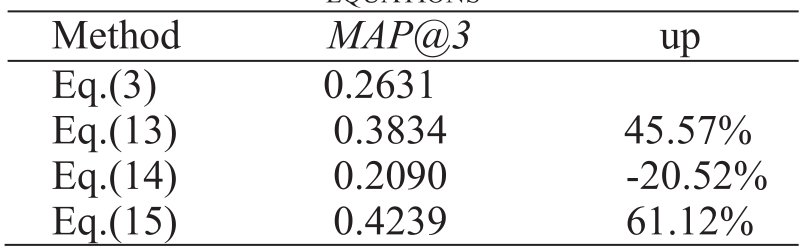 Table: Comparison of UISA variants against the baseline. Equation 15 shows the 61.12% improvement.
Impact of "Top N"
Interestingly, the study shows that increasing the number of neighbors beyond a certain point (usually 8-10) actually decreases accuracy (as shown in Figure 1). This confirms that "noise" from distant neighbors is a real threat to recommendation quality.
Critical Analysis & Conclusion
Takeaway
UISA proves that hybridization is the only way forward for modern recommenders. By treating social data as a "denoising" filter for rating data, we can filter out accidental similarities and focus on meaningful relationships.
Limitations
While UISA is mathematically sound, it relies on the availability of SNS data during login (e.g., via OAuth from WeChat/Facebook). In an era of increasing privacy regulations (GDPR/CCPA), accessing these social graphs may become a bottleneck. Furthermore, the keyword-based Jaccard similarity is basic compared to modern LLM-based embeddings.
Future Work
The logical next step for this architecture would be replacing the manual keyword extraction with Transformer-based embeddings and replacing the Gaussian Kernel with Graph Neural Networks (GNN) to capture multi-hop social influences.