
Collaborative Filtering for Social Voting: Bridging Social Links and Group Affiliations
Collaborative Filtering-Based Recommendation of Online Social Voting
This paper introduces specialized Recommender Systems (RS) for online social voting, utilizing Matix Factorization (MF) and Nearest-Neighbor (NN) models. The authors propose a multichannel "Weibo-MF" model and metapath-based NN methods to integrate user-voting, social networks, and group affiliations, achieving State-of-the-Art performance on Sina Weibo datasets.
TL;DR
Social voting is not just about what you like; it’s about who you follow and which groups you belong to. Researchers have developed a hybrid recommendation framework—combining Multichannel Matrix Factorization (MF) and Metapath-based Nearest-Neighbors (NN)—that leverages Sina Weibo's massive social graph. The result? A massive 254% boost in recommendation accuracy, particularly for "cold users" who rarely participate but are influenced by their social circle.
The "Information Overload" in Social Voting
Unlike movies on Netflix, social voting campaigns (like those on Sina Weibo) propagate through social links. If your friend retweets a vote, you see it. This creates a unique Social Influence bias. Traditional recommenders ignore this "visibility" factor, treating all items as equally discoverable. Furthermore, voting data is binary (you either voted or you didn't), making it a classic One-Class Collaborative Filtering (OCCF) problem where negative signals are missing.
Methodology: Latent Features meet Social Paths
The authors tackled the problem from two distinct angles:
1. Multichannel Matrix Factorization (Weibo-MF)
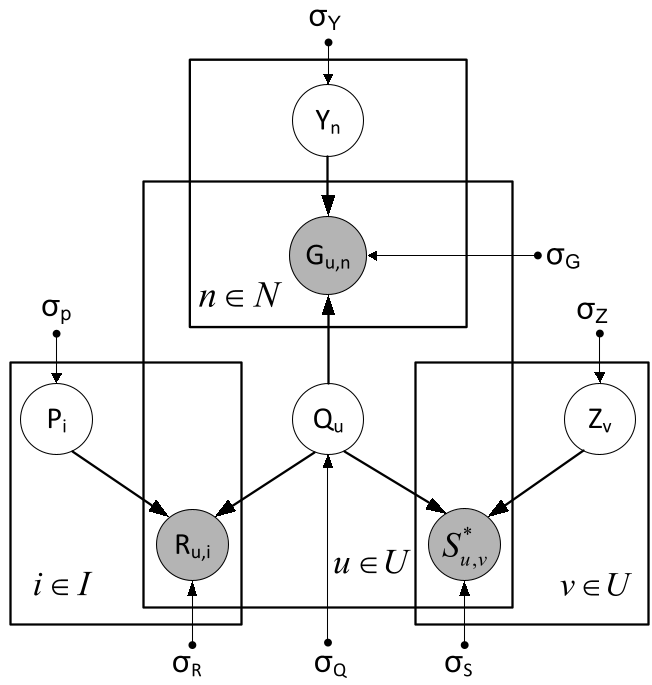
Instead of just looking at the User-Voting matrix, the authors created a unified latent space. By sharing a user latent feature vector across three tasks—predicting votes, predicting social ties, and predicting group memberships—the model "forces" the latent features to encode not just interest, but also social context.
2. Metapath-based NN Approaches
The authors explored the "Heterogeneous Information Network" (HIN) using specific Metapaths:
- U-U-V (Social Path): Recommending what your friends (within 1 or 2 hops) voted for.
- U-G-U-V (Group Path): Recommending items popular within your specific interest groups.
- U-V-U-V (Behavioral Path): Finding "voting twins" who participate in the same campaigns.
Key Insights from Experiments
The study utilized a massive dataset from Sina Weibo (1M users, 83M social links).
The Cold User Rescue
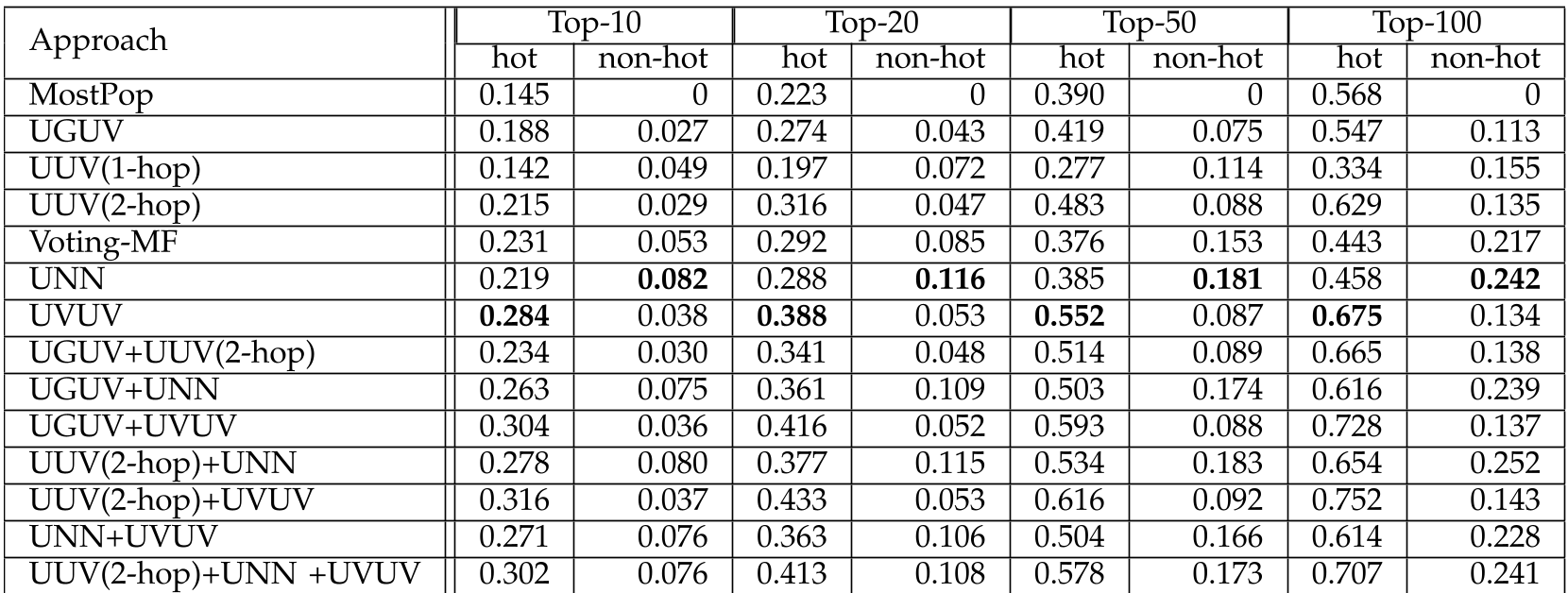
One of the most striking findings was that social and group information is significantly more valuable to cold users than to heavy users. Cold users tend to participate in "Hot Votings" driven by social pressure or global popularity, whereas heavy users have specific, niche interests that require deep Matrix Factorization to uncover.
Hot vs. Non-Hot Votings
- Hot Votings: Simple metapath NNs (like UVUV) outperformed complex MF. Why? Because hot items have enough signal in the social graph to be "picked up" by simple neighbor counting.
- Non-Hot Votings: MF models won. Latent space modeling is essential to find the subtle patterns in niche content where the social graph is sparse.
Critical Analysis & Future Outlook
Contribution: The paper proves that while "Group Affiliation" is useful, Social Network information is the dominant factor in driving voting behavior. The hybrid approach of bagging different models allows for a "best of both worlds" scenario.
Limitations: The model relies on bidirectional social links (mutual followers). In a modern "Follow" culture (like Twitter/X), the influence of unidirectional celebrities vs. real-life friends remains a variable to explore. Future work could also integrate Content-Based Filtering (NLP on the voting topic) to solve the "Cold Start" problem for brand-new voting campaigns that haven't propagated yet.
Takeaway
For developers building social features, the message is clear: Don't just model the user; model the graph. Leveraging 2-hop social connections and group data can turn a dormant user into an active participant.