
Empowering LBSN: Moving Beyond Raw Check-ins with Probabilistic Latent Semantic Analysis
A Study of Recommending Locations on Location-Based Social Network by Collaborative Filtering
The paper presents a comprehensive study on Point-of-Interest (POI) recommendation for Location-Based Social Networks (LBSNs). It introduces a distributed crawler for data acquisition from Gowalla and evaluates multiple Collaborative Filtering (CF) approaches across three data utilization strategies: Binary, FIF (Frequency-Inverse Frequency), and Probability utilization via Probabilistic Latent Semantic Analysis (PLSA).
TL;DR
Recommending your next favorite hangout is harder than it looks. This paper explores how to turn "check-in" counts into meaningful recommendations. By comparing traditional memory-based methods with a probabilistic model (PLSA), the researchers found that treating check-ins as latent statistical probabilities yields much better results than simply looking at how many times you've visited a shop.
Context & Motivation: The Implicit Feedback Trap
In the world of Location-Based Social Networks (LBSNs) like Gowalla or Foursquare, we rarely "rate" a park 5 stars. Instead, we "check-in." This is implicit feedback.
The problem? If User A visits a coffee shop 20 times because it’s next to their office, it doesn’t necessarily mean they love it more than User B, who visited a scenic lookout once during a vacation. Current systems struggle to distinguish between convenience and preference.
Methodology: Three Ways to View a Check-in
The authors break down check-in data into three distinct mathematical interpretations:
- Binary Utilization: Did you visit? (1 or 0). It's simple but loses all nuance regarding frequency.
- FIF (Frequency-Inverse Frequency): A clever adaptation of NLP's TF-IDF.
- UFILF: How significant is your visit to this specific location?
- LFIUF: How important is this location to your overall travel history?
- Probability (PLSA): The "Gold Standard" in this paper. It uses an Aspect Model to assume there’s a "latent reason" (z) why a user (u) visits a location (l).
The PLSA Architecture
The core of the PLSA approach is the Expectation-Maximization (EM) algorithm, which iteratively estimates why users and locations cluster together.
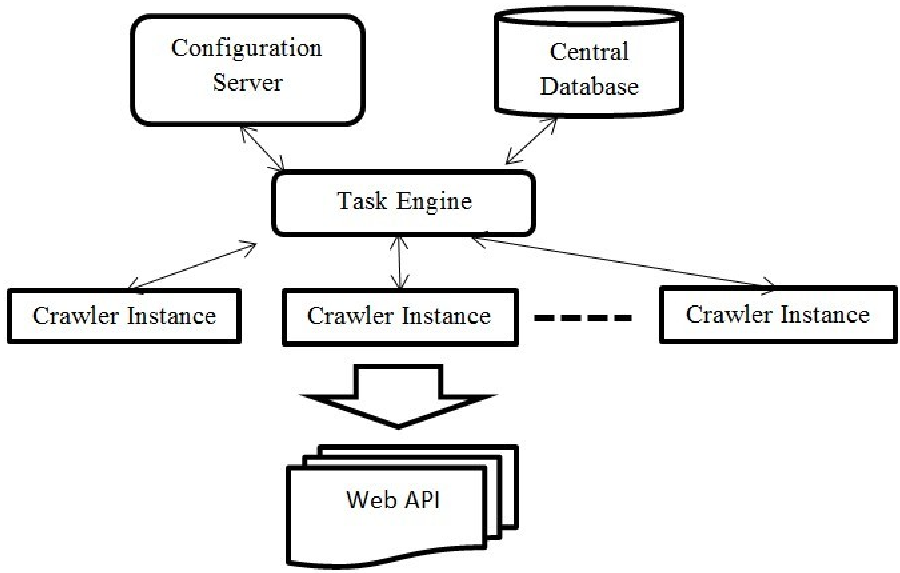 Figure 1: The distributed crawler used to harvest real-world Gowalla data across cities like Austin and San Francisco.
Experiments: Battle of the Recommenders
The researchers tested five combinations across four cities. They compared User-based (U) and Item-based (I) CF using Binary and Pearson (for FIF) metrics against the PLSA model.
Key Findings:
- PLSA is King: On every dataset (Austin, NY, SF, Seattle), PLSA with probability utilization outperformed all memory-based methods.
- The Frequency Paradox: Interestingly, the FIF method (using Pearson correlation) didn't always beat the simple Binary method. This suggests that simply "weighting" frequency isn't enough; you need to model the latent space of behavior.
- User Similarity > Item Similarity: For binary data, looking at similar users (User-based) was generally more effective than looking at similar locations (Item-based).
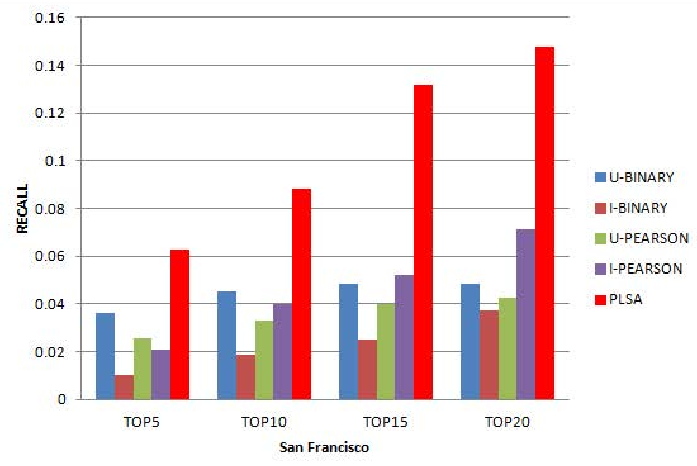 Figure 2: Performance metrics (Precision and Recall) showing PLSA (top line) consistently leading the pack.
Critical Insight: Why Probabilities Win
Why did PLSA win? Memory-based CF is "brittle"—it relies on direct overlaps between users. If two users haven't visited the exact same spot, the system sees zero similarity.
PLSA, however, maps users and locations to Latent Variables. It might realize that User A (who likes coffee) and User B (who likes bookstores) actually share a latent "Indoor-Chilling" preference, allowing the system to recommend a bookstore to the coffee lover even if no previous overlap existed.
Conclusion & Future Directions
The study proves that probabilistic modeling is a robust way to handle the noise of implicit LBSN data. However, the authors note a few limitations:
- Missing Context: The model ignores when you check in (time) and where the locations are physically (geography).
- Social Ties: While the study avoided social data for privacy reasons, incorporating friendship graphs could further sharpen the "latent" variables.
Ultimately, this work moves the needle from "counting visits" to "understanding intentions."