
Explicit Rules vs. Latent Behavior: Scaling Community Recommendations on Orkut
Collaborative filtering for orkut communities: discovery of user latent behavior
This paper evaluates Association Rule Mining (ARM) and Latent Dirichlet Allocation (LDA) for personalized community recommendations in social networks. Using an Orkut dataset (492k users, 118k communities), it finds that while ARM excels at very short recommendation lists, LDA offers superior and more consistent performance for longer lists (top-4 or more).
TL;DR
In the era of massive social networks, suggesting the right "community" to a user is a monumental task. This paper dives into a head-to-head comparison between Association Rule Mining (ARM)—which looks for explicit "if you joined A, you'll like B" rules—and Latent Dirichlet Allocation (LDA), which uncovers hidden behavioral patterns. The verdict? While ARM is precise for the very top recommendation, LDA is far better at understanding the broader spectrum of user interests. To make this work at scale, the authors open-sourced a parallelized version of LDA that cuts training time by over 90%.
Background: The Sparsity Challenge
Social networks like Orkut (at its peak) hosted hundreds of thousands of communities. Most users only join a handful, resulting in an extremely sparse user-community matrix (0.01286% density in this study).
- ARM relies on explicit overlap. If no one has joined both "Community X" and "Community Y" yet, ARM cannot link them.
- LDA views joins as a generative process driven by latent topics. It can recommend "New York Yankees" to a "Mets" fan because it realizes both belong to the latent topic of "Baseball," even if direct co-occurrence is low.
Methodology: Bringing Topic Models to CF
The authors treat each user as a "document" and each community they join as a "word."
- Latent Modeling: Using Gibbs sampling, the model learns two distributions: User-to-Topic () and Topic-to-Community ().
- Scoring: Recommendations are ranked by the probability .
- Parallelization: Since Gibbs sampling is iterative and normally slow, the authors split the users across multiple machines (). They use MPI AllReduce to synchronize the global topic-community counts across the cluster at each iteration.
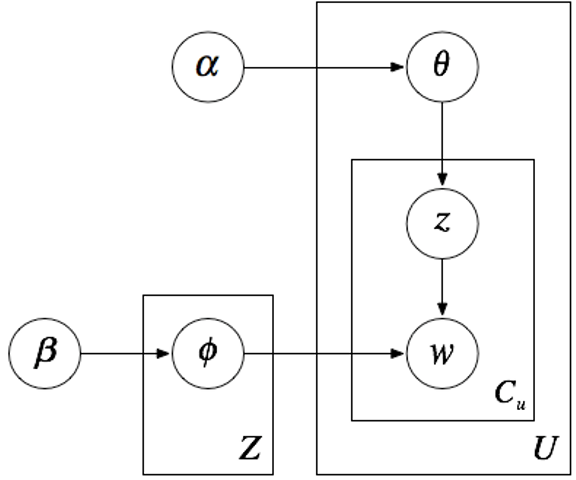 Figure 1: The LDA generative model adapted for user-community interaction.
Experiments: When does LDA beat ARM?
The study discovered a fascinating "crossover" point in recommendation quality:
- The Top-3 Sweet Spot: ARM is slightly better for the #1 recommendation. This is because high-confidence rules (e.g., "People in 'Java Programming' always join 'Software Engineering'") are almost always correct.
- The Long Tail: For lists of 4 or more, LDA wins. ARM runs out of "explicit rules" and falls off a cliff, whereas LDA’s latent understanding allows it to keep suggesting relevant, semantically linked communities.
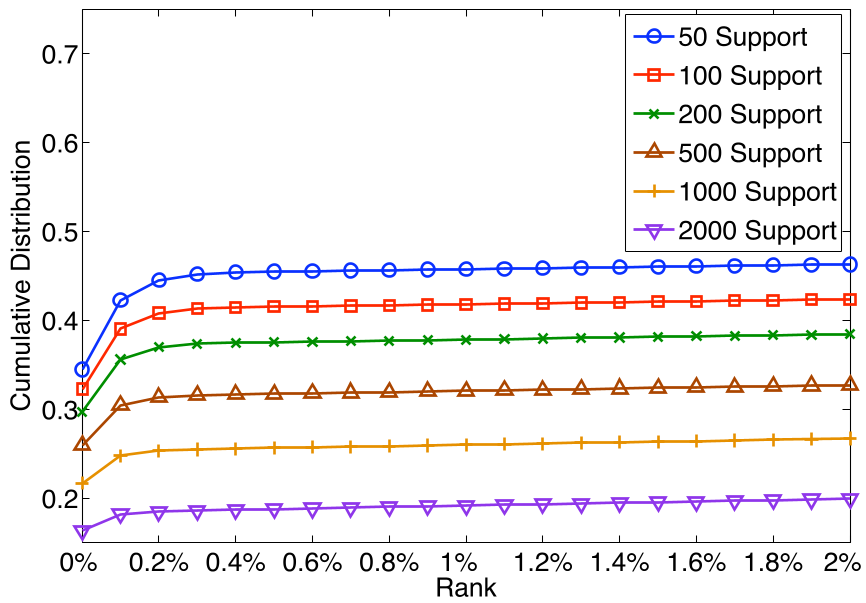 Figure 2: Performance metrics showing LDA's consistency versus ARM's decay in longer lists.
Scalability Results
The authors' parallel implementation (PLDA) showed that communication overhead is the primary bottleneck. As shown in the speedup analysis, moving from 1 to 8 machines provides almost linear gains, but by 32 machines, the time spent "talking" (communication) nearly equals the time spent "thinking" (computation).
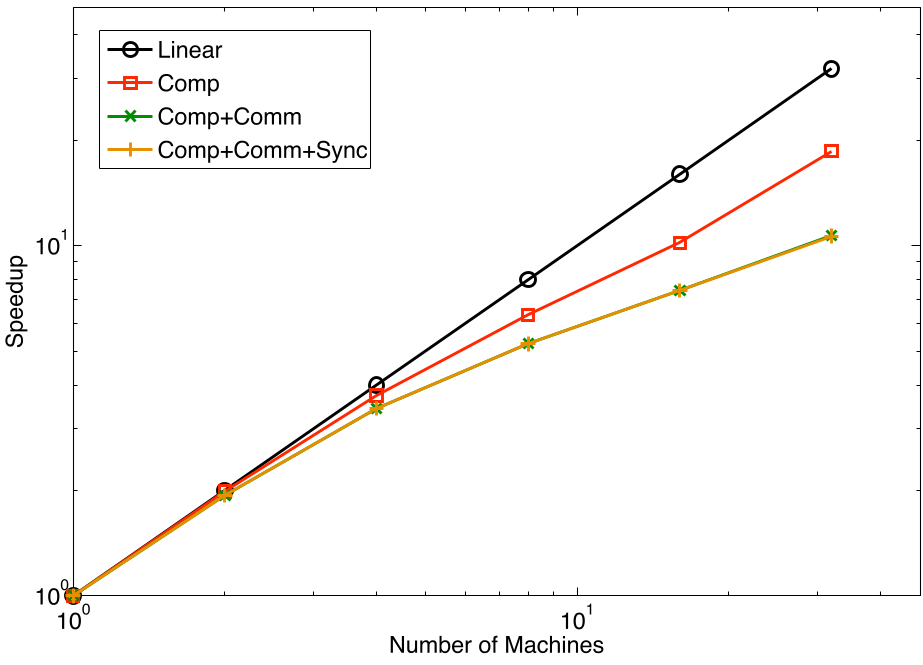 Figure 3: Speedup curves highlighting the diminishing returns as communication overhead increases.
Critical Insight: Entropy of Interest
The paper provides a deep dive into why LDA works. It found that:
- LDA is superior for "Concentrated Interests": Users like Doe#1 (Tech enthusiasts) have low-entropy topic distributions. LDA easily identifies their niche.
- ARM is better for "Scattered Interests": Users like Doe#3, who join large, diverse communities (Automotive + Romance + Sports), are better served by ARM because large communities have enough data to support explicit rules even across diverse categories.
Conclusion
This work highlights that for large-scale recommendation, "Latent Behavior" discovery is essential for coverage, but "Explicit Rules" are still king for precision. Modern hybrid systems often combine these two. The release of the parallel LDA framework remains a significant contribution to the distributed machine learning community.
Takeaway: If you need to recommend niche items, use a latent model. If you only have space for one recommendation and the user joins "mainstream" groups, stick to the rules.