
SocialCollab: Beyond Passive Items — Modeling Bilateral Attraction in Social Recommendations
Collaborative filtering for people to people recommendation in social networks
This paper introduces SocialCollab, a bilateral collaborative filtering (CF) framework specifically designed for people-to-people recommendation in social networks. Unlike traditional CF that treats items as passive, SocialCollab models users as active agents with both personal "taste" and social "attractiveness" to ensure mutual interest.
TL;DR
Recommending a book is easy because the book can't reject you. Recommending a person is hard because they might. SocialCollab is a neighbor-based collaborative filtering (CF) algorithm that tackles the "People-to-People" problem by modeling both Taste (who you like) and Attractiveness (who likes you), ensuring that recommendations move beyond simple interest toward mutual compatibility.
Problem & Motivation: The "Passive Item" Fallacy
In the world of Amazon or Netflix, the item is a passive entity. If the system predicts you will like a Ridley Scott movie, the movie doesn't need to "like you back" for the transaction to succeed.
However, in Social Networks—specifically dating or professional networking—users play a dual role. They are both the "User" (initiating contact) and the "Item" (receiving contact). Traditional CF fails here because it only solves one half of the equation. If a system recommends a highly popular user to everyone based solely on taste, that popular user will be overwhelmed, and the success rate of those contacts will plummet because the "attractiveness" of the initiating users was never considered.
Methodology: Taste vs. Attractiveness
The authors suggest that to predict a successful interaction, we must move from a 1D similarity check to a 2D bilateral framework.
1. The Two Dimensions of Similarity
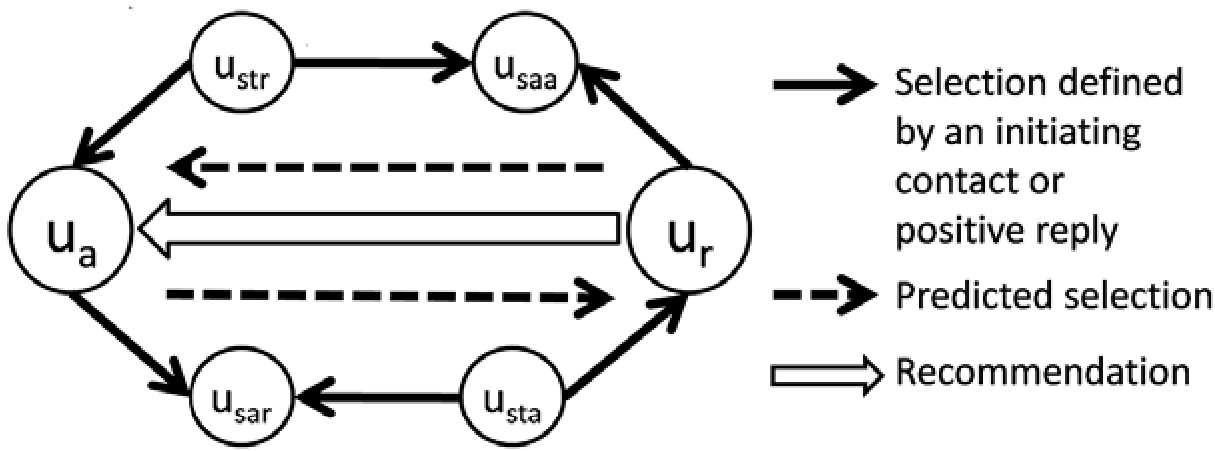
- Taste Similarity (): Two users are similar if they tend to contact the same people.
- Attractiveness Similarity (): Two users are similar if they tend to be contacted by the same group of people.
2. The SocialCollab Logic
For a recommendation to be "successful," two conditions must be met:
- Initiation: The active user () must want to contact the recommended user (). This is predicted if is liked by others who have similar taste to .
- Reciprocation: The recommended user () must respond positively to the active user (). This is predicted if has similar attractiveness to people that has liked in the past.
Experiments & Results
The researchers tested SocialCollab against a dataset from a commercial dating site involving over 180,000 interactions.
Performance Gains
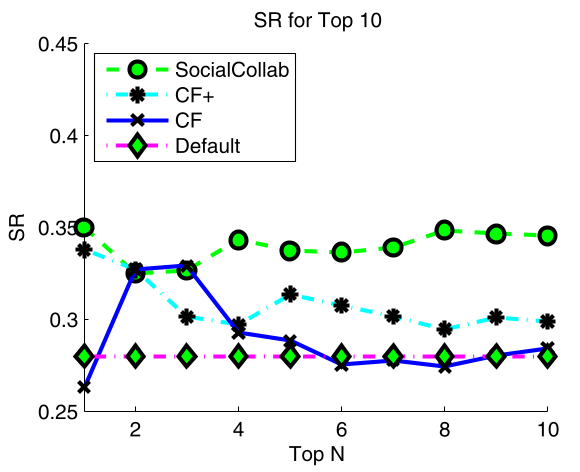
The results demonstrated that standard CF actually performs worse than a random baseline (Default Success Rate) in some scenarios because it recommends popular users who are unlikely to respond. SocialCollab, however, achieved a consistent Success Rate (SR) of 0.35, significantly outperforming both standard CF and a modified version (CF+).
| Algorithm | SR (Top 100) | Success Rate Improvement (SRI) |
|---|---|---|
| SocialCollab | 0.35 | 1.25 |
| Standard CF | 0.25 | 0.89 |
| Default Baseline | 0.28 | 1.00 |
Critical Analysis & Conclusion
Takeaway
SocialCollab successfully transitions CF from a "discovery" tool to a "matching" tool. By formalizing attractiveness as a latent property derived from incoming links, it provides a mathematical foundation for bilateral markets.
Limitations
- Cold Start: The model relies on existing interaction history (who liked whom). New users with no incoming or outgoing contacts will still face the classic cold-start problem.
- Simplicity: The current model treats all "positive responses" equally, without considering the depth of interaction or textual content of messages.
Future Work
The authors hint at developing a more sophisticated ranking framework. In the modern era, this logic would likely be extended using Graph Neural Networks (GNNs), where "Taste" and "Attractiveness" are represented as multi-dimensional embeddings in a bipartite social graph.