
EMTR-CF: Fortifying Recommendations with the Power of Social Trust and Human Emotion
Collaborative filtering recommendation based on trust and emotion
The paper proposes EMTR-CF, a collaborative filtering recommendation method that integrates Trust and Emotion to enhance accuracy. It utilizes explicit/implicit satisfaction to handle data sparsity and combines objective/subjective trust with emotional consistency to filter out malicious users and improve performance for cold start users.
TL;DR
Recommendation systems are under constant threat from data sparsity and malicious "shilling attacks." This paper introduces EMTR-CF, a novel Collaborative Filtering framework that doesn't just look at what you rate, but who you trust and how you feel. By combining a dual-layer trust model with sentiment analysis of user reviews, EMTR-CF achieves superior accuracy and robust security, even in cold start scenarios.
Problem & Motivation: The Fragility of Similarity
Most recommendation engines rely on the "Similarity" of users. However, in the real world, similarity is a weak proxy for reliability.
- Sparsity: Most users only rate a tiny fraction of items, making the similarity matrix look like a Swiss cheese.
- Shilling Attacks: Attackers can easily forge "similarity" by rating popular items, then "inject" fake preferences to promote specific products.
- The Emotional Gap: Ratings (1-5 stars) are low-resolution data. They fail to capture the nuance of why a user liked or disliked an item—information hidden deep within their text reviews.
Methodology: The Three Pillars of EMTR-CF
1. Fixing the Sparsity: Implicit Satisfaction
Instead of relying solely on explicit ratings, the authors propose an Implicit Satisfaction degree. If a user hasn't rated Item A, the system calculates a score based on the similarity of Item A to other items the user has rated. This "densifies" the matrix before the core logic even begins.
2. Enhanced Trust: Objective Meets Subjective
The model splits trust into two distinct dimensions:
- Objective Trust: Micro-level rating similarity (Pearson) combined with macro-level preference similarity (Jaccard).
- Subjective Trust: Derived from social interactions. Inspired by the "six degrees of separation," it measures how "familiar" users are based on successful interactions and the time intervals between them.
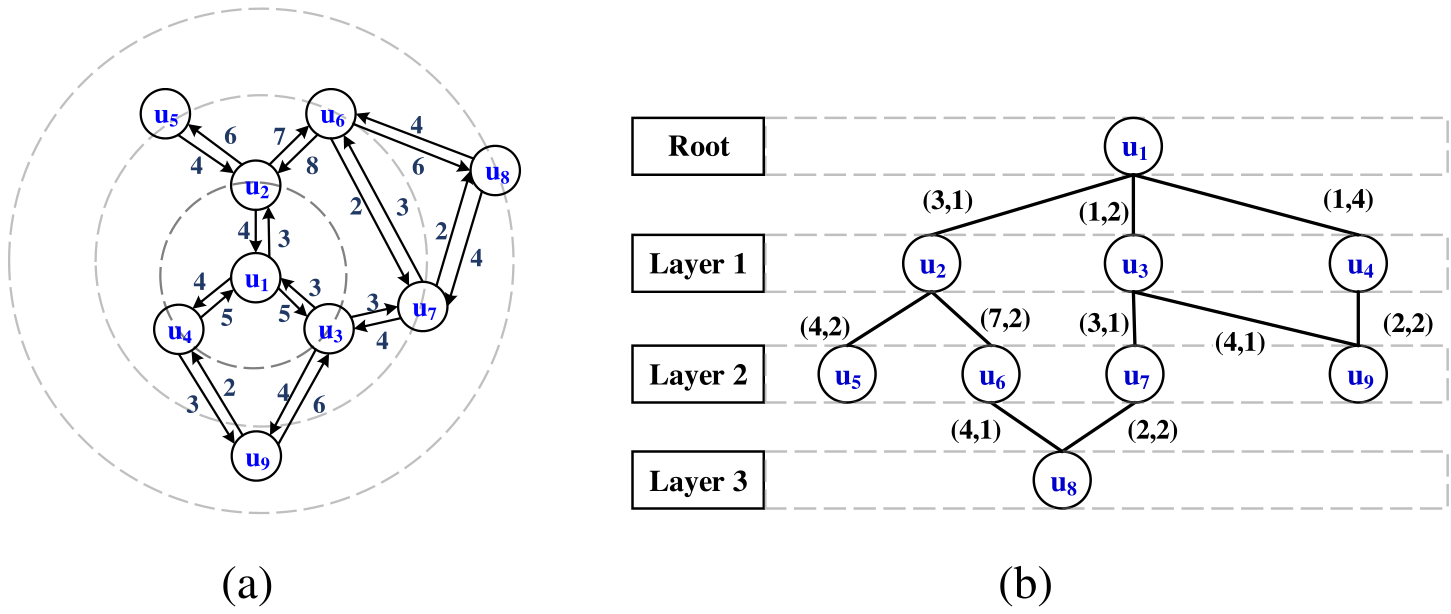 Figure 1: The transition from active interaction graphs to weighted familiarity models.
3. The Security Shield: Emotional Consistency
This is where the paper shines. To filter out "neighbors" who might be attackers, the system performs sentiment analysis on Chinese reviews.
- It calculates an Emotional Value (the intensity of the feeling).
- It assigns Emotional Labels (Happy, Sad, Disgust, etc.). By ensuring the target user and their neighbors share a consistent emotional "vibe," the system effectively isolates bots and malicious actors whose emotional patterns rarely match organic users.
Experimental Battleground
The researchers crawled Douban.com, collecting data from 13,650 users and 6,230 movies.
SOTA Comparison
The results were clear: EMTR-CF maintained the lowest MAE (Mean Absolute Error) across varying numbers of neighbors (k). While traditional methods like User-CF saw their error rates spike under data sparsity, EMTR-CF remained stable.
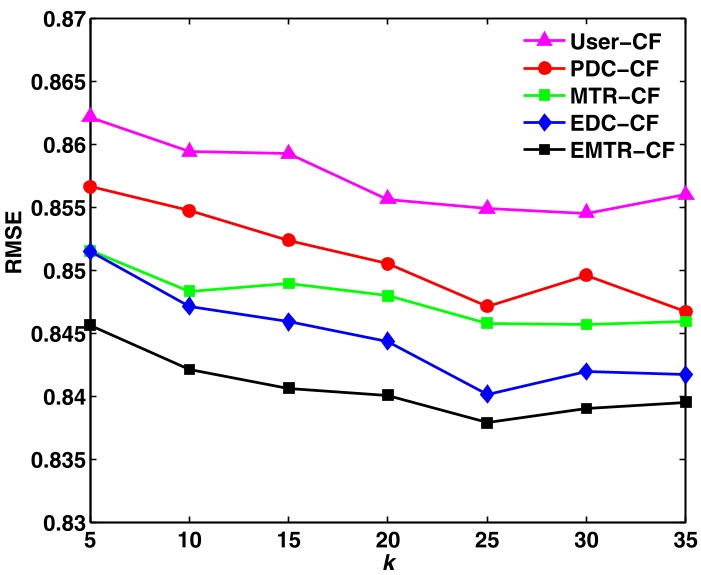 Figure 2: MAE and RMSE results showing EMTR-CF (blue line) consistently outperforming baselines.
Defeating Shilling Attacks
When subjected to "Bandwagon" or "Average" attacks, most systems witnessed a sharp decline in performance. EMTR-CF, thanks to its emotional consistency filter, successfully identified the "shilling" profiles, keeping the recommendation list clean and trustworthy.
Critical Insight & Conclusion
The genius of this work lies in the Subjective Trust refinement. By penalizing long time-intervals between interactions and rewarding "satisfactory" exchanges, the model mimics organic human relationship building.
Limitations: Currently, the emotional mining is optimized for Chinese text. Porting this to a global scale would require handling multi-lingual sentiment nuances and higher computational overhead for real-time processing.
The Takeaway? Future recommendation systems must move beyond "Item A is like Item B." They must understand the social fabric and emotional resonance between users to remain both accurate and secure in an era of information warfare.