
Beyond Ratings: Fusing Social Trust and User Tags for Robust Collaborative Filtering
A collaborative filtering algorithm based on social network information
The paper introduces a hybrid Collaborative Filtering (USTCF) framework that integrates Social Network Services (SNS) trust relationships and user tags. Tested on the KDD Cup 2012 dataset, the fusion of user-based, trust-based, and tag-based similarity achieves a significant improvement in recommendation accuracy, specifically outperforming traditional CF in sparse data scenarios.
TL;DR
This research tackles the chronic "Data Sparsity" and "Cold Start" issues in recommendation systems. By moving beyond simple rating matrices and integrating Social Network (SNS) trust structures and User Tags (keywords), the authors propose the USTCF algorithm. This multi-view approach improves recommendation precision (MAP@3) by over 24% compared to traditional Collaborative Filtering.
Context: The Limits of Traditional CF
Collaborative Filtering (CF) has been the industry workhorse for decades (e.g., Amazon’s item-to-item CF). However, it relies on a fundamental assumption: users are independent and identically distributed. In reality, our choices are heavily influenced by:
- Direct Peers: Friends and people we trust.
- Identity/Interests: The keywords and "tags" we use to describe ourselves.
When a user is new or has only rated one or two items, traditional CF fails because it cannot find enough "similar" neighbors.
Methodology: The Triple-Neighborhood Approach
The core innovation of this paper is the expansion of the "Top N Neighbors" calculation from one dimension to three.
1. Three Pillars of Similarity
- Rating Similarity (UB): Uses the standard Pearson Correlation Coefficient to find users with similar historical tastes.
- Social Trust (SNS): Uses a Gaussian Kernel to map the topological distance () between users in a social graph into a trust score.
- Physical Intuition: A shorter distance in the social graph implies higher trust, which decayed exponentially via .
- Tag Similarity (TAG): Employs the Jaccard Coefficient to compare the sets of keywords users use to describe their occupations or interests.
2. Weighted Fusion Strategy
Instead of just averaging these scores, the authors use a set-intersection logic. They define three levels of "reliability" ():
- Primary Weight: Users appearing in all three neighbor sets (Rating SNS Tag).
- Secondary Weight: Users appearing in two sets.
- Tertiary Weight: Users appearing in only one set.
 Eq 12: The final prediction formula integrates all three similarity weights into a single preference score.
Experimental Proof
The researchers used the KDD CUP 2012 Track 1 dataset from Tencent, featuring millions of users and social records.
Key Findings:
- Individual Performance: User-based CF (UB) remains the strongest single factor, but Social and Tag models provide critical "coverage" where UB lacks data.
- The Power of Fusion: As factors are added, accuracy climbs steadily.
- UB + SNS (US): +9.15% improvement.
- UB + TAG (UT): +14.83% improvement.
- Full Fusion (UST): +24.29% improvement.
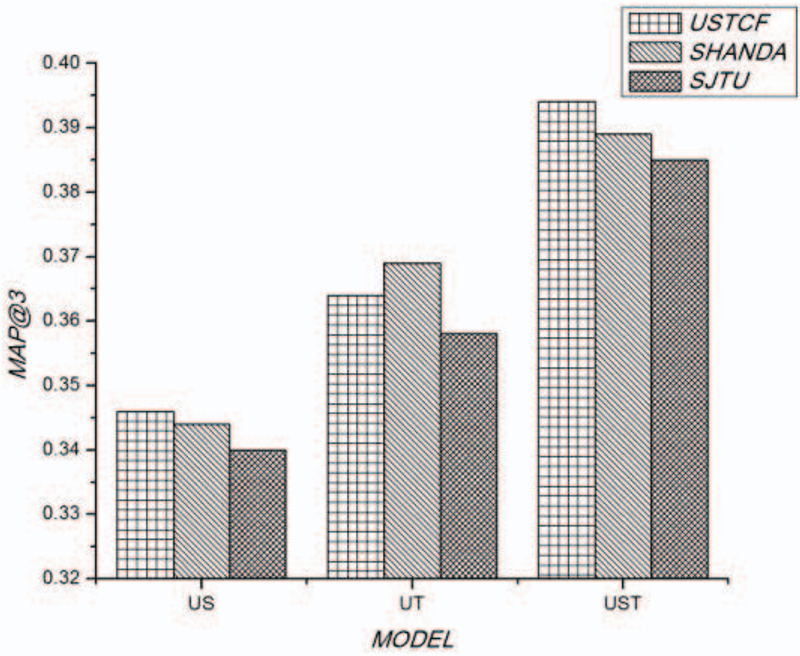 Figure: USTCF vs. SHANDA and SJTU. The UST (Triple-factor) model shows the most convincing performance across metrics.
Critical Insight: Why Does This Work?
The effectiveness of this method lies in its ability to densify the decision space. In sparse datasets, the probability of two users having rated the same items is low. However, the probability of them having common friends or overlapping tags is much higher. By treating Social and Tag data as "Implicit Feedback," the algorithm can calculate a meaningful neighborhood even for "Cold Start" users.
Conclusion & Future Work
The paper successfully demonstrates that recommendation is not just a mathematical matrix problem, but a social one. By acknowledging the "Trust" and "Identity" of users, USTCF bridges the gap between raw data and human behavior.
Future Directions:
- Dynamic Weighting: Instead of fixed set-based weights, using machine learning to learn the optimal weight of each factor for different user types.
- Indirect Neighbors: Exploring whether "friends of friends" (2rd-degree connections) can further enhance the neighborhood capacity without introducing too much noise.