
LDA+RF: Decoding Patient Behavior and Alcohol-Related Concerns in Online Health Forums
A Collaborative Framework Based for Semantic Patients-Behavior Analysis and Highlight Topics Discovery of Alcoholic Beverages in Online Healthcare Forums
This paper proposes a collaborative semantic framework that integrates Latent Dirichlet Allocation (LDA) for feature extraction and Random Forest (RF) for topic classification. The goal is to analyze patient behavior and identify highlight discussion topics regarding alcoholic beverages in online healthcare forums like patient.info.
Executive Summary
TL;DR: This paper presents a semantic framework that combines Latent Dirichlet Allocation (LDA) and Random Forest (RF) to automatically retrieve and classify latent topics from online healthcare discussions. Tested on over 32,000 patient questions from patient.info, the model identifies critical health concerns—such as alcohol withdrawal—with a remarkable 98.82% accuracy, providing medical professionals with a scalable window into patient safety and sentiment.
Academic Context: Positioned at the intersection of Natural Language Processing (NLP) and Behavioral Health, this work advances the utility of unsupervised topic modeling as a feature engineering tool for supervised classification in specialized medical domains.
Problem & Motivation: The "Noise" in Virtual Support Groups
Online health communities are a goldmine of patient-reported outcomes (PROs). Unlike clinical settings, patients in these forums speak freely about their fears, daily struggles, and experiences with substances like alcohol.
However, the sheer volume of this data creates a "knowledge extraction" bottleneck. Traditional methods fail because:
- Manual analysis is unscalable and prone to subjective bias.
- Medical records often miss the behavioral nuances found in informal patient questions.
- Keyword searches fail to capture the "latent" semantic meaning behind complex discussions like "detox" versus "recovery."
The authors' intuition was to use LDA to uncover the hidden thematic structure (topics) and then use RF to provide the predictive power needed to categorize these behaviors accurately.
Methodology: The Hybrid Semantic Framework
The framework follows a four-step pipeline: Extraction → Pre-processing → Latent Discovery (LDA) → Classification (RF).
1. Latent Dirichlet Allocation (LDA)
The paper treats patient questions as a mixture of topics. Using Gibbs sampling, the model estimates the probability of words belonging to specific latent topics.
- The Physics of the Formula: The joint distribution formula (Eq. 1-3) essentially calculates how likely a specific patient's question is to belong to a "withdrawal" topic vs. a "greetings" topic based on word co-occurrence.
2. Random Forest Classification
Once topics are identified, the topic distributions are used as features for a Random Forest classifier. Random Forest is chosen for its ability to handle high-dimensional data (2000 topics in this study) with less parameter tuning than Neural Networks.
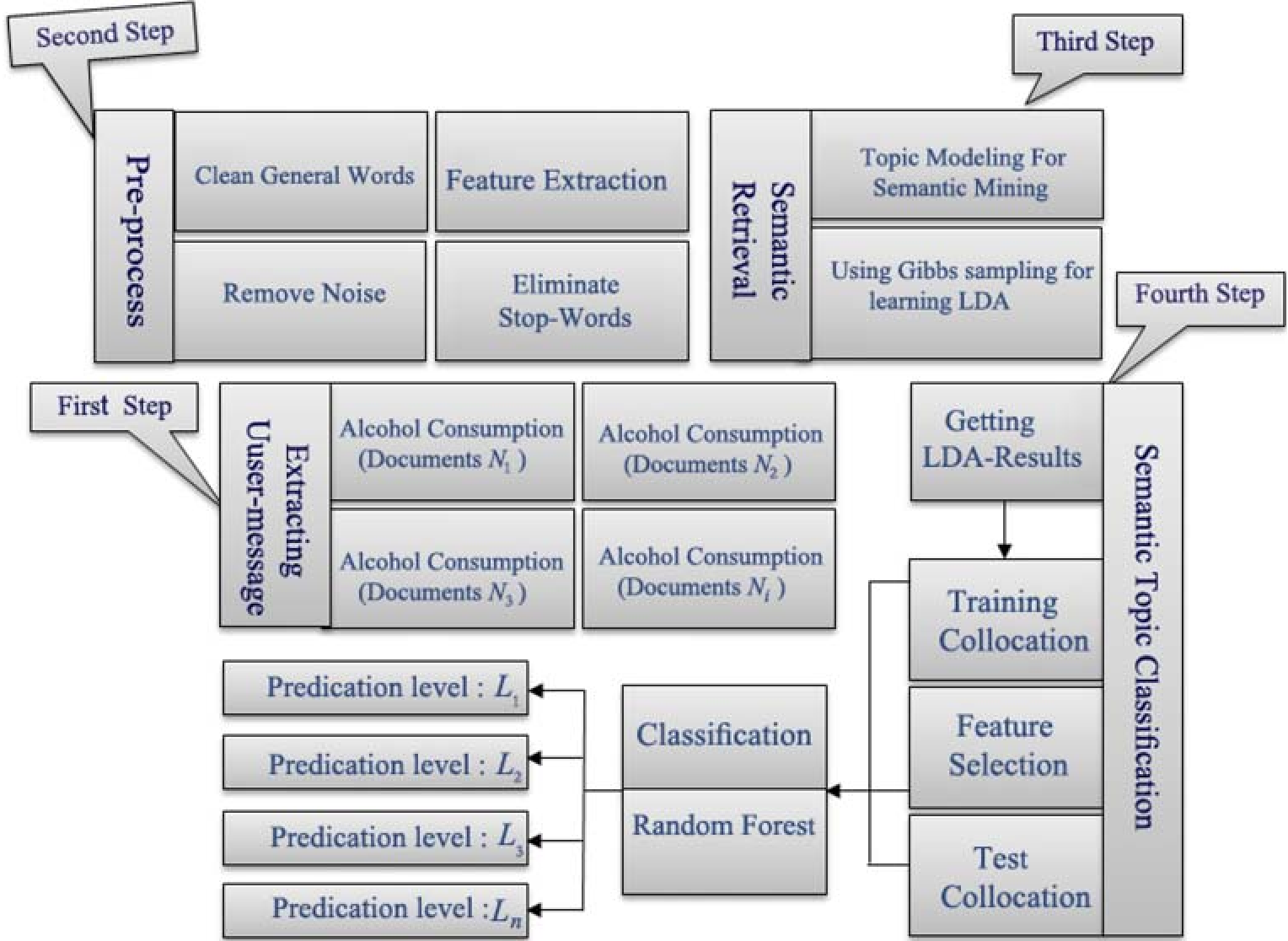 Figure 1: The proposed workflow from data extraction to semantic classification.
Experiments & Results: SOTA Performance
The researchers evaluated the model against three common baselines: SMO (SVM), Multilayer Perceptron (Neural Net), and KNN.
Quantitative Comparison:
The LDA+RF configuration outperformed all others across every metric (Accuracy, MCC, AUC, F-Measure).
| Method | Accuracy | MCC | AUC |
|---|---|---|---|
| LDA + RF | 98.82% | 0.977 | 0.994 |
| LDA + MP | 91.76% | 0.833 | 0.974 |
| LDA + SMO | 88.67% | 0.786 | 0.900 |
| LDA + KNN | 85.44% | 0.725 | 0.864 |
Qualitative Insights (Word Clouds)
The model identified "Highlight Topics" like Topic 388 (Withdrawal and Detox), featuring high-probability words like alcohol, detox, drinking, withdrawal, worse, health.
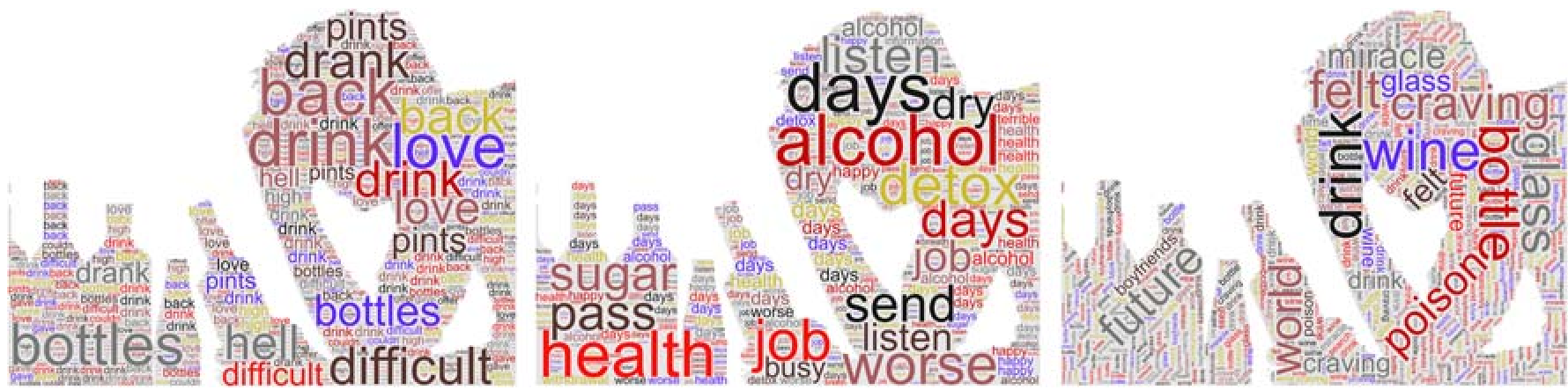 Figure 2: Word cloud representations for Topic 169 (Usage patterns), Topic 388 (Withdrawal), and Topic 27 (Craving).
Critical Analysis & Conclusion
Takeaway
The synergy between unsupervised topic modeling (LDA) and supervised ensemble learning (RF) creates a highly robust system for medical text mining. In niche domains where labels are scarce but raw text is plentiful, this approach remains a "gold standard" for reliability.
Limitations
- Static Analysis: The data spans 2006 to 2019, but it doesn't account for the temporal "evolution" of topics (e.g., how discussions changed during specific public health crises).
- Language: The study is limited to English-language forums.
Future Work
The authors suggest incorporating Fuzzy logic and more advanced NLP techniques to further refine knowledge extraction in noisy social media environments. This could pave the way for real-time patient monitoring systems that alert healthcare providers to sudden spikes in alcohol-related distress within online communities.