
CGAR: Decoding Group Dynamics for Precision Activity Recommendation in LBSNs
Collaborative group-activity recommendation in location-based social networks
The paper introduces CGAR (Collaborative Group-Activity Recommender), a hierarchical Bayesian model for group recommendation in Location-Based Social Networks (LBSNs). It integrates topic models with matrix factorization to jointly learn group preferences and location activities, achieving a 12-15% prediction accuracy improvement over state-of-the-art methods like CTR and MF.
TL;DR
Recommending activities for groups (e.g., a movie for friends or lunch for colleagues) is significantly harder than individual recommendation because group preferences are not just the sum of their parts. This paper proposes CGAR, a hierarchical Bayesian model that combines Topic Models (LDA) and Matrix Factorization to capture how users behave differently when they are in a group versus being alone. It achieves a ~15% boost in accuracy and effectively solves the "cold-start" problem for new locations.
The "Aggregation" Fallacy: Why Group Recommendations Fail
Most existing systems treat group recommendation as a post-processing step: they predict what User A likes, what User B likes, and then "average" them. However, social science and the Gowalla dataset reveal a different reality:
- Novelty Seeking: 62% of groups visit places that none of the individual members have visited alone.
- The Influencer Effect: A single "dominant" user or "expert" often drives the group's decision-making.
- Contextual Shifts: User A might visit a Thai restaurant alone but prefer a sports bar when with a specific group of friends.
Traditional models fail because they ignore these group dynamics and struggle with the extreme sparsity (99.96% in the Gowalla dataset) of social check-in data.
Methodology: Fusing Communities and Activities
The core innovation of CGAR is its dual-topic model approach, integrated within a collaborative filtering framework.
1. Group Modeling (Community Space)
Instead of viewing a group as a list of IDs, CGAR models groups as a generative process. Users belong to latent communities (analogous to topics in LDA). A group's preference () is a distribution over these communities.
2. Location Modeling (Activity Space)
Locations are not just points on a map; they are bags of activity words. A shopping mall might have topics like "Electronics," "Food Court," and "Cinema."
3. The "Latent Offset" Bridge
The model uses Matrix Factorization to match group preferences to location activities. Crucially, it introduces offset variables (). If a location has a high offset for a certain topic, it indicates that the location offers unique group-oriented activities that aren't immediately obvious from the basic description.
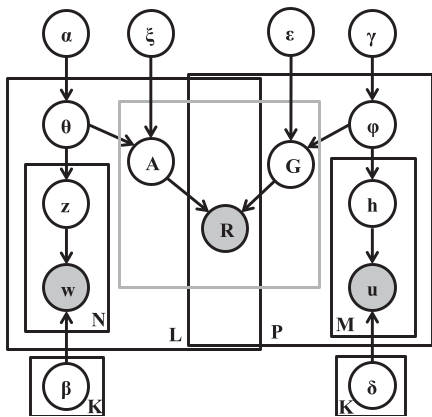 Figure 1: The hierarchical structure of CGAR, showing the interaction between user communities and activity topics.
Experimental Battleground: Gowalla Dataset
The authors tested CGAR against standard Matrix Factorization (MF), Collaborative Topic Regression (CTR), and various aggregation strategies (Least Misery, Average, etc.).
Key Findings:
- Superior Accuracy: CGAR achieved a 0.89 accuracy in-matrix, compared to 0.74-0.75 for MF and CTR.
- Solving Cold-Starts: For brand new locations (Out-matrix), CGAR still performed reliably by leveraging activity descriptions, whereas MF failed completely.
- Interpretability: Unlike "black-box" neural networks, CGAR allows researchers to see why a group was recommended a place by examining the latent topic weights.
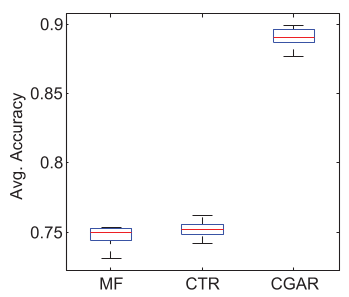 Figure 2: Performance metrics showing CGAR's consistent lead in both Accuracy and RMSE.
Deep Insight: Expert Influence and Exploration
The results reveal a fascinating behavioral insight: users exhibit a "flair for novelty" in group settings. The model successfully distinguished between different versions of the same user. For instance, User 1 might show a preference for "Thai Food" alone, but the model learns that when User 1 joins "Group A," the preference shifts toward "Basketball and Sports Bars."
| Model | Recommended Activities for a Group | Actual Group Check-ins |
|---|---|---|
| CGAR | Deli, Spa, Movie, Mexican Restaurant | Mexican, Sandwich, Theater, Cafe |
| Averaging | Shopping, Cafe, Office, Donuts | (Mismatched) |
| Table: CGAR's recommendations closely mirror actual group behavior compared to simple averaging. |
Critical Analysis & Future Outlook
While CGAR is a major step forward, its computational complexity (training time) is slightly higher than basic MF due to the variational inference required for community learning.
The Takeaway: Future recommendation engines must move beyond "User-Item" pairs and start modeling "User-Group-Context" triplets. This paper proves that by representing social groups as latent communities and locations as semantic activities, we can predict the unpredictable behavior of social gatherings with high precision.