
Technology as a Social Architect: How Expertise Shapes Informal Power
How Does Collaborative Group Technology Influence Social Network Structure?
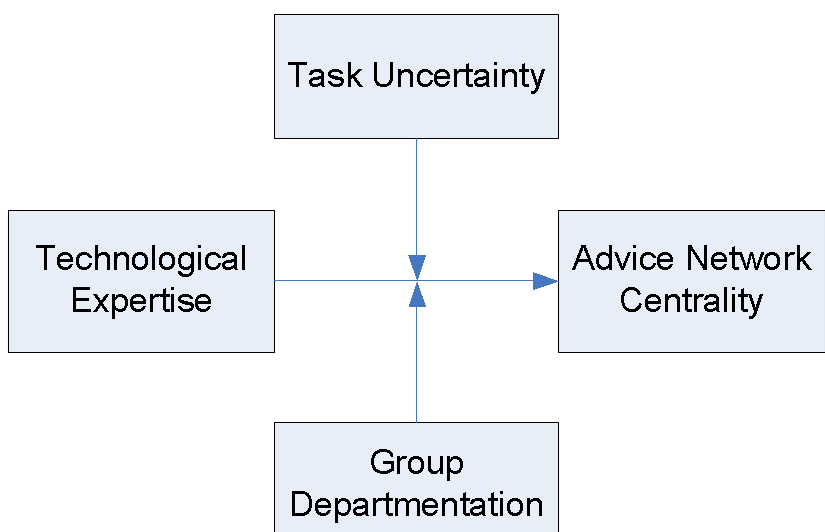
This study investigates the influence of technological expertise on informal social network structure within a project team environment involving 99 graduate students. Utilizing Social Network Analysis (SNA), the authors demonstrate that an individual's centrality in advice networks is significantly predicted by their proficiency in specific technologies, contingent upon task uncertainty and group departmentation.
TL;DR
Is your technical skill set just a tool, or is it a blueprint for your social standing? This research reveals that technological expertise is a primary driver of advice network centrality. However, this isn't a universal law—it depends heavily on whether your task is "uncertain" and how your group is formally structured. In short: in a crisis of uncertainty, the "expert" becomes the social sun around which the team orbits.
The "Invisible" Structure
Most organizational charts show boxes and lines—the formal structure. But beneath that lies the informal social network, the web of who actually goes to whom for advice. While traditional theory suggests management dictates structure, this paper argues that technology and task environment act as a "technological imperative" that reshapes these informal webs. The core question is: Why do certain people become central nodes in a team, and how does the tech stack influence this?
Methodology: The Graduate Sandbox
The researchers tracked 99 graduate students across two distinct courses, creating a high-fidelity simulation of corporate project teams. They measured two types of technology:
- Office Productivity: Word, Excel, Email (Low complexity).
- Advanced Collaborative Tech: Wikis, Blogs, Google Docs, and ThinkTank™ (High coordination requirements).
They then varied the Task Uncertainty (creating standard reports vs. complex Reusable Learning Objects) and the Group Departmentation (Functional vs. Divisional).
Key Insights: Why Uncertainty Matters
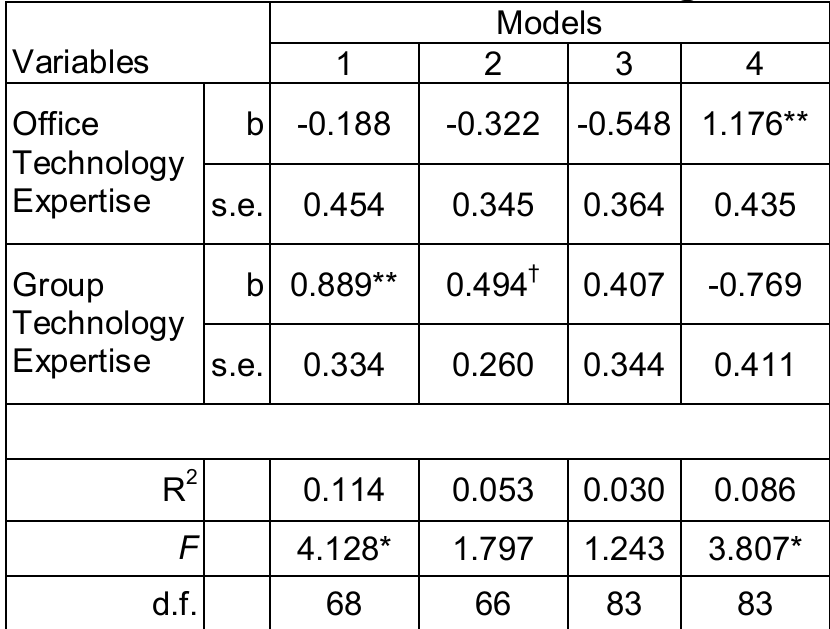
The study found that in highly uncertain tasks, basic office skills didn't matter for social standing. Instead, expertise in collaborative group technology was the significant predictor of being central in the advice network.
The Logic: When a task is ambiguous (like building a new e-learning module), individuals seek those who can handle the coordination and information processing demands. The expert doesn't just provide a tool; they provide a way to reduce the group's collective anxiety.
Structural Contingency and "Asymmetric Adaptability"
One of the most profound findings relates to how teams change.
- Divisional to Functional (D2F): When teams moved from segregated roles to a unified task, the need for expertise sharing spiked, strengthening the social network.
- Functional to Divisional (F2D): Interestingly, when experts were moved into segregated roles, their social influence didn't vanish immediately. This is Entrainment Theory in action—social habits of seeking advice from the tech expert persisted even after the formal need decreased.
Takeaways for the Modern Workplace
For managers and project leads, the implications are clear:
- Technology is a Social Intervention: Implementing a new collaborative tool (like Notion or Jira) will naturally elevate the social power of those who master it first.
- Context is King: In low-stakes, routine tasks (low uncertainty), technical expertise has a diminished impact on social structure.
- Network Persistence: Beware of "ghost" social structures. People will continue to seek advice from former hubs even after a reorganization, which can either facilitate or hinder the new structure's efficiency.
Conclusion
This paper serves as a reminder that the "informal" organization is not random. It is a calculated response to the Information Processing (IP) demands of the environment. As we move into an era of AI and increasingly complex collaborative tools, the individuals who master these "advanced technologies" will inevitably find themselves at the center of the organization's advice network, regardless of their formal title.