
Beyond the Screen: How Collective Efficacy and Playfulness Drive Collaborative U-Learning
Exploring the antecedents of collaborative learning performance over social networking sites in a ubiquitous learning context
This study develops an augmented Technology Acceptance Model (TAM) to evaluate collaborative learning on social networking sites (SNS) within a ubiquitous learning (U-learning) context. By integrating Collective Efficacy and Personal Innovativeness in IT (PIIT), the research identifies the psychological drivers behind students' satisfaction and continued usage of platforms like Google+ for academic cooperation.
TL;DR
Is a social network just a distraction, or a powerful classroom without walls? This study redefines the Technology Acceptance Model (TAM) for the mobile age, proving that for "digital natives," the success of collaborative learning hinges on Perceived Playfulness and the group's Collective Efficacy. Using Google+ and a Jigsaw-based learning strategy, the researchers demonstrate that tech-fluency (PIIT) and group confidence are the ultimate gatekeepers of learning satisfaction.
The "Digital Native" Dilemma: Why TAM Wasn't Enough
For years, the Technology Acceptance Model (TAM) reigned supreme in explaining why users adopt new tools. Its logic was simple: if it’s useful and easy to use, they will come. However, in the realm of Ubiquitous Learning (U-learning)—where learning happens anywhere, anytime via mobile devices—this "utilitarian" view falls short.
The authors argue that social learning is not just a solo act of operating a browser; it is a social performance. They identified a gap in existing literature: we didn't fully understand how personal innovativeness and the psychology of the group (Collective Efficacy) impact the actual learning experience on Social Networking Sites (SNS).
Methodology: The Jigsaw Experiment on Google+
To test their hypotheses, the researchers designed a "Jigsaw" learning activity involving 321 university students. The task: studying Taiwanese ecological culture.
- The Tool: Google+ (chosen for its "Circles" functionality and lower cognitive load compared to the ad-heavy Facebook).
- The Strategy: Students were split into expert groups to master specific topics, then returned to their original teams to teach their peers.
- The Model: An expanded TAM including Personal Innovativeness (PIIT), Collective Efficacy, and Perceived Playfulness.
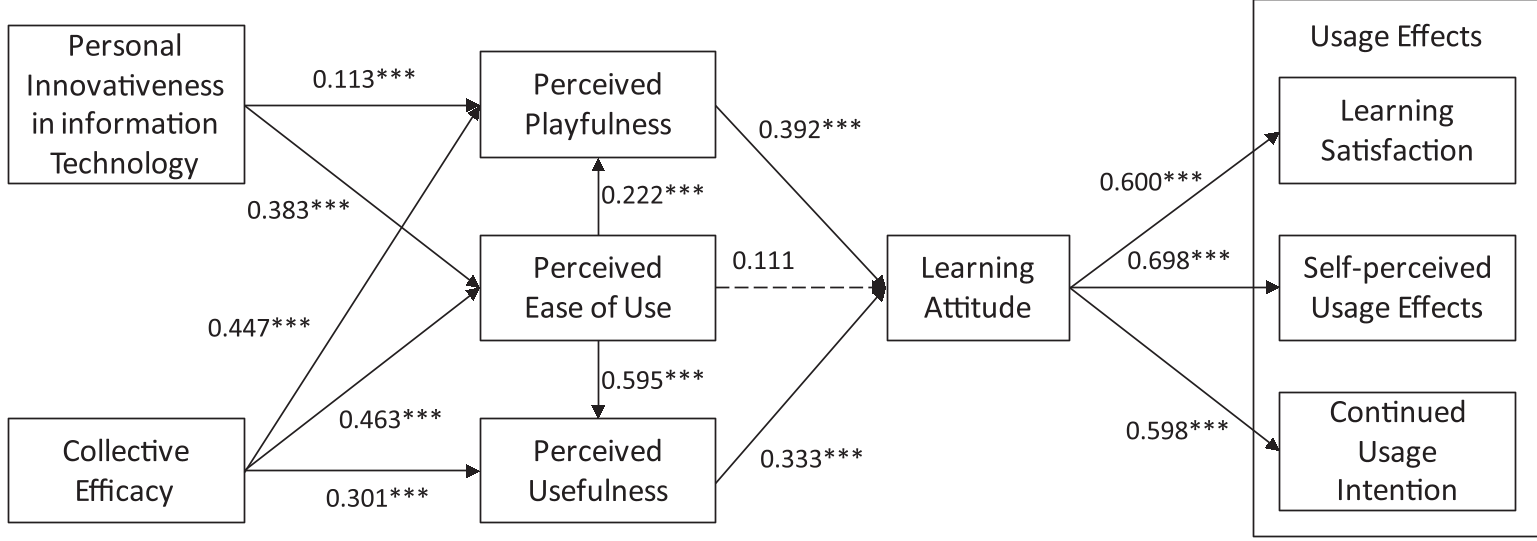 Figure 1: The proposed structural model showing the path coefficients between collective efficacy, PIIT, and usage effects.
Deep Dive: The Power of "Play" and "We"
The study’s findings provide several high-level insights into the mechanics of modern education:
1. The Death of "Ease of Use" as a Primary Driver
Surprisingly, the path from Perceived Ease of Use to Learning Attitude was not statistically significant (p > 0.05). Technical Insight: For digital natives, "Ease of Use" is a baseline expectation, not a motivator. Students today find mobile interfaces intuitive by default; therefore, simply being "easy" doesn't make a student want to learn. Its influence is entirely mediated through whether the tool makes the task feel more useful or fun.
2. Collective Efficacy: The "We Can" Factor
The strongest antecedent to Perceived Playfulness (β = 0.447) and Ease of Use (β = 0.463) was Collective Efficacy. Why this works: When students believe their team is capable and tech-savvy, the anxiety of the "ubiquitous" environment vanishes, replaced by a sense of "Concentration, Curiosity, and Enjoyment"—the three pillars of Playfulness.
3. Personal Innovativeness (PIIT)
Individuals who are naturally "innovative" with IT are more likely to find the social learning environment playful. This suggests that Inductive Bias toward new technology significantly lowers the barrier to cognitive absorption in digital classrooms.
Results & Empirical Evidence
The Partial Least Squares (PLS) analysis showed impressive explanatory power ():
- Perceived Usefulness: 69.8% variance explained.
- Learning Attitude: 57% variance explained.
- Self-Perceived Usage Effects: 48.7% variance explained.
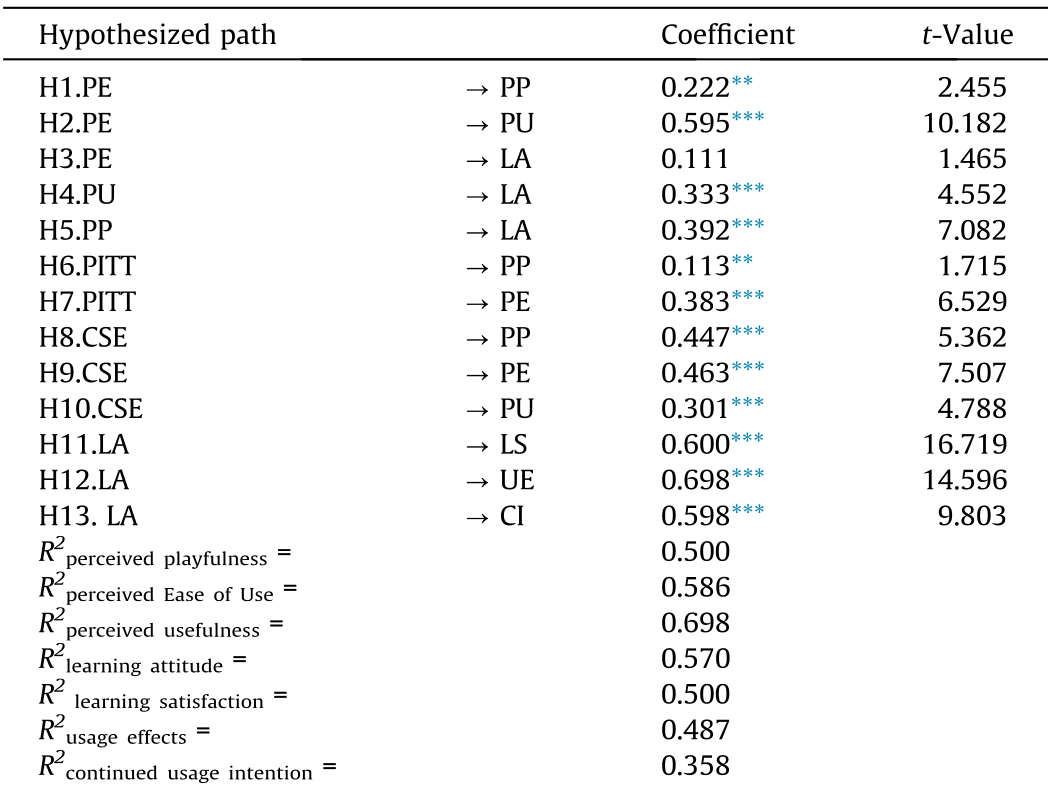 Table 1: Standardized path coefficients and significance levels.
Conclusion: A Blueprint for Instructional Designers
The takeaway for educators is clear: instructional design must evolve.
- Don't just pick a platform; design for interaction: Leverage the "Circles" or "Threads" of SNS to create expert-led collaborative structures.
- Focus on Playfulness: If the learning environment doesn't spark curiosity or concentration, the attitude will remain stagnant, regardless of the tech's utility.
- Build Team Confidence: Before diving into complex content, ensure the group feels capable of using the tools together.
Limitations: The study was conducted at a single university in Taiwan. Future research should explore if these "playfulness" drivers remain consistent across different cultures and age groups (e.g., corporate learners vs. K-12).
Takeaway
This research moves us from "Does the tech work?" to "Does the social ecosystem work?" In the world of ubiquitous learning, the Social in Social Networking is the most powerful feature of the "classroom."