
Identifying the Silent Architects: A SNA Approach to Emergent Leadership in Collaborative Learning
Of Collaborative Learning Team: An Approach for Emergent Leadership Roles Identification by Using Social Network Analysis
This paper introduces a Social Network Analysis (SNA)-based approach to identify emergent leadership roles in collaborative learning teams. It proposes a novel Leadership Index (LI) that integrates three centrality measures—degree, closeness, and betweenness—to pinpoint members who most effectively influence team connectivity.
TL;DR
In virtual learning, the most vocal student isn't always the most effective leader. This research moves beyond simple message counting to propose a Leadership Index (LI) based on Social Network Analysis (SNA). By combining how many connections a student has (Degree), how quickly they can reach others (Closeness), and how often they act as a bridge (Betweenness), the authors provide a mathematical framework to identify who can unify a team the fastest.
Problem & Motivation: The "Volume" Fallacy
For years, identifying leaders in online education was a game of statistics: Who posted the most? Who wrote the longest messages? However, high activity does not equate to high influence.
The authors argue that true emergent leadership in a collaborative team—where members start with equal status—is about coordination skill. A leader’s primary mission is to transform a fragmented group into a "circle network" (decentralized and fully connected) where information flows freely. Identifying these leaders is a "moving target" because roles shift as the project evolves.
Methodology: The Geometry of Influence
The core contribution is the Leadership Index (LI). Instead of looking at a single metric, the authors treat leadership as a three-dimensional vector in the social space:
- Shared Degree Centrality (): Measures "Expert Power." If many people interact with you, you are a popular source of knowledge.
- Closeness (): Measures "Reach." How many steps does it take for your message to reach the furthest member? High closeness means your interventions spread across the team instantly.
- Betweenness (): Measures "Bridging." Do you sit between two people who don't talk to each other? Leaders act as the "social glue" that brings isolated peers into the fold.
The formula is defined as:
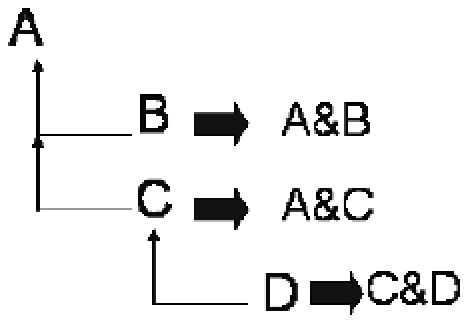 Figure 1: How interactions are mapped into a non-directional graph to calculate the index.
Experiments & Results: Validating the "Fast-Closer"
The authors tested this on a class of Engineering students and through a Scale-Free Network simulation.
1. The Human Vote
In a real-world experiment (Electric Circuit Analysis project), students voted for their leaders. The data showed that the student with the highest LI was almost always the one receiving the most votes. Interestingly, the LI was able to distinguish between students who had the same number of votes but different structural impacts on the network.
2. The Speed Simulation
To prove a leader's worth, the authors simulated how long it would take groups to become "fully connected" (everyone talking to everyone).
- High LI Leader: Teams reached full connectivity in ~15.9 time units.
- Low LI Leader: Teams languished, taking over 40 units to reach the same level of cohesion.
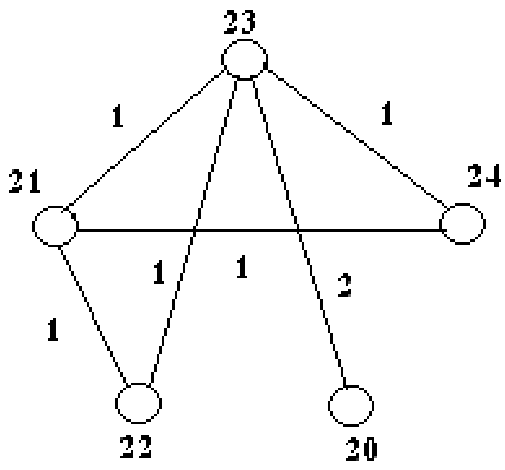 Figure 2: A snapshot of a team's collaboration pattern where Member 23 acts as the central hub.
Critical Analysis & Conclusion
Takeaway: Leadership in the digital age is defined by topological position, not just sentiment or volume. By using this index, online instructors can identify struggling groups early or promote students with high "Betweenness" to help integrate isolated peers.
Limitations: The study acknowledges that pre-existing friendships (prior to the experiment) might bias student votes, a factor the LI doesn't account for. Furthermore, while the index tells us who the leader is, it doesn't analyze the content of their messages—a "toxic" leader could theoretically have a high LI but a negative impact.
Future Outlook: As we move toward AI-managed classrooms, indices like this could allow an AI "facilitator" to dynamically assign roles or suggest communication paths to optimize team performance in real-time.
Reference: Temdee, P., et al. "Of Collaborative Learning Team: An Approach for Emergent Leadership Roles Identification by Using Social Network Analysis."