
CNSR: Bridging Social Correlation and Deep Neural Networks for Smarter Recommendations
Collaborative Neural Social Recommendation
The paper introduces Collaborative Neural Social Recommendation (CNSR), a deep learning framework for social recommender systems. It combines an unsupervised social embedding part with a neural collaborative part to achieve state-of-the-art ranking performance on sparse user-item interaction data.
TL;DR
The Collaborative Neural Social Recommendation (CNSR) model revolutionizes social recommender systems by merging unsupervised social embedding learning with a deep neural architecture. By incorporating a dedicated Collaboration Layer, it captures both the simple linear interactions of traditional methods and the complex non-linear patterns of deep learning, resulting in significant performance gains (up to 15% in NDCG) over previous SOTA models like NeuMF.
The Motivation: Why Linear Models Aren't Enough
Most Collaborative Filtering (CF) systems rely on a simple premise: the inner product of user and item latent vectors. While mathematically elegant, this assumes a linear relationship that often fails to reflect the "messy" reality of human behavior.
Furthermore, while Social Recommendation has emerged to fight data sparsity by using friend networks, existing models typically treat social information as a mere regularization term. The authors of CNSR argued that we need something more organic—a model that sees social influence and user-item interactions as two sides of the same coin.
Methodology: The CNSR Architecture
CNSR is built on two primary engines:
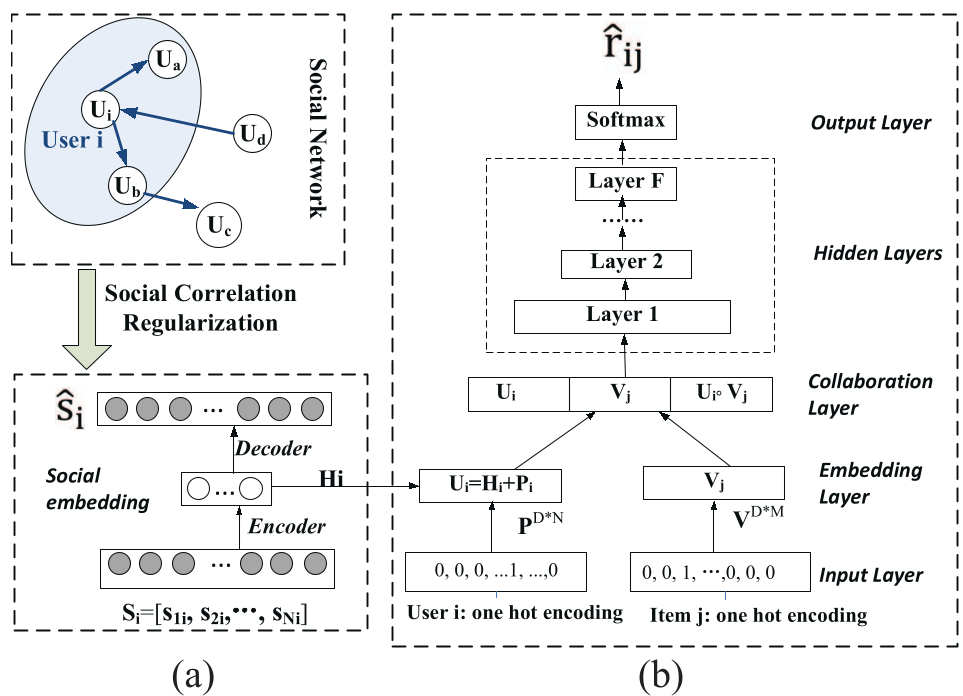
1. Social Correlation-Based Embedding
Instead of simple friend-averaging, CNSR uses an Autoencoder to learn social interest embeddings (). It doesn't just look at who you follow but uses Social Correlation Regularization. This ensures that if User A follows User B, their latent social embeddings are pulled closer together, reflecting the theories of homophily and social influence.
2. Collaborative Neural Recommendation (CNR)
This is where the recommendation happens. The model takes the Social Embedding () and adds a specific User Offset () to capture unique personal tastes.
The breakthrough is the Collaboration Layer. Most neural models simply concatenate user and item vectors. CNSR does more: it concatenates the user vector, the item vector, and their element-wise product.
- Intuition: By providing the element-wise product directly, the model "reminds" the deep layers of the basic collaborative filtering signal, making it much easier for the subsequent feed-forward layers to learn complex residuals.
Experiments & Results
The model was tested on Flixster and Douban, two stalwarts of social recommendation research.
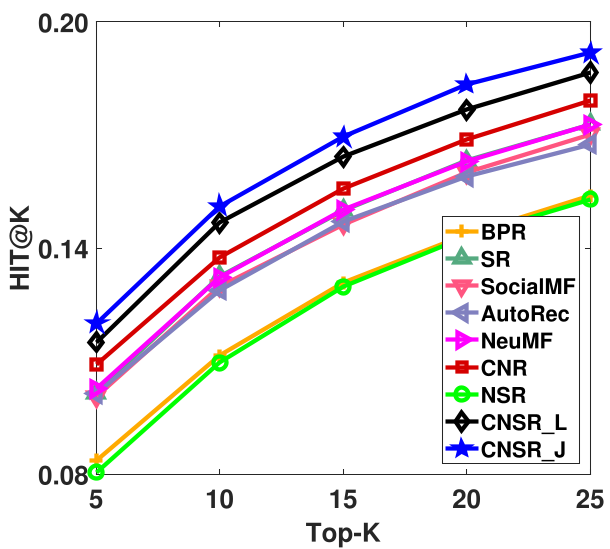
- SOTA Defeated: CNSR consistently outperformed NeuMF (the top neural baseline) and SocialMF (the top social baseline).
- The Power of Joint Learning: The authors found that training the social part and the recommendation part together (Joint Training) yielded better results than training them separately (Loosely Training). This suggests that rating data actually helps refine social embeddings and vice versa.
- Ablation Study: Removing the collaboration layer (the NSR variant) caused a massive performance drop, proving that even in the age of Deep Learning, the "shallow" collaborative signal is still the backbone of recommendation.
Critical Insight: The Value of Inductive Bias
CNSR teaches us an important lesson in AI design: Structural Inductive Bias matters.
While a sufficiently deep neural network could theoretically learn how to perform a dot product or an element-wise product, explicitly building a "Collaboration Layer" into the architecture provides a shortcut that improves convergence and final accuracy. It combines the "memorization" capability of shallow models with the "generalization" capability of deep networks.
Conclusion and Future Work
CNSR is a robust blueprint for how to handle multi-view data (social links + ratings) in a neural framework. While the current model uses a standard autoencoder for social data, a natural evolution would be to replace this with Graph Convolutional Networks (GCNs) to better capture multi-hop social influences. As social platforms grow more complex, architectures like CNSR that can digest both structure and behavior simultaneously will become the industry standard.