
Collaborative Optimization of Matrix Manufacturing Systems: Beyond Traditional Flow-Shops via Online OEE
Collaborative Optimization of a Matrix Manufacturing System Based on Overall Equipment Effectiveness
2024-09-29
Summary
Problem
Method
Results
Takeaways
Abstract
This paper introduces a Collaborative Optimization method for Matrix Manufacturing Systems (MMS) by transforming traditional parallel SMT (Surface Mount Technology) lines into reconfigurable matrix units. The core approach utilizes an online Overall Equipment Effectiveness (OEE) calculation model powered by SMOTE-MLP to drive real-time task reallocation. The proposed architecture achieves significant SOTA improvements in production efficiency for underutilized lines.
## Executive Summary
**TL;DR**: This research addresses the inherent rigidity and low efficiency of traditional parallel SMT (Surface Mount Technology) production lines. By reconfiguring these lines into a **Matrix Manufacturing System (MMS)** and utilizing a machine-learning-powered **online OEE (Overall Equipment Effectiveness)** monitoring tool, the authors enable autonomous collaborative optimization. The result is a system where matrix units (MUs) "think" and request additional tasks when idle, leading to OEE improvements of up to **18.6%**.
**Background**: Positioned at the intersection of Intelligent Manufacturing and Operational Research, this work shifts OEE from a "post-mortem" diagnostic tool to a real-time "decision-engine," marking a transition from centralized, plan-driven systems to distributed, event-driven matrix architectures.
## The Core Malaise: Why Traditional Lines Fail
In many high-tech factories (such as Inventec or AKM), parallel flow-shops operate in silos. Despite their high theoretical capacity, their actual OEE is often surprisingly low—sometimes under 30%. The authors identify two primary culprits:
1. **Rigid Material Flow**: Traditional lines are tied to physical conveyors. If one station is slightly faster than the next, it sits idle, wasting potential capacity (low Performance rate, $P$).
2. **Delayed Indicators**: Conventional OEE calculation is offline. If a skilled worker completes a changeover faster than estimated, the system often misclassifies the gain as "unplanned time," leading to skewed data and poor decision-making.
## Methodology: The Matrix Reconfiguration
The authors propose a structural and logical overhaul.
### 1. Granular Matrix Units (MU)
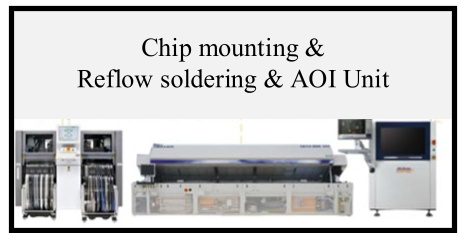
Parallel SMT lines are subdivided into functional units (e.g., Loading, Printing, Chip Mounting, Inspection). Instead of a fixed sequence, these units are treated as a pool of resources.
### 2. SMOTE-MLP for Accurate Real-Time OEE
To make real-time decisions, the system must distinguish between normal production, planned downtime, and unplanned errors.
- **SMOTE**: Handles the imbalanced nature of industrial data (where errors are rare compared to normal operation).
- **MLP (Multi-Layer Perceptron)**: Acts as a high-speed classifier (18ms inference) to categorize downtime.
### 3. The Collaborative Agent
Units are color-coded based on their OEE:
- **Red (Critical Idle)**: OEE < 40%
- **Yellow (Low Efficiency)**: 40% - 50%
- **Green (Optimal)**: > 50%
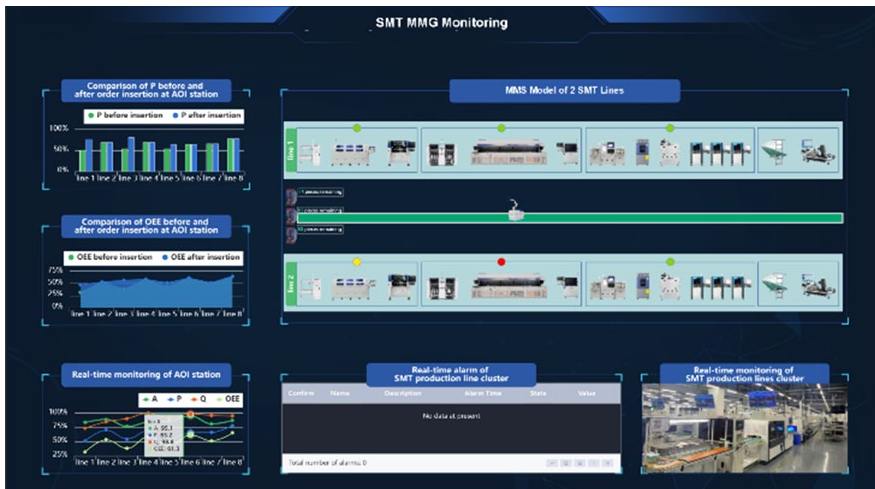
When a unit enters a "Red" or "Yellow" state, the collaborative agent triggers a **job insertion**. For example, products from specialized batches or returned inspection chips are dynamically routed to these idle units to maximize performance.
## Experimental Results & Performance
The architecture was tested on eight SMT lines. The key bottleneck identified was the **Performance Rate ($P$)**—the frequency of micro-waits between machines.
**Key Findings:**
- **Classification Accuracy**: The MLP reached **99.70%** accuracy in identifying equipment states.
- **Efficiency Gains**: Line 3, which was previously at a "Red" state (37.7% OEE), saw an improvement to 56.5% after job insertion.
- **Statistical Validation**: The OEE improvement was consistent across all low-performing lines, proving that the bottleneck was indeed the unequal pace of serial flow-shops.
## Critical Analysis & Future Outlook
**Insight**: The brilliance of this paper lies in its "Physical-to-Digital" bridge. By simply adding a collaborative robotic arm to bridge parallel lines and using OEE as the trigger, it provides a low-cost upgrade path for existing factories to achieve "matrix-like" flexibility without rebuilding the entire shop floor.
**Limitations**: The current model is optimized for SMT flow-shops. Applying this to high-complexity job-shops (where process paths are highly variable) would require a more sophisticated scheduling agent (e.g., Deep Q-Learning).
**Future Work**: The authors envision the MU as an "Autonomous Agent." Future research will likely focus on how these units can negotiate for tasks using auction-based mechanisms or AI, effectively creating a "self-organizing" factory floor.
---
*Senior Editor's Note: This work serves as a practical bridge between the high-level concept of Matrix Production and the gritty reality of SMT manufacturing, proving that data-driven collaboration can unlock hidden capacity.*