
Our Digital Tapestry: Reimagining Social Networks as Canvases for Collaborative Poetry
Collaborative poetry on the facebook social network
The paper introduces "Our Digital Tapestry," a collaborative multimedia poetry project conducted on the Facebook social network. Using the platform's "status" field, the researchers facilitated a cross-geographical creative experiment involving 19 poets to produce a bilingual, multi-script poetic work.
TL;DR
Can the "status update" on a social network be more than just a mundane announcement? The paper "Collaborative Poetry on the Facebook Social Network" explores this by transforming Facebook into a creative laboratory. Through the project "Our Digital Tapestry," 19 poets from across the globe collaborated on a bilingual, multimedia poem, proving that social infrastructure can break down the logistical and social barriers of traditional artistic co-creation.
Problem & Motivation: Beyond the "Status" Post
In 2010, Facebook was rapidly becoming the digital town square, yet its potential for deep creative collaboration remained under-explored. Most professional artists used the platform merely for promotion (e.g., announcing a gallery opening) rather than as a medium for the act of creation itself.
The authors identified several key friction points in creative collaboration:
- Geographical and Financial Barriers: Organizing international talent is expensive and logistically complex.
- Social Stigmas: Offline social hierarchies often stifle the "democratic" flow of ideas.
- Risk and Commitment: Traditional projects require high levels of initial investment and rigid timing.
The researchers' insight was simple yet profound: The same features that make social networks addictive—minimal cost of entry, lack of social status cues, and flexible timing—are the exact ingredients needed for a new form of "democratic" creative collaboration.
Methodology: The "Status" Field as a Hypertext Canvas
The authors launched "Our Digital Tapestry," a four-week experiment. The methodology relied on the unique position of the Artist-Researcher. By acting as both the catalyst and a participant, the researcher served as the central node in the social graph.
The Workflow:
- Recruitment: Participants were recruited directly via Facebook messages, utilizing existing social ties.
- The Prompt: Each week, a short poem was posted in the researcher's "Status" field.
- The Interaction: Collaborators responded by adding new lines of poetry, links to external images, or videos.
- Bilingualism: The work was written in English and Farsi (including "Pinglish"—Farsi in Latin script), showcasing the platform's ability to handle diverse linguistic identities.
 Figure 1: The social and technical framework of "Our Digital Tapestry" was built upon the existing Facebook social graph.
Experiments & Results: Poetic Dialogues
The project successfully synthesized contributions from 19 poets across 5 cities. The key findings include:
- Evolution of Form: The poetry naturally adopted a "dialogue" format, mimicking the conversational nature of social media interaction but elevated through poetic intent.
- Identification and Trust: Because every contribution was tied to a Facebook profile (with timestamps and thumbnails), participants felt a sense of accountability and connection, allowing them to contact other poets directly.
- Lowered Barriers: The study confirmed that social networks reduce the "risk" of contributing. Poets could jump in for a single line or engage deeply over weeks without the pressure of a formal studio environment.
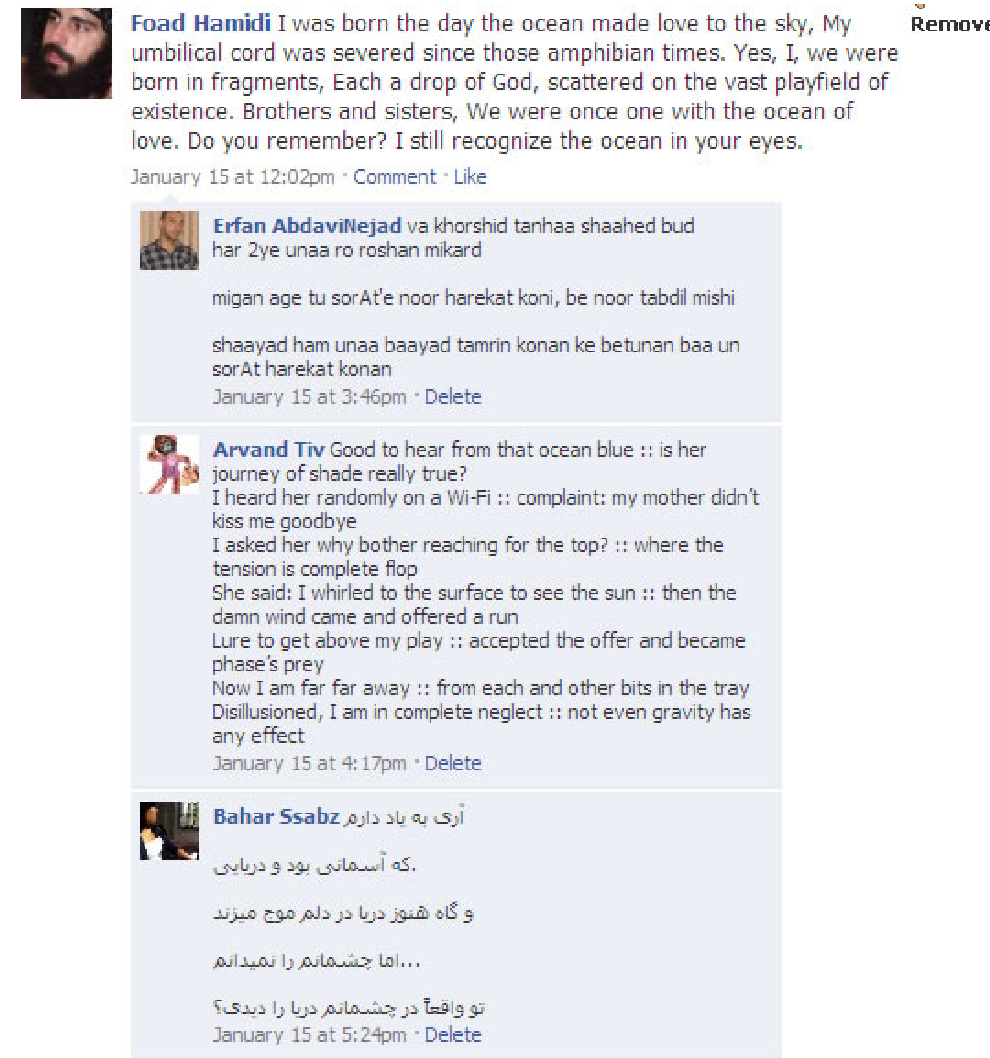 Figure 2: An excerpt from the final poem, showcasing the mix of scripts (English, Farsi, Pinglish) and the chronological flow of the creative dialogue.
Critical Analysis & Conclusion
Takeaway
"Our Digital Tapestry" demonstrates that social media is more than a tool for consumption—it is a viable environment for hypertextual, collaborative art. By repurposing the "Status" field, the researchers proved that structural limitations (like character counts or linear threads) can actually provide a helpful framework for creative constraints.
Limitations
While the project succeeded in engagement, the authors noted that the researcher was the primary social link. This raises a question of Scalability: Can such a project thrive in a "cold start" scenario where the participants don't already share a mutual connection? Furthermore, the reliance on a proprietary platform like Facebook means the "tapestry" is subject to the platform's changing UI and data policies.
Future Outlook
As we move into the era of AI-human collaboration, the principles of "Our Digital Tapestry" remain highly relevant. Future work could examine how automated "poet-agents" might integrate into these social threads, or how decentralized networks could host such creative endeavors without the risk of platform de-platforming. This 2010 study remains a foundational look at how we transcend "status" to reach "art."