
EMCP: Shielding User Privacy in the Era of IPTV Social Recommendations
Collaborative privacy framework for minimizing privacy risks in an IPTV social recommender service
The paper introduces a Collaborative Privacy Framework (CPF) and an Enhanced Middleware for Collaborative Privacy (EMCP) designed for IPTV social recommender services. It employs a two-stage concealment process—Clustering Based Obfuscation (CBO) and Random Ratings Generation (RRG)—to protect user profiles while maintaining high recommendation accuracy.
TL;DR
The paper proposes the Enhanced Middleware for Collaborative Privacy (EMCP), a framework that allows IPTV users to receive personalized content recommendations without exposing their actual viewing habits to third-party providers. By utilizing a two-stage concealment process (local obfuscation and global aggregation), it bridges the gap between high privacy and recommendation precision.
Background & Motivation: The Recommender's Paradox
Modern IPTV services rely on Social Recommender Services (SRS) to help users navigate mountains of content. However, these systems are "privacy-hungry." To provide accurate referrals, they require deep access to your consumption history, demographics, and ratings.
The authors identify a critical Recommender's Paradox:
- If users hide their data, the recommendations become useless (the Sparsity Problem).
- If users share their data, they risk identity theft, government surveillance, or profiling.
Existing solutions like simple randomization or encryption often fail because they either destroy the statistical utility of the data or require immense computational overhead.
Methodology: The Two-Stage Shield
The core innovation of this paper is the hierarchical approach to data concealment, orchestrated via a middleware running on the user’s Set-Top Box (STB).
1. Local Concealment: Clustering Based Obfuscation (CBO)
Before any data leaves the STB, the CBO algorithm kicks in. Unlike simple noise addition, CBO uses a Naïve Bayesian classifier to select "fake items" that are semantically similar to the user’s real interests. This ensures the profile remains homogeneous and indistinguishable to an attacker while satisfying Differential Privacy requirements.
2. Global Concealment: Random Ratings Generation (RRG)
Users are grouped into coalitions managed by an elected Super-Peer. This peer aggregates the already-obfuscated profiles. To protect the group from "sparsity attacks," the RRG algorithm fills unrated cells using a mix of KNN-predicted values and random noise.
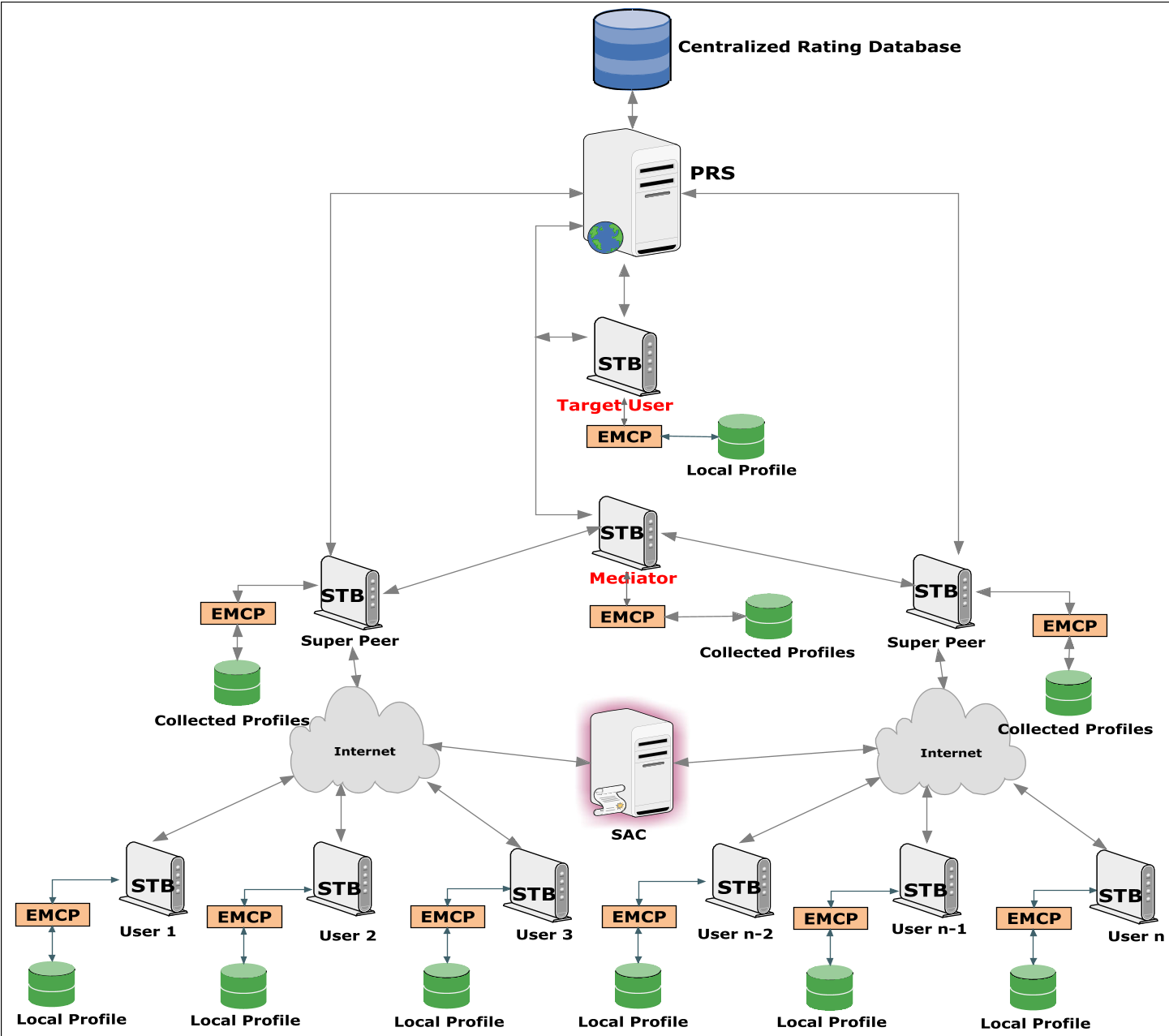 Figure 1: The EMCP middleware components running inside the user's STB.
Experimental Validation
The authors tested the EMCP framework using the MovieLens dataset. The primary metric was Mean Average Error (MAE)—the smaller the MAE, the better the recommendation.
- Accuracy vs. Privacy: The study found that even with high concealment rates, the MAE increased only slightly. For instance, in the "Optimal Fake Set" scenario, adding noise had a negligible impact on the user experience.
- Robustness: The framework was tested against "Honest-but-Curious" adversaries. The RRG algorithm proved that identifying individual users within the aggregated group profile is mathematically improbable given the entropy introduced.
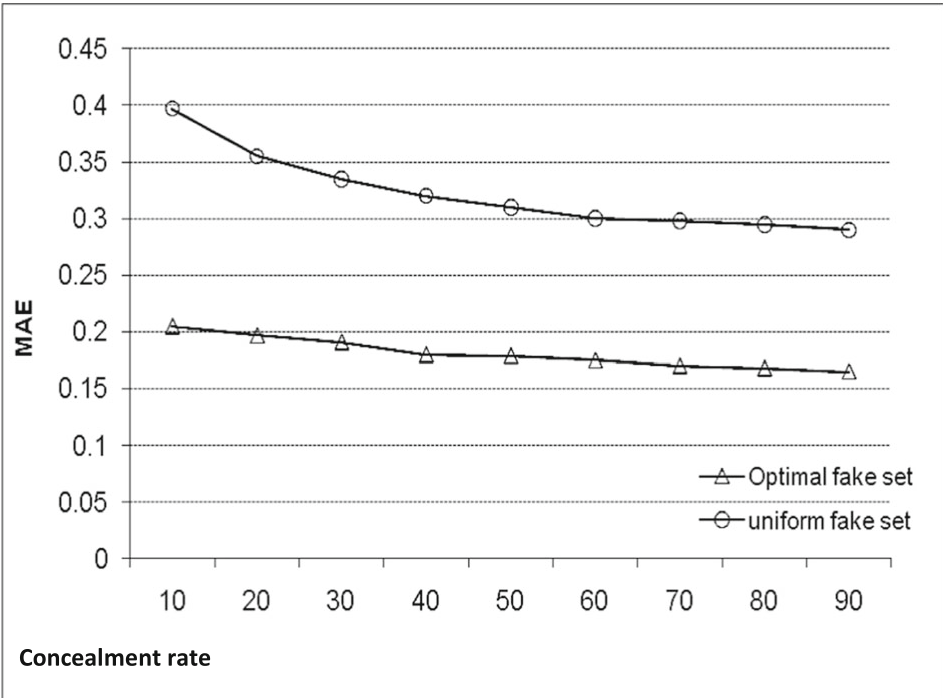 Figure 2: MAE as a function of the concealment rate. Higher rates provide more privacy with minimal accuracy loss.
Critical Insight: Why This Matters
The "magic" of this paper lies in its User-Centric Architecture. By moving the privacy logic to the "Edge" (the Set-Top Box) and using social coalitions, it removes the need to trust the central Service Provider.
However, the reliance on Super-Peers introduces a new bottleneck: the system is only as strong as the reputation mechanism used to elect these aggregators. If a Super-Peer is compromised, the aggregate group data (though still locally obfuscated) is at risk.
Conclusion
The Collaborative Privacy Framework demonstrates that privacy does not have to be the "price" of personalization. Through clever semantic obfuscation and group-based anonymity, IPTV providers can maintain their business models while respecting the digital autonomy of their users. Future work will likely look at Game Theory to incentivize users to act as super-peers and further harden the system against malicious "shilling" attacks.