
CLER: Bridging Online Social Circles with Offline Event Participation via RBMs
Collaborative restricted boltzmann machine for social event recommendation
The paper introduces CLER (Collaborative Learning Approach for Event Recommendation), a hybrid neural framework based on Restricted Boltzmann Machines (RBM) for social event recommendation. It achieves significant SOTA performance across synthetic and real-world datasets (Renren, Meetup) by fusing multi-source content features with social network relationships.
Executive Summary
TL;DR: CLER (Collaborative Learning Approach for Event Recommendation) is a hybrid framework that tackles the extreme sparsity of social event participation by combining Restricted Boltzmann Machines (RBM) with social network theory. It effectively solves the "Cold Start" problem for new events by using tensor factorization to model complex interactions between user attributes and event features.
Positioning: This work serves as a sophisticated bridge between classical Collaborative Filtering and deep generative modeling, specifically optimized for the unique constraints of Event-Based Social Networks (EBSNs).
The Pain Point: Why Is Event Recommendation Hard?
Unlike recommending movies or books, recommending offline events faces three major hurdles:
- Extreme Sparsity: Users only participate in a handful of events; a lack of participation doesn't necessarily mean a lack of interest—it could be due to location, timing, or simply not knowing the event existed.
- Binary Labels: We often only have "User A attended" (1) or "No record" (0), without explicit ratings.
- The Cold Start Wall: New events have zero history, rendering traditional Matrix Factorization (MF) useless.
Methodology: The Core of CLER
The authors propose a conditional RBM that models the joint probability of recommendation confidence () and hidden variables () conditioned on user features () and event features ().
1. High-Dimensional Interaction Modeling
The model uses a four-way tensor to connect . Instead of simple linear weights, this structure allows the model to capture the "Gated" interactions — how specific user traits interact with specific event characteristics to trigger a "participation" signals.
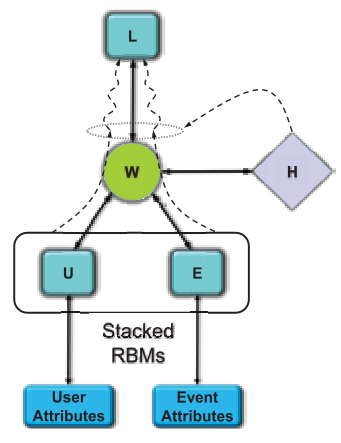 Figure 1: (a) The basic RBM structure for event recommendation; (b) Deep structure with stacked RBMs for feature extraction.
2. Efficiency via Tensor Factorization
A 4-way tensor leads to parameters, which is prone to overfitting. The authors employ CANDECOMP/PARAFAC (CP) decomposition, factorizing the bulky tensor into a sum of vector outer products. This reduces complexity to , making the training of deep structures feasible.
3. Integrating Social "Peer Pressure"
CLER recognizes that social events are inherently social. They modify the bias term of the RBM using the participation probability of a user's friends. If your friends are likely to attend an event and share similar features with you, the model increases your own participation probability through a combined gradient update rule.
Experiments & Results
The model was tested against several baselines, including Matrix Co-Factorization (MCF) and History-based Regression (HRM).
Performance in Warm Start
In standard scenarios, CLER outperformed baselines by over 20% in some metrics.
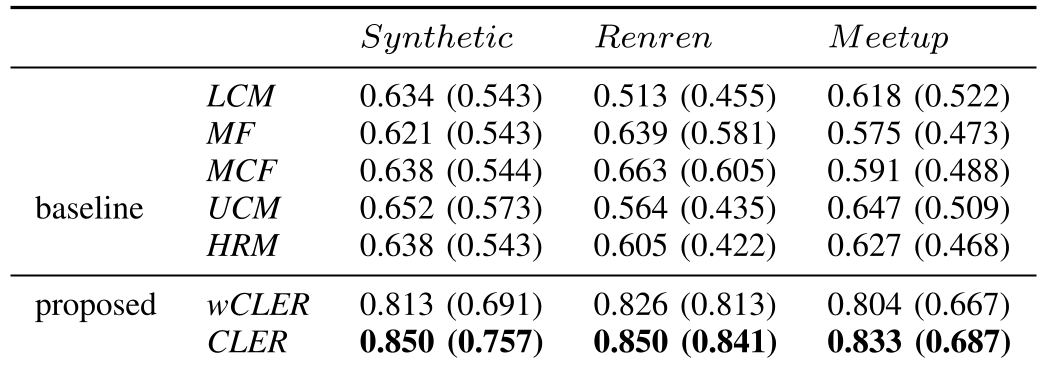 Table 1: Comparison of AUC/MAP across Synthetic, Renren, and Meetup datasets.
Solving the Cold Start
Even when events had no prior history (Cold Start), CLER maintained high precision. The inclusion of social relationships (comparing wCLER vs. CLER) showed a significant jump in AUC, proving that your friends' interests are excellent proxies for your own when data is scarce.
Critical Analysis & Conclusion
Takeaway
CLER demonstrates that Restricted Boltzmann Machines are not just for unsupervised feature learning; when combined with tensor factorization and social priors, they become powerful discriminative tools for sparse recommendation tasks.
Limitations
- Dynamic Interests: The current model treats user features as static, whereas interests in events can be highly seasonal or trend-dependent.
- Scalability: While is better than , scaling to millions of users/events may still require more aggressive sampling or approximation techniques beyond Contrastive Divergence.
Future Prospect
The success of the "Social Bias" in CLER hints that Graph Neural Networks (GNNs) could be the next logical step, potentially replacing the RBM's social update rule with a more formal message-passing architecture.