
CSQCA: Revolutionizing Edge Video Streaming via Social Interaction and Dynamic Adaptation
17651_Collaborative Social-Aware and QoE-Driven Video Caching and Adaptation in Edge Network.
This paper proposes CSQCA, a novel framework for Collaborative Social-aware QoE-driven video Caching and Adaptation in 5G-enabled Multi-access Edge Computing (MEC). It integrates a 2-tier collaborative architecture with social interaction modeling and dynamic transcoding to optimize user Quality of Experience (QoE) and network efficiency.
TL;DR
High-definition video streaming is the primary driver of 5G traffic, but edge servers have limited storage. This paper introduces CSQCA, a framework that predicts what users want to watch by analyzing their social media interactions (modeled via ARMA and bi-directed graphs). By combining collaborative partial caching with real-time transcoding, it significantly boosts cache hit ratios and user QoE compared to standard methods like LRU or ARC.
Background & Motivation
Most videos live in the remote cloud, causing high latency and backhaul congestion. While Multi-access Edge Computing (MEC) brings resources closer to users, edge nodes are storage-constrained. Existing cache strategies often treat content popularity as a static or global metric, ignoring a critical fact: social interactions drive video requests. Whether it is a shared TikTok or a viral Facebook post, videos spread through "infection" in social networks.
The authors identify a missing link in current research: a holistic system that accounts for Time-Varying Social Influence, Collaborative 2-Tier Caching, and Dynamic Bitrate Adaptation (Transcoding) simultaneously.
Methodology: The Core Mechanism
1. Social Dissemination Modeling
Instead of simple popularity counts, the authors model social communities as dynamic, bi-directed graphs.
- ARMA Model: Used to predict the intensity of interactions between users, recognizing that social ties (e.g., student friendships) change over time.
- Infection Probability: The framework calculates the likelihood of a user watching a "shared" video based on their "reactivity" and the "importance" of the sharer.
2. The 2-Tier Collaborative Architecture
The system splits the problem into two distinct phases to handle different time scales (hours for caching vs. seconds for streaming):
- Caching Phase (P1): The Regional Server uses Simulated Annealing (SA) to decide which chunks of which videos to store across multiple edge nodes, ensuring no duplicates and optimizing "Cache Lifetime."
- Adaptation Phase (P2): Edge servers use Lagrange Multipliers and KKT conditions to solve a real-time optimization problem—transcoding cached high-res videos into the perfect bitrate for a user's current signal strength.
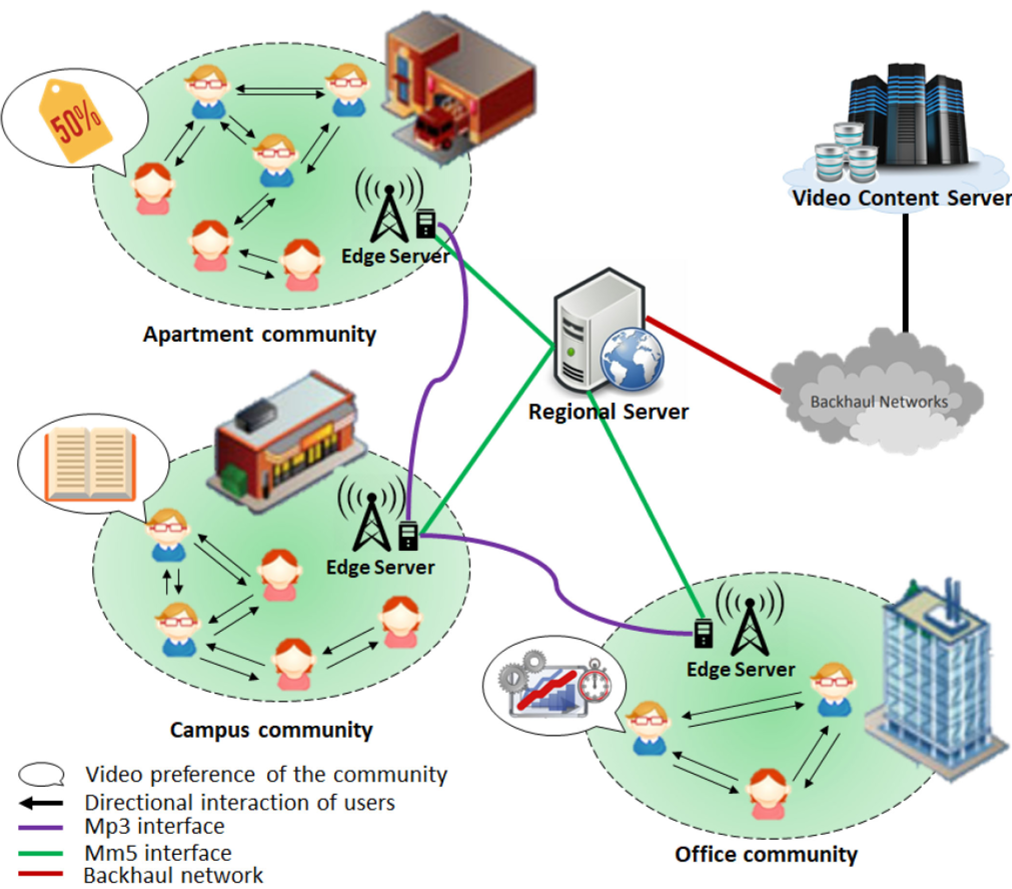 Figure 1: The CSQCA 2-tier architecture showing the flow between Social Communities, Edge Servers, and the Cloud.
Experimental Validation
The authors didn't just use math; they tested their theory against real-world datasets from UC Irvine and a European research institute.
Key Performance Metrics:
- Cache Hit Ratio: CSQCA outperformed all baselines (LRU, MP, ARC). Interestingly, Partial Caching allowed CSQCA to store "parts" of more videos, leading to a much higher chance of hitting a request.
- Traffic Reduction: Collaborative caching (where edge servers share content via the Mp3 interface) drastically reduced backhaul load compared to standalone edge nodes.
- QoE Resilience: As the frequency of requests (Poisson ω) increased, traditional methods saw a sharp drop in Quality of Experience. CSQCA's QoE remained remarkably stable due to its high local hit rate.
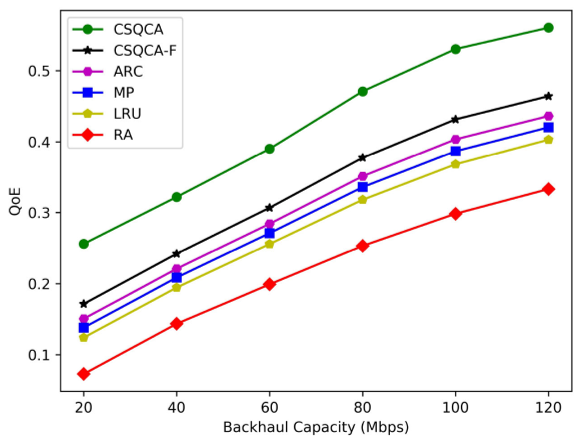 Figure 2: Performance comparison showing that CSQCA maintains higher QoE even under heavy traffic loads.
Critical Insight & Conclusion
The "secret sauce" of this paper is the dynamic cache lifetime. By predicting when a video's social dissemination starts to slow down, the system can evict it exactly when it's no longer "trending," freeing up space for the next viral hit.
Limitations: The model assumes that social interaction data is accessible to the ISP/MEC orchestrator, which may raise privacy concerns (GDPR/CCPA). Future work could explore Federated Learning to predict social trends without exposing raw user messages.
Final Takeaway: For 5G/6G providers, the future of content delivery isn't just about faster pipes—it's about understanding the "social fabric" of the users at the edge.