
Breaking the Data Silence: Crowdsourcing Speech Corpora for Under-Resourced Languages
Collaborative Speech Data Acquisition for Under Resourced Languages through Crowdsourcing
This paper presents a collaborative framework for speech data acquisition targeting under-resourced languages (specifically Hindi) using a mobile-based crowdsourcing approach. By leveraging a client-server architecture via an Android application, the authors successfully collected 16 hours of transcribed speech data from over 100 speakers to build robust ASR systems.
TL;DR
Building reliable Automatic Speech Recognition (ASR) systems requires massive datasets, which are often non-existent for under-resourced languages like many Indian dialects. This paper introduces a mobile-based crowdsourcing framework to collect high-quality, natural speech data for Hindi. By moving from the lab to the "crowd," the authors collected 16 hours of diverse audio with only a 3% error rate, providing a scalable blueprint for low-resource NLP.
The Motivation: The "Resource Desert" in NLP
Despite Hindi being one of the top 10 most spoken languages globally, its digital footprint—specifically in terms of transcribed speech corpora—remains disproportionately small compared to languages like English or German.
The authors identify a critical "fragility" in current ASR: systems trained in quiet labs fail when exposed to the chaos of real-world environments (traffic noise, varying distances from the microphone, and dialectal code-switching). To solve this, we don't need cleaner data; we need representative data.
Methodology: The Client-Server Mobile Architecture
The core of the study is a shift toward Collaborative Data Acquisition. Instead of bringing speakers to a recording studio, the researchers brought the "studio" to the speakers via an Android App.
1. System Architecture
The architecture follows a standard but efficient Client-Server model. The mobile client presents prompts, records audio, and transmits data via HTTP to a central server where it is validated and stored.

2. Speech Database Design
The ingenuity lies in the prompt design. The authors categorized prompts into three types:
- Phonetically Rich Sentences: Collected via a greedy algorithm to ensure maximum phone/tri-phone coverage.
- Guided Prompts: Specific instructions (e.g., "Speak this phone number digit by digit").
- Unguided Queries: Open-ended questions to capture natural, casual speaking styles and regional idioms.
Experimental Results and Observations
The study involved 105 speakers, largely college students, recording in four specific environments: Home/Office, Public Places (park backgrounds), and Roadside (traffic noise).
| Metric | Value |
|---|---|
| Total Speakers | 105 |
| Total Data Volume | ~16 Hours |
| Word Error Rate (WER) | 3% |
| Completed Sessions | 97/105 |
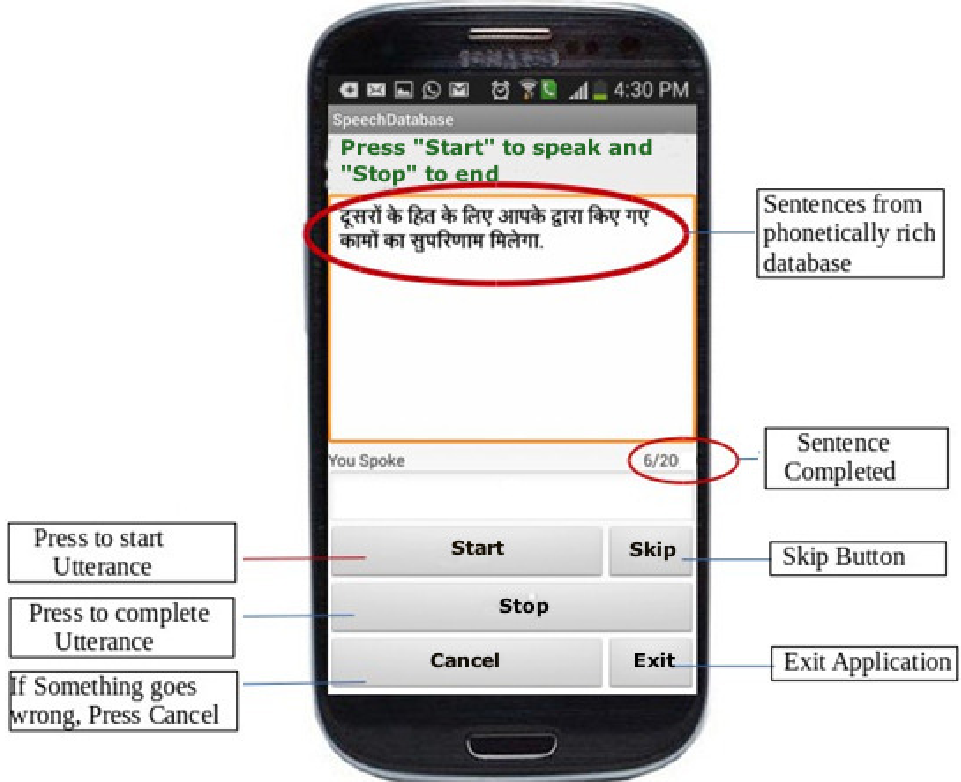 Fig: The mobile interface allows for metadata collection (age, gender, mother tongue) and facilitates split-session recording.
A key finding was the naturalness of the data. Because users used their own smartphones—devices they are already comfortable with—the resulting audio captured the authentic distance from the microphone and ambient noise profiles that a real-world application would encounter.
Critical Analysis: A Double-Edged Sword
While the speed and cost-effectiveness of this approach are undeniable, crowdsourcing introduces unique challenges:
- Quality Control: The authors noted instances where "cheating" occurred (e.g., two different speakers completing one session).
- Technical Stability: Network failures during recording can lead to data loss.
- Validation Overhead: The cost saved in collection is partially offset by the need for manual validation of the crowd's output.
Conclusion and Future Outlook
This work proves that for under-resourced languages, the bottleneck isn't the lack of speakers, but the lack of accessible collection tools. The future of NLP for the "next billion users" lies in these collaborative frameworks. Further research is needed to automate the validation process (possibly using semi-supervised learning) to make this process truly autonomous.
Reference: Arora, S., et al. (2016). Collaborative Speech Data Acquisition for Under Resourced Languages through Crowdsourcing. SLTU 2016.