
CTA: Synchronizing the Crowd for Collaborative Tasks in Opportunistic Networks
A Collaborative-Task Assignment Algorithm for Mobile Crowdsourcing in Opportunistic Networks
This paper introduces the Collaborative-Task Assignment (CTA) algorithm for mobile crowdsourcing in opportunistic networks, specifically targeting tasks that require multiple workers simultaneously. By minimizing worker idle time, the CTA algorithm effectively reduces the overall makespan for complex, multi-user tasks.
TL;DR
While mobile crowdsourcing has traditionally focused on "lone wolf" tasks (like taking a photo), real-world missions like disaster rescue require teamwork. This paper presents the Collaborative-Task Assignment (CTA) algorithm, the first framework specifically designed to coordinate multi-worker tasks in intermittent networks. By strategically minimizing the "waiting time" between collaborators, CTA achieves nearly optimal efficiency.
The "Collaboration Gap" in Mobile Sensing
Current task assignment models operate on a simple premise: one task, one worker. However, in scenarios like moving heavy debris or guiding evacuees, a single worker is ineffective. The challenge in Opportunistic Networks (networks with no stable connectivity) is that a requester cannot just broadcast a command. They must wait for "contacts" with workers based on mobility.
The authors identify a unique pain point: Idle Time. If Worker A arrives at a task site but must wait three hours for Worker B to arrive, those three hours are wasted. The research intuition here is brilliant yet simple: To minimize the total project duration (makespan), one must minimize the collective idle time of the workforce.
Methodology: The Dual-Mode Strategy
The CTA algorithm treats task assignment as an optimization problem where the goal is to align task requirements with the contact frequencies () of workers.
1. The Mathematical Foundation
The paper proves that the total makespan is bounded by the sum of inter-meeting times, task processing times, and most importantly, the idle time (). By minimizing , they directly minimize the makespan.
2. Dual-Mode Execution
Algorithm 1 oscillates between two modes to prevent any single worker from becoming a bottleneck:
- Range-Minimizing Mode: It identifies the worker with the largest current workload and tries to assign new tasks to others to "close the gap," ensuring a balanced load across the crowd.
- Largest-Task-First Mode: It greedily assigns the most time-consuming tasks to the workers with the most availability (smallest makespan).
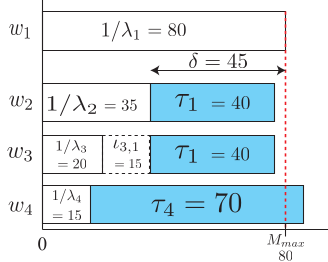 Figure 1: Visualization of the task assignment process where multiple workers are synchronized for a single task.
Experiments and Results
The authors tested CTA against a modified version of the FTA (Fixed Task Assignment) algorithm using the CRAWDAD INFOCOM 2005 dataset.
- Consistency: In every test case, CTA outperformed the baseline.
- Complexity Handling: As the number of required collaborators per task increased, the performance gap between CTA and traditional methods widened. When tasks required 20+ collaborators, CTA provided a 15% improvement in completion time.
- Proximity to Optima: In large-scale simulations (200+ workers), CTA's results were within 2% of the theoretical Expected Optimal Makespan (EOM).
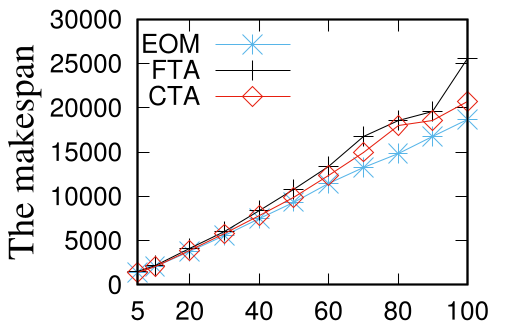 Figure 2: Performance comparison showing CTA consistently achieving lower makespan across different task volumes.
Critical Insight & Future Outlook
The core value of this paper lies in its recognition that collaboration costs time in decentralized systems. In an opportunistic network, a worker is not just a resource; they are a "probability of contact."
Limitations: The current model assumes that task processing times are fixed. In reality, adding more workers than the required minimum (e.g., three people lifting a log instead of two) might reduce processing time. Future iterations could benefit from a "flexible collaboration" model.
Takeaway: For developers and researchers in edge computing and decentralized MANETs, this paper provides a robust template for handling multi-agent synchronization without a persistent central controller.