
Beyond Ratings: Leveraging Sentiment and Behavior for Social Recommendations
A collaborative user-centered framework for recommending items in Online Social Networks
The paper introduces a novel collaborative and user-centered recommendation framework specifically designed for Online Social Networks (OSNs). It integrates user preferences, behavior patterns, and sentiment analysis of textual comments using a Latent Dirichlet Allocation (LDA) based approach to provide multi-dimensional recommendations in domains like movies and travel.
TL;DR
This paper presents a robust framework that moves beyond simple star ratings by analyzing how users talk (sentiments) and how they browse (behavioral patterns). By combining co-clustering, graph-based ranking, and LDA-based sentiment analysis, the authors provide a system that remains accurate even when data is sparse—a common plague in modern Online Social Networks (OSNs).
The "Data Sparsity" Wall
Most recommendation engines are built on a house of cards: the User-Item Rating Matrix. In the real world, this matrix is incredibly empty; most users never rate most items. Content-based systems try to fix this but end up recommending more of the same, while Collaborative Filtering fails completely for new items (the "Cold Start").
The authors' insight is simple yet powerful: OSNs are rich in secondary data. If a user doesn't rate a movie but leaves a passionate comment or browses three similar travel packages in a row, the system should "learn" from those signals.
Methodology: The Three-Stage Engine
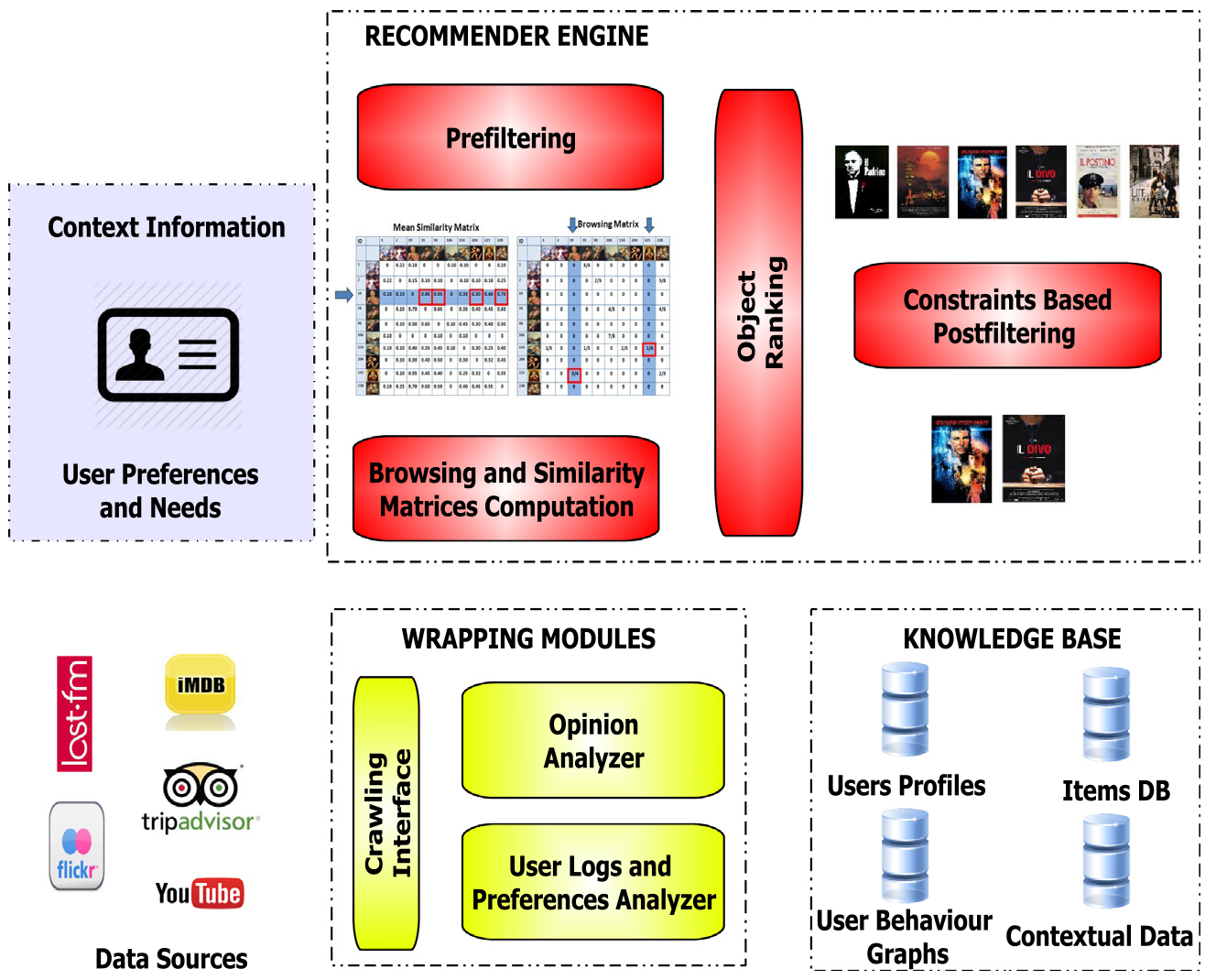
The framework operates through a sophisticated pipeline designed to filter noise and amplify intent.
1. Pre-Filtering (The Compass)
Before ranking, the system narrows the search space. It uses star-structured co-clustering to group items and features simultaneously. By measuring the cosine distance between a user's profile and these cluster centroids, the system identifies "candidate" items that align with technical preferences (e.g., a specific movie director or a hotel price range).
2. Behavioral Ranking (The Map)
The core ranking logic treats the item collection as a Labeled Graph.
- Pattern Edges: If the community frequently visits Item B after Item A, Item A "votes" for Item B.
- Similarity Edges: If Item A and Item B share intrinsic characteristics, they share "authority."
The final rank is calculated using the Power Method to find the stationary vector of a transition matrix—essentially PageRank for user behavior.
3. Sentiment Refinement (The Filter)
This is the paper’s "secret sauce." Using Latent Dirichlet Allocation (LDA), the system builds a "Mixed Graph of Terms" (mGT). It identifies aggregate root nodes (key sentiment-carrying words) and weighs the probability of a review being positive or negative. The final recommendation score () is then adjusted: positive sentiment boosts the rank, while negative vibes suppress it.
Proving the Value: Accuracy and Satisfaction
The authors tested their framework in two high-stakes domains: Movies (accuracy focus) and Travel (user experience focus).
SOTA Comparison
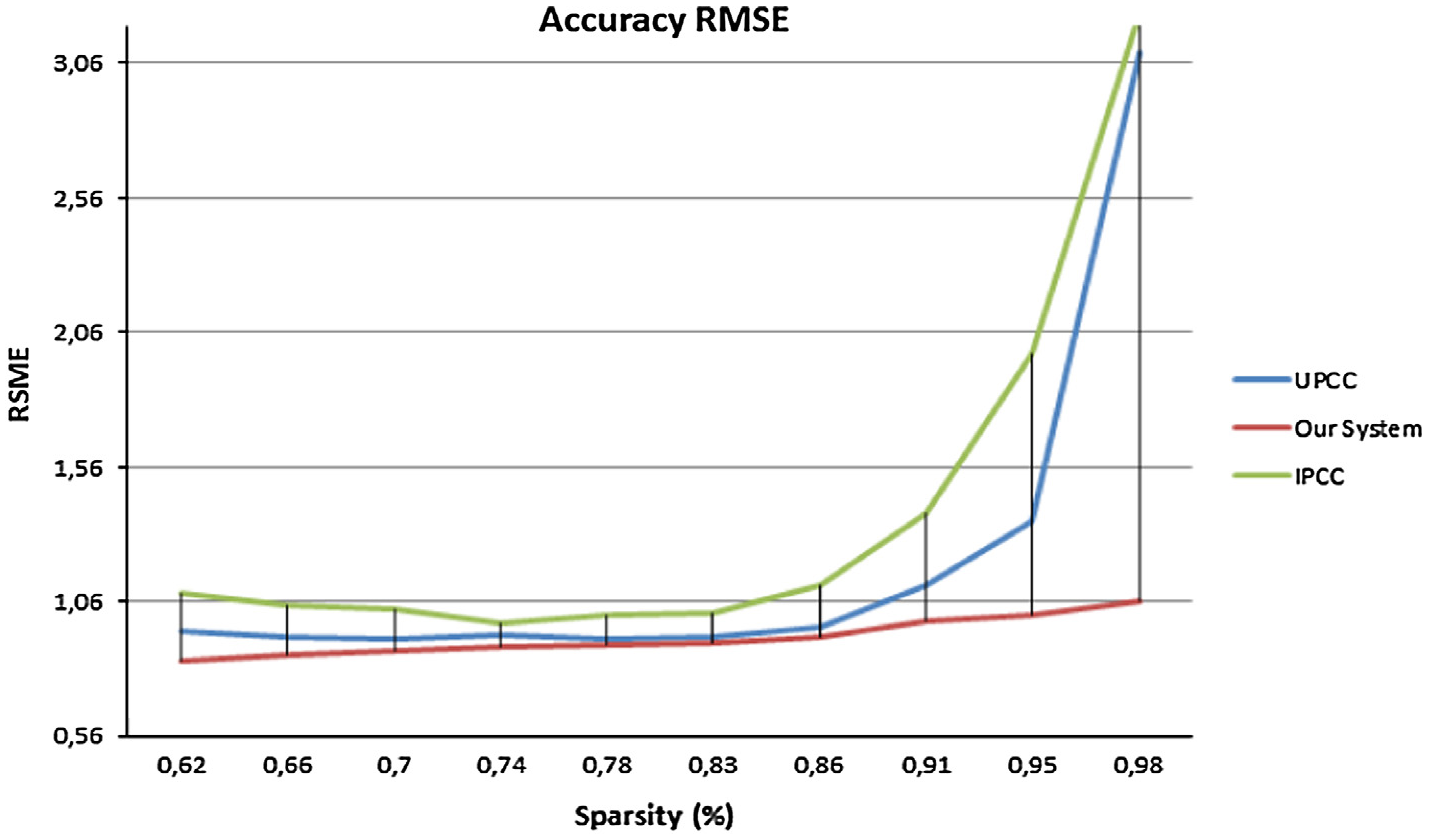
When compared against standard User-based (UPCC) and Item-based (IPCC) Collaborative Filtering, the proposed system showed a massive advantage as the "sparsity" of the data increased. While traditional models fail when ratings are missing, the inclusion of similarity matrices and social sentiment kept the error rates (RMSE) low.
User Experience (NASA-TLX)
In the travel scenario, users were asked to find complex packages (e.g., "cheap flight + 5-star hotel + pizza restaurant near the sea"). Using the proposed system, users completed these "Very High Complexity" tasks significantly faster (645s vs 842s on TripAdvisor) and reported lower frustration levels.
Critical Insight & Conclusion
This paper successfully bridges the gap between Quantitative Filtering (ratings) and Qualitative Analysis (sentiments).
Takeaway: The future of RecSys isn't just about predicting a 1-to-5 star rating; it's about understanding the contextual flow of a user session and the emotional nuance of the community.
Limitations: While powerful, the LDA-based sentiment analysis is computationally heavier than simple lexicon matching. Furthermore, the reliance on a "Similarity Matrix" (B) requires a well-defined domain taxonomy, which might be difficult to maintain in hyper-dynamic social environments.
Future Outlook: As we move toward 2026, the integration of Large Language Models (LLMs) to replace the LDA component for sentiment extraction could take this framework's accuracy to even higher levels.