
Burning Social Capital: Why Even Massive Social Networks Collapse
Collapse of an online social network: Burning social capital to create it?
This study investigates the collapse of iWiW, a major Hungarian online social network (OSN) with 3.5 million users, which was overtaken by Facebook. By analyzing the "last login" data of nearly 4 million users, the authors identify the micro-structural triggers that cause individuals to become early leavers, thereby sparking a cascading abandonment of the entire platform.
TL;DR
In the digital age, a platform with millions of users can vanish almost overnight. This paper analyzes the death of iWiW, a Hungarian giant that once held 2/3 of the nation's internet users. The findings suggest that networks don't collapse from the "core" outward; rather, they fail because they stop providing Bridging Social Capital. Users with diverse, open networks (bridges) are the "glue" that holds the site together. When they leave, the tightly-knit clusters (bonds) find the platform redundant and follow suit in a massive cascade.
The Mystery of the Digital Exodus
Why would anyone leave a platform where all their friends still reside? Economists call this "Network Externalities"—the idea that a service becomes more valuable as more people use it. By all accounts, iWiW should have been invincible in Hungary. Yet, by 2014, it was shut down.
The authors argue that we must look at the Micro-Structural level. The decision to leave isn't just about a "better" app (Facebook); it's about the type of social capital a user is "investing" in the platform.
Methodology: The Anatomy of an "Early Leaver"
The research defines an Early Leaver as a user who abandons the site while at least 90% of their friends are still active. They analyzed:
- Degree: How many connections do you have? (Social Capital volume)
- Local Clustering Coefficient (LCC): Are your friends also friends with each other? (Closed vs. Open structure)
- Early Adoption: Did you join the platform when it was still "cool" and new?
 The lifecycle of iWiW: From rising popularity to the tipping point where Facebook domesticates the market.
Core Insight: Bridges vs. Bonds
The study tests two competing sociological theories:
- The Closure Argument: Dense, clustered networks (where everyone knows everyone) should keep you on the site because of "social monitoring" and pressure.
- The Structural Hole Argument: Open networks (where you connect different groups) keep you on the site because the platform acts as a unique information "phonebook."
The Verdict:
The data reveals that Open Networks (Bridges) are more resilient. Users in bridging positions were significantly less likely to leave early. Why? Because if your network is highly clustered (redundant), you likely see those people offline or on other apps anyway. But if your network is a diverse collection of "weak ties," iWiW was the only place to maintain those information paths.
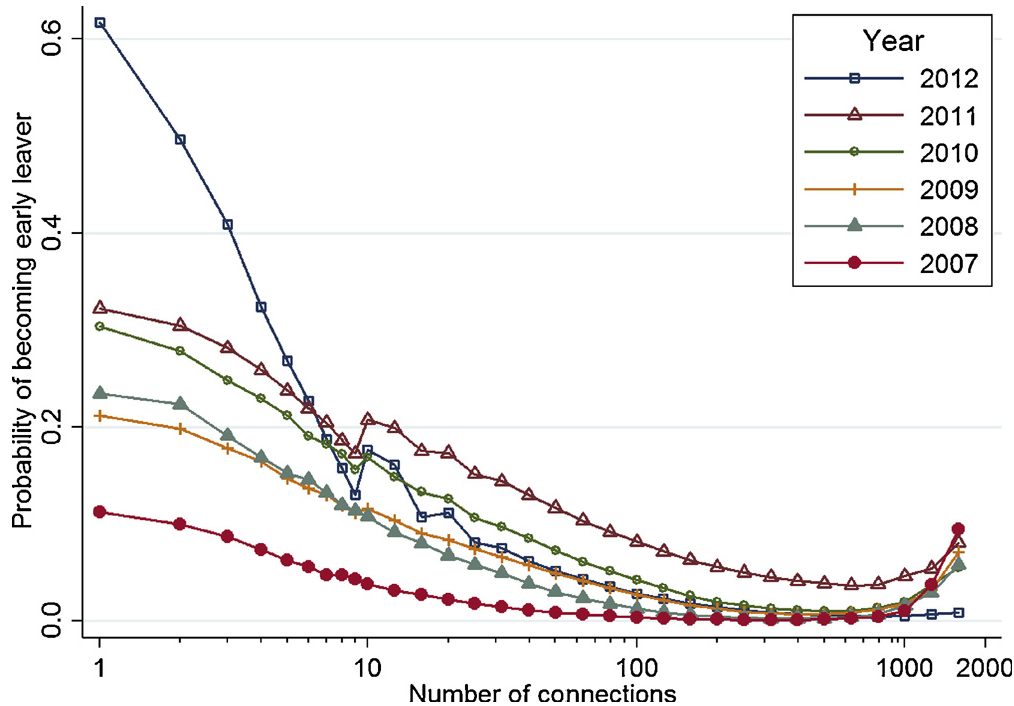 Evidence shows that the more connections (Degree) a user has, the lower their probability of leaving early—up to a point (Superhubs excepted).
Experiments and Results
Using Heterogeneous Choice Models, the authors found that:
- Degree Matters: Increasing connections from 100 to 200 decreases the chance of early abandonment by 39%.
- Clustering is a Risk: A decrease in clustering (making the network more "open") is associated with a 28% decrease in leaving probability.
- The "Innovator" Effect: While early adopters are generally more likely to try new things (and thus leave for Facebook first), this was only a secondary factor. The structural position in the network was the primary driver.
 Table 3: The multivariate analysis showing the negative impact of Degree and the positive impact of LCC on early leaving.
Critical Analysis: What This Means for the Future
The collapse of iWiW wasn't a failure of the "core" members leaving. It was a failure to retain the Information Brokers.
Takeaway for Product Managers: If your platform only serves "closed groups" (bonding capital), you are highly replaceable. To survive, a network must facilitate "bridging capital"—providing connections that users cannot easily replicate elsewhere.
Limitations: The study lacks data on the intensity of usage (how many likes/messages) and misses users who deleted their profiles entirely. However, the sheer scale of the 4-million-user dataset makes these structural findings highly robust.
Conclusion
Social networks don't just die because of "bugs" or "features." They die when the structural utility of the social capital they host is exceeded by a competitor. By the time the "clusters" start to leave, the network is already a ghost town; the real battle for survival is won or lost by how well you keep your "bridges" engaged.