
Collateral Damage: Why Your Friends' Apps are a Threat to Your Privacy
Collateral Damage of Facebook Apps: Friends, Providers, and Privacy Interdependence
2016-01-01
Summary
Problem
Method
Results
Takeaways
Abstract
This paper investigates "Collateral Damage" in Online Social Networks (OSNs), specifically how third-party Facebook apps collect personal data from a user's friends without the user's direct consent. The authors develop a mathematical framework to quantify the likelihood and significance of this privacy interdependence, demonstrating that a single popular app can affect the majority of a user's social circle.
## TL;DR
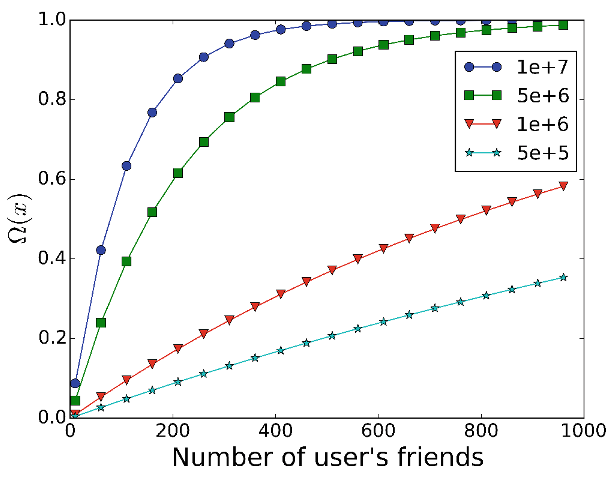
Think you're safe because you don't install sketchy Facebook apps? Think again. This research reveals the phenomenon of **Collateral Damage**: the privacy loss you suffer when your *friends* install apps that scrape *your* data. By analyzing real-world Facebook data and network simulations, the authors show that if you have 200+ friends, there is a nearly **80% chance** your data is being harvested by an app you never even touched.
## The Illusion of Individual Control
The core of the problem lies in **Privacy Interdependence**. In the Facebook ecosystem (especially at the time of this study), when User A installs an app, that app gains "permissions" not just to User A's data, but to certain attributes of User A's friends (User B).
The authors argue that this creates a **negative externality**:
* **User A** gets the benefit (a game, a quiz, or a utility).
* **User B** pays the price (loss of data privacy) without ever giving consent.
## Methodology: Quantifying the Crisis
The researchers didn't just speculate; they combined sociological surveys with rigorous mathematical modeling.
### 1. User Perception
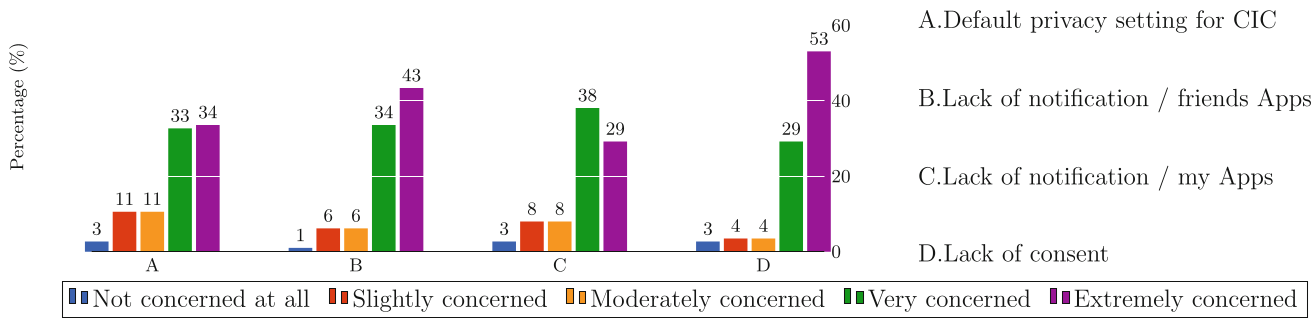
Through a survey of 114 participants, they found a striking "bidirectional concern." Users aren't just worried about their friends leaking their data; they are also worried about accidentally leaking their friends' data. Over **80% of users** were "very concerned" about collateral information collection without approval.
### 2. The Math of Exposure
The authors modeled the probability ($\varOmega$) that at least one friend installs a specific app.
$$ \varOmega = 1 - \prod_{f \in \mathsf{F}^{u}} (1 - Q^{f}) $$
Using the **Appinspect dataset** (16,808 apps), they found that for popular apps, the probability of exposure scales aggressively with your friend count.
## Profiling: The Provider Threat
A major insight of this paper is the "App Provider" (appP) problem. Unlike a single app, a provider might own 100+ different apps. By aggregating data from multiple apps, a provider can engage in **profiling**, stitching together bits of your identity—location from one friend's app, family status from another, and photos from a third—to create a "full profile" of a user who never used any of their services.
## Experimental Results: What’s Actually Leaking?
The study categorized profile attributes by sensitivity. The results were alarming:
* **Sensitive Attributes**: 48.6% of sensitive data (photos, videos, relationships) are exposed via profiling.
* **Location Data**: Roughly 23.5% of location-related attributes (hometown, work history) are collectable via collateral means.
Surprisingly, the amount of data an app can get from a user's friends is almost **equivalent** to what they get from the user themselves, proving that your "privacy wall" is only as strong as your least-private friend.
## The Solution: A Privacy Dashboard
To combat this, the authors propose a **Privacy Dashboard**. Instead of burying settings in complex menus, this tool would:
1. **Visualize Risk**: Show exactly which attributes are being leaked by which apps.
2. **Highlight Providers**: Identify the "shadow" entities (providers) aggregating your data.
3. **Enable Damage Control**: Provide a centralized hub to restrict what friends can "carry with them" to third-party apps.

## Critical Analysis & Future Outlook
While Facebook has since tightened its Graph API permissions (notably after the Cambridge Analytica scandal, which mirrored the "collateral damage" described here), the **logic of interdependence** remains relevant for modern OSNs, TikTok, and collaborative SaaS tools.
**Limitations**: The user survey was limited to a specific demographic (educated, IT-leaning), which might overstate general privacy awareness. However, the mathematical models for network exposure remain a robust warning for any platform that allows "contact syncing" or "friend-based" permissions.
**Conclusion**: This paper serves as a seminal warning that personal privacy is no longer personal—it is a collective social asset.