
Peer Collections: Reinventing Social App Development for the Mobile Ad-Hoc Era
A Collection-Oriented Framework for Social Applications
The paper introduces a collection-oriented framework designed for developing social applications in mobile ad-hoc environments. By extending the traditional object-oriented "collection" concept into "Peer Collections," the framework enables seamless data sharing and collaborative logic execution across mobile devices via Bluetooth or Wi-Fi.
TL;DR
Building mobile social apps used to mean wrestling with low-level sockets and complex message-passing logic. This paper presents a framework that abstracts these hurdles into Peer Collections—data structures that know how to "talk" to each other. By separating what an app does (logic) from how it collaborates (rules), developers can build complex social tools, from chat apps to location-based resource sharers, with minimal code.
Background: The Infrastructure of Physical Proximity
In the landscape of mobile computing, we often rely on fixed 3G or Wi-Fi hotspots. However, the most "social" connections often happen opportunistically—when two people are physically in the same space. The authors argue that while the hardware (Bluetooth, Wi-Fi) exists, the software abstractions are lagging. Developers are forced to rebuild the "collaboration wheel" for every new app.
The Problem/Motivation: The Coding Bottleneck
Why is it so hard to build a mobile social app?
- Tight Coupling: Collaboration logic (e.g., "if I see Bob, send him my latest reviews") is usually intertwined with the application UI and data storage.
- Low-Level Networking: Using JXTA or raw Java ME requires managing message formats and connection states manually.
- Lack of Abstraction: Most P2P frameworks focus on finding data, not managing the social interaction revolving around that data.
Methodology: The "Peer Collection" Insight
The core genius of this framework is the dual-interface collection. Imagine a standard Java List or Set, but with a "Social" side-car.
1. The Dual Interface
- Management Interface: Handles local
insert,retrieve, andremoveoperations. To the application, it looks like a normal local data structure. - Collaboration Interface: Binds to specific events like
New Peer Available,Remote Data Received, orNew Neighbour.
2. The Architecture
The framework consists of a persistence layer, a connectivity component (hiding the Bluetooth/Socket complexity), and a handling component.
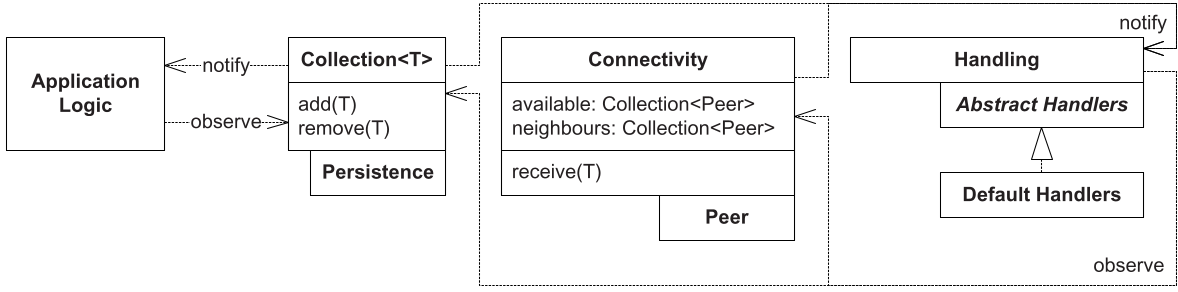
3. Event-Driven Collaboration
Instead of writing complex loops to check for peers, the developer defines a Policy. For example:
- On Local Creation: Broadcast to all neighbors.
- On New Neighbour: Share the last 10 items.
Experiments & Results: Putting it to the Test
The authors validated the framework by building two distinct applications:
- Opportunistic Chat: A group chat that handles multi-hop communication simply by adding peers to a "Neighbourhood" collection.
- Location-Based Resource Exchange: An app for sharing parking spot availability based on spatial relevance.
As shown in the code snippets below, the chat app requires almost zero custom logic; it relies entirely on the framework's Default Policies.
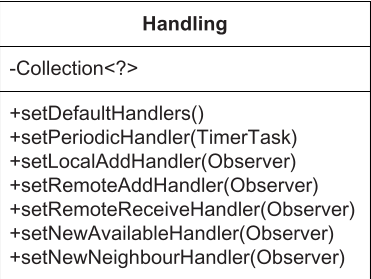
The results demonstrate that by using Hierarchical Collections (where a "Review" is a sub-collection of "General Data"), the framework can support complex data inheritance and specialized sharing rules without increasing system complexity.
Critical Analysis & Conclusion
Takeaway
The paper successfully shifts the focus from communication to collaboration. By making "sharing" a first-class property of a data collection, it effectively commoditizes the most difficult part of mobile ad-hoc networking.
Limitations
- Scalability: While excellent for small-scale physical groups, the paper doesn't deeply explore the "broadcast storm" problem in high-density environments.
- Security: The current model relies on a "push" paradigm for privacy, which is a good start, but lacks robust encryption or trust-scoring for unknown peers.
Future Outlook
This work lays the groundwork for "Edge Intelligence," where data moves not through a central cloud, but through the social fabric of the people carrying the devices. As we move toward more decentralized web technologies, the "Peer Collection" model remains a highly relevant blueprint for decoupling social behavior from network implementation.