
Social Mpower: Bridging the Gap Between Autonomic Systems and Human Collective Action
Collective Awareness for Collective Action in Socio-technical Systems
The paper introduces Social Mpower, a serious game designed to foster Collective Awareness and self-organization in Decentralized Community Energy Systems (dCES). It integrates Elinor Ostrom’s institutional design principles into a socio-technical framework to enable "humans-in-the-loop" to manage energy as a common-pool resource effectively.
TL;DR
In the transition to decentralized green energy, the bottleneck isn't just hardware—it's human coordination. This paper presents Social Mpower, a serious game that applies Nobel laureate Elinor Ostrom’s governance principles to smart grids. By fostering Collective Awareness, the system turns energy consumers into cooperative "prosumers," enabling them to avoid grid overloads through self-organization rather than top-down control.
The "Invisible Mechanic" Problem
Most autonomic systems—like those managing data centers—operate in the background, hidden from the user. However, in a Decentralized Community Energy System (dCES), human behavior is the primary variable.
The authors argue that current "smart" technology, specifically smart meters, are failing. They provide individual data (micro-level) and show national goals (macro-level), but they ignore the meso-level: the interaction between neighbors that actually determines if a local transformer will blow during a peak hour. Without a sense of "collective responsibility," users remain reactive, complaining only after a blackout occurs.
Methodology: Gaming for Governance
The core insight of this work is that to solve the "Common-Pool Resource" (CPR) problem of energy, we must treat the smart grid as a Social-Technical System. The authors implement this through a serious game based on Ostrom’s Principles.
1. The Architecture of Awareness
Social Mpower isn't just a simulation; it's a digital institution. It uses three pillars to drive collective action:
- Visualisation: Making energy scarcity "perceptually prominent."
- Social Networking: Providing communication channels (Local, IM, Group Chat) to allow for real-time negotiation.
- The Assembly: A virtual space where users collectively decide on the rules of distribution, satisfying Ostrom's "Collective Choice Arrangement."
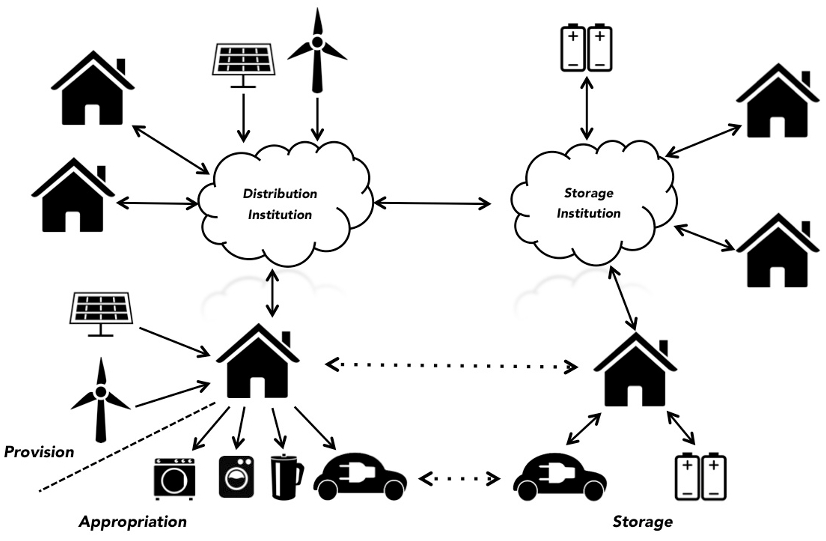 Figure 1: The dCES model where generation and decision-making are pushed to the edges (households).
2. Operationalizing Ostrom
The researchers mapped institutional theory directly into game mechanics. For instance, Smart Meters in the game serve as "Monitoring" agents (Principle 4), while access control to the game ensures "Clearly Defined Boundaries" (Principle 1).
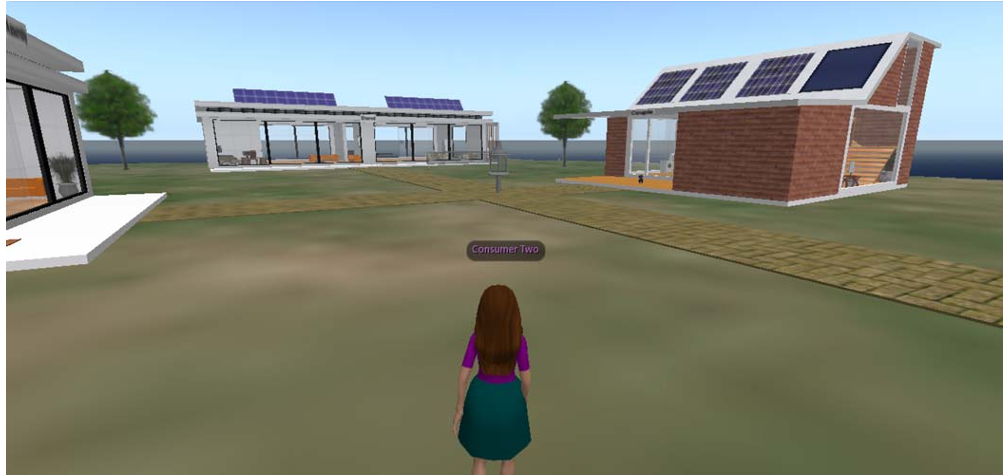 Figure 2: Players manage solar generation; scarcity triggers the need for social coordination.
Experiments & Human-in-the-Loop Results
Unlike purely automated Virtual Power Plants (VPPs), Social Mpower relies on pro-active behavior. The game demonstrates that when players are aware of the "physiological condition of the collective" (e.g., an imminent transformer trip), they are more likely to synchronize their appliance usage.
The authors compare Social Mpower with industry benchmarks:
- IBM CityOne & Siemens PowerMatrix: These focus on the "Manager" perspective—top-down optimization.
- Social Mpower: Focuses on Demand-side Self-Organisation. It proves that social capital and community-defined norms are more effective for long-term sustainability than price-only signals.
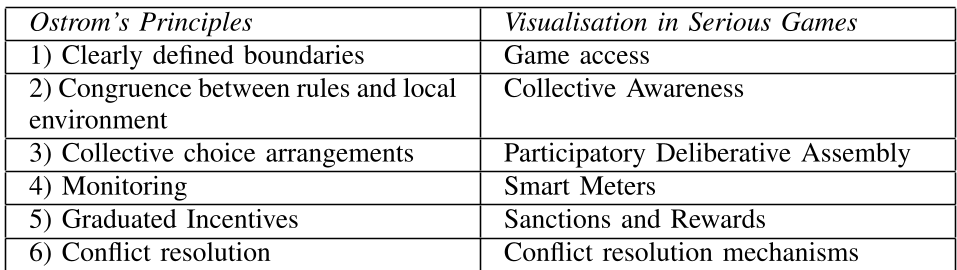 Table 1: Mapping Institutional Design Principles to Game Mechanics.
Critical Insight & Conclusion
The true value of this research lies in its rejection of the "Rational Agent" model. By showing that Collective Awareness acts as a "sense" (like hunger), the authors provide a blueprint for future socio-technical systems.
Limitations: The current study lacks a robust rewarding/sanctioning scheme (Ostrom's Principle 5) and does not yet account for external authority interference.
Future Outlook: As we move toward a world of "Systems-of-Systems," the integration of gamified self-governance into actual IoT infrastructure could be the key to making smart cities not just "automated," but truly "functional" for the people living in them.