
Collective Churn Prediction: Why Your Friends' Departure Matters More Than Your Profile
Collective Churn Prediction in Social Network
This paper introduces a "Collective Classification" (CC) framework for churn prediction in social networks, utilizing the Iterative Classification Algorithm (ICA). By integrating both intrinsic user profiles and extrinsic social interaction dependencies, the method achieves superior performance on real-world data from the myGamma mobile social network.
TL;DR
Predicting user churn has traditionally been a "lonely" task, focusing on individual behavior. This paper shifts the paradigm toward Collective Classification (CC). By treating a social network as a living graph, the authors demonstrate that a user's likelihood to quit is deeply intertwined with the behavior of their social circle. Using an iterative algorithm on real-world chat data, they achieved an F1-score of up to 76.25%, proving that social "extrinsic" factors are the true signal in the noise.
Problem & Motivation: The Echo Chamber of Churn
Most churn models operate on the i.i.d. assumption—the idea that User A stays or leaves independently of User B. However, in service industries like mobile social networks, churn is contagious.
Existing "Spreading Activation" models tried to account for this influence but were often too rigid, treating everyone with the same global parameters. They missed the nuance: Why a user leaves is a cocktail of their own profile (intrinsic) and their friends' influence (extrinsic). This paper bridges that gap by modeling churn as a joint inference problem across the entire community.
Methodology: The Power of Relational Thinking
The authors' core contribution is applying the Iterative Classification Algorithm (ICA) to a custom-built Chat Graph.
1. Robust Churn Definition
Instead of complex time windows, the authors found a natural "breaking point": if a user hasn't chatted for 30 days, they almost never return. This empirical threshold forms the basis of their ground truth.
2. The Chat Graph
Edges aren't just "friendship" links; they are built from reciprocal chat sessions. The strength of a tie is calculated based on session frequency and duration, adjusted for group chat sizes to ensure weight integrity.
3. Iterative Collective Classification
Unlike a standard SVM that looks at a user in isolation, the ICA works in cycles:
- Step 1 (Bootstrapping): Use a local classifier to make initial guesses based on user profiles and interaction stats.
- Step 2 (Relational Update): Recompute "Relational Features" (e.g., "What percentage of my frequent chat partners have already churned?").
- Step 3 (Refinement): Use a relational classifier to update the user's status based on both their own data and their neighbors' predicted status.
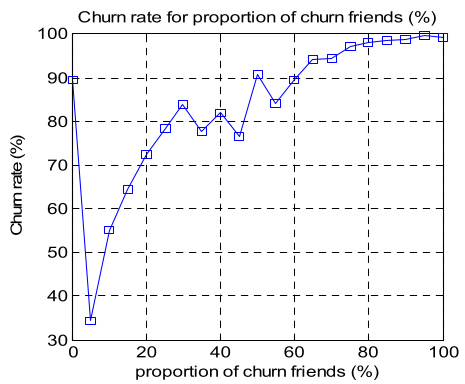 Figure 1: Distribution of chat gaps (a) and the clear correlation between friends' churn and user's churn rate (b).
Experiments & Results: Social Factors Reign Supreme
The study compared a conventional LIBLINEAR SVM against the ICA approach across different feature sets.
Key Insights:
- Beyond the Profile: User profiles (age, country, etc.) are weak predictors. Adding Interaction Features (number of messages, blogs, etc.) and Relational Features (network degree, neighbor churn status) drastically improved results.
- The CC Advantage: The Iterative CC approach was particularly effective when data was sparse. It "cautiously" propagated labels, leading to a much more robust F1-score (68.38% vs 60.38%) compared to non-relational models.
- Social Ties as Features: High-weight reciprocal edges were the strongest indicators. If your "inner circle" stops responding, you are likely next.
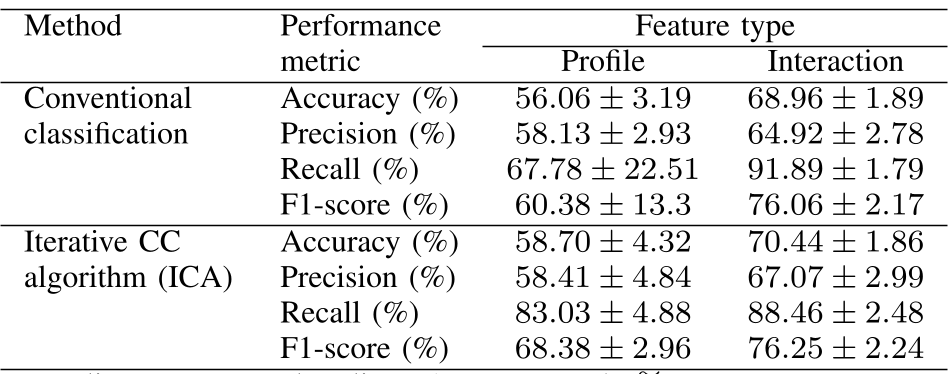 Table 3: Comparison shows ICA (Iterative CC) consistently delivering higher recall and better F1-scores than conventional methods.
Critical Analysis & Conclusion
Takeaway
The paper effectively argues that churn is a network phenomenon. Their use of both Label-Dependent and Label-Independent features allows the model to remain accurate even when the status of many users in the network is unknown.
Limitations
While powerful, the ICA approach depends heavily on the quality of the initial graph. The authors acknowledge that their current model uses a single "chat graph." In modern ecosystems, users interact through various layers (payments, games, groups).
Future Outlook
The next logical step—as hinted by the authors—is multi-graph fusion. By combining different interaction graphs (e.g., a "following" graph and a "transaction" graph) into a collective framework, service providers can gain an even more granular early warning system for user attrition.