
ICA-SN: Re-imagining Collective Classification for Social Network Surveillance
Collective classification in social networks
This paper introduces ICA-SN, an enhanced Iterative Classification Algorithm specifically tailored for social networks. It leverages multi-layer graph structures and custom neighborhood definitions to achieve superior classification in highly unbalanced datasets, specifically targeting the detection of jihadi propagandists and malware distributors.
TL;DR
The paper presents ICA-SN, a refined Iterative Classification Algorithm designed to handle the messy, unbalanced reality of online social networks (OSNs). By moving beyond simple "friendship" links and using multi-layer behavioral similarities coupled with stochastic neighborhood sampling, the authors significantly improve the detection of hidden threats like jihadi propagandists and malware distributors.
Problem & Motivation: The "Popularity" Trap
Most social network classification assumes Homophily—the idea that "birds of a feather flock together." If you are connected to a spammer, you are likely a spammer. However, researchers identify three critical failures in this logic:
- The Power Law Problem: High-degree (popular) nodes are connected to everyone, regardless of class. Following a celebrity doesn't define your intent.
- Cascading Errors: In traditional ICA, if a neighbor is misclassified, that error infects all its neighbors in the next step, creating a "feedback loop of wrongness."
- Sparse Interactions: Many users have almost no direct links, making it impossible to aggregate "neighbor data" effectively.
The authors' insight? Behavioral similarity is stronger than explicit links. If two accounts mention the same set of influencers or share the same obscure URLs, they belong to the same community, even if they never "follow" each other.
Methodology: Beyond Direct Links
The ICA-SN workflow introduces three major innovations to the standard collective classification pipeline:
1. Multi-Layer weighting
Social interaction is multifaceted (Retweets, Replies, Shared URLs). The model assigns different weights to these "layers" based on how well they cluster similar users together.
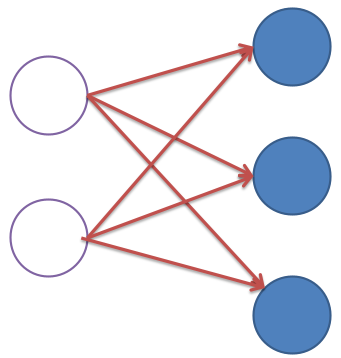 Fig. 1: Demonstrating that nodes reaching the same targets (hollow nodes) should be clustered together despite lacking a direct edge.
2. Markov Chain Distances
Instead of using the adjacency matrix, ICA-SN uses a -step Markov chain. This captures the probability that a random surfer lands on node starting from in a few steps. The distance is defined as: This identifies neighbors who have a similar "influence footprint."
3. Weighted Sampling
To solve the "cascading error," the algorithm doesn't use all neighbors every time. It samples edges from the -nearest neighbors based on distance. In each iteration, a node sees a slightly different neighborhood. This acts as a regularizer, preventing a single misclassified neighbor from permanently skewing the label.
Experiments & Results
The authors tested ICA-SN on a real-world ISIS Supporter Dataset. The data was intentionally split 20/80 (Training/Test) to simulate real-world surveillance where labels are scarce.
| Method | TP (True Positive) | FP (False Positive) |
|---|---|---|
| No Neighbors (Attribute Only) | 85.25 | 13.75 |
| Proposed ICA-SN | 88.75 | 11.25 |
| Standard ICA | 78.00 | 22.00 |
| KNN nodes using | 61.81 | 38.18 |
Deep Insight: Why did standard ICA fail?
Surprisingly, standard ICA performed worse than using no graph data at all (78% vs 85%). This highlights the Concentrated Linkage problem: in extremist networks, high-degree "hub" accounts are often monitored by both supporters and counter-narrative accounts. Standard ICA gets "confused" by these hubs, whereas ICA-SN's sampling and distance metric effectively bypasses them.
Critical Analysis & Conclusion
ICA-SN proves that how we define a neighbor is more important than the classification algorithm itself. By treating a social network as a multi-layered interaction space rather than a static graph, we can detect niche, malicious communities even within massive, unbalanced datasets.
Limitations:
- Computational Complexity: Calculating -step Markov chains and pairwise distances between "friends-of-friends" can be expensive for billion-node graphs.
- Static vs. Dynamic: The paper uses a static snapshot; however, malicious behavior is often highly temporal.
Future Outlook: This work paves the way for "Graph Contrastive Learning" in social surveillance, where the model learns the essence of a "neighbor" through interaction patterns rather than just link existence.