
CGE: Mapping the Social Graph onto the Physical World through Geometric Embedding
Collective Geographical Embedding for Geolocating Social Network Users
The paper introduces Collective Geographical Embedding (CGE), a novel framework for geolocating social network users by embedding heterogeneous data sources—social links, check-ins, and location affinities—into a joint low-dimensional space. CGE achieves SOTA performance by ensuring that Euclidean distances in the embedding space directly reflect real-world physical distances.
TL;DR
Locating social media users is a challenge dominated by sparse check-ins and noise. Collective Geographical Embedding (CGE) solves this by fusioning social networks and footprints into a unified embedding space where "closeness" isn't just a social metric, but a physical one. By adding a geometric constraint to the learning process, CGE outperforms traditional label propagation and standard embedding models (like PTE) in predicting user home locations at the city level.
The "Physicality" Gap in Representation Learning
Most network embedding algorithms are designed to capture topological similarity: if User A and User B share many friends, their vectors should be close. However, in the realm of geolocation, "closeness" has a literal meaning.
The problem with prior works is threefold:
- Sparsity: Only about 1% of tweets contain coordinates.
- Noise: You might follow a celebrity in Los Angeles while living in London.
- Missing Geometry: Standard embeddings treat "New York" and "Philadelphia" as abstract IDs, ignoring the fact that they are geographically adjacent.
CGE’s core intuition is that the embedding space should be a distorted map of the physical world, where social ties act as forces pulling users toward coordinates.
Methodology: Bridging Topology and Geography
The CGE framework constructs a Heterogeneous User Network consisting of three sub-graphs:
- Social Network (User-User): Captures "friendships."
- User-Location Network (User-Point of Interest): Captures "check-in behavior."
- Location Affinity Network (Point-Point): Encodes "geographical proximity."
The Core Mechanism: Geometric Regularization
While the social and check-in components are learned via standard second-order proximity (minimizing KL divergence), the breakthrough lies in the Geometric Regularization term :
Using a Laplacian matrix , the authors force the location vectors to respect the real-world distance. If two venues are close on a map, their embeddings must be close in the vector space. This spreads spatial information from users with check-ins to their "dark" (non-geotagged) social neighbors.
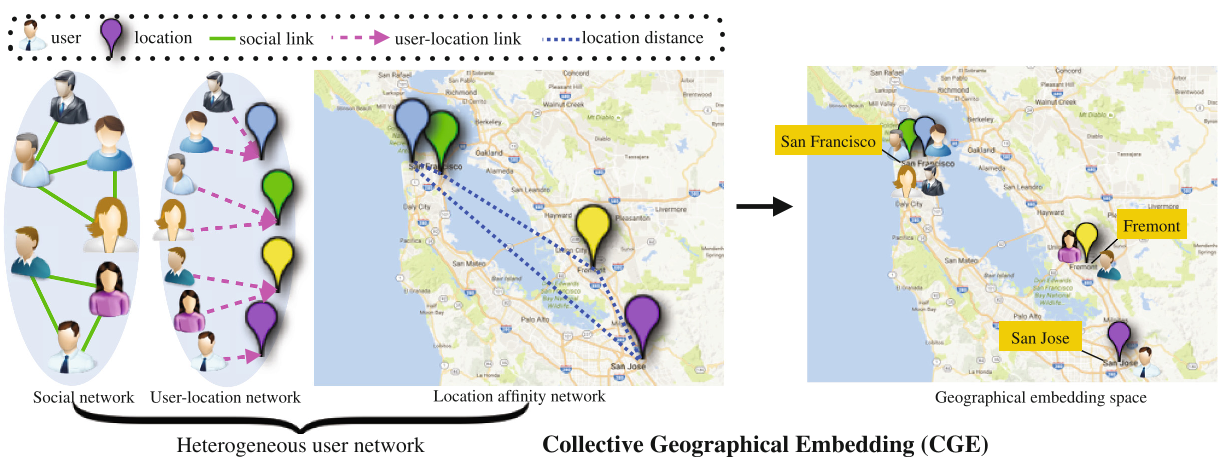 Figure 1: Transition from a heterogeneous network (left) to a geometrically-constrained embedding space (right).
Experiments and Results
The authors tested CGE on Foursquare and Twitter datasets (covering global users, not just US-based, increasing difficulty).
SOTA Comparison
CGE consistently outperformed non-embedding methods (LP, SLP, FIND) and general embedding methods (LINE, PTE).
- Foursquare: CGE(CFV) achieved an AUC of 77.13%, a massive leap over SLP’s 61.21%.
- Twitter: Even with noisy "follow" relationships, CGE maintained a lead, proving that the user-location network is the most robust signal for geolocation.
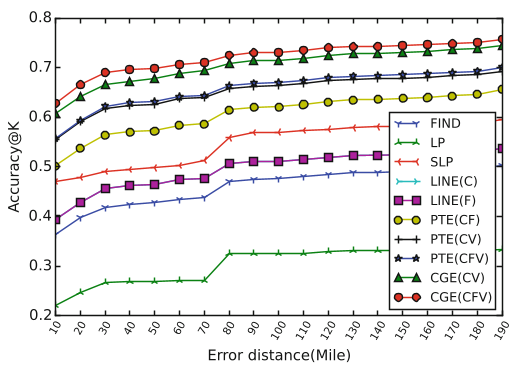 Figure 2: Accuracy@k comparison showing CGE's dominance across various distance thresholds.
Ablation Insight: What Matters Most?
The ablation study revealed a hierarchy of data value:
- User-Location (Check-ins): The strongest predictor. Without it, performance drops by ~19%.
- Location Affinity: Crucial for "grounding" the model. Without it, performance drops by ~13%.
- Friendships: Valuable but noisy, especially on Twitter (only ~3% drop if excluded).
Critical Insight & Future Outlook
The genius of CGE is the realization that latent spaces don't have to be purely abstract. By forcing the embedding to align with a known physical manifold (the Earth's surface), the model becomes significantly more robust to the noise inherent in social media.
Limitations: The current approach uses a static snapshot of data. Social behavior is temporal—users move, and local events come and go. Integrating a temporal decay factor or a dynamic graph mechanism could be the next frontier for this work. Furthermore, applying this to Location Recommendation (predicting where a user will go rather than where they live) is a natural and high-value extension.
Conclusion: CGE represents a shift from "Social-only" to "Social-Spatial" AI, providing a blueprints for how to fuse physical-world constraints into deep learning architectures.