
ReviewRank: Leveraging Collective Intelligence to Solve the Book Review Ranking Challenge
Collective Intelligence Based Algorithm for Ranking Book Reviews
The paper introduces ReviewRank, a novel ranking technique specifically designed for book reviews that leverages collective intelligence. It integrates user engagement metrics with traditional TF-IDF to identify both explicitly and potentially important reviews in online bookstores.
TL;DR
Search engines like Google excel at finding web pages by tracing the "web of links." However, book reviews exist in a "link-sparse" vacuum where citations are rare. ReviewRank solves this by treating user interactions—replies, reply lengths, and reviewer activity—as a form of Collective Intelligence, creating a more accurate relevance model that outperforms both traditional TF-IDF and general-purpose search engines.
Background: Beyond the Hyperlink
In the world of Information Retrieval (IR), the PageRank algorithm is king. It views a hyperlink from Page A to Page B as a vote of confidence. But if you look at an online bookstore like Amazon, users don't "link" to each other's reviews. Without these "votes," traditional search engines struggle to distinguish between a thoughtful, 500-word critique and a one-sentence "It was okay."
The authors argue that while links are missing, voluntary participation is not. The community’s reaction to a review (collective intelligence) provides a hidden signal of quality that can be mathematically harnessed.
The Core Insight: Quantifying Collective Intelligence
The authors identified three specific "measures" that correlate strongly with a review’s perceived importance:
- Number of Replies: High engagement usually signals a controversial or highly informative review.
- Average Length of Replies: Deep discussions indicate that the original review provided significant substance.
- Reviewer Participation: The historical activity level of the author.
By using the Pearson Correlation Coefficient, the system determines the "adoption rate" (weight) of these measures. If a certain community values reply length over reply count, the algorithm adjusts itself automatically.
The Architecture of ReviewRank
The algorithm follows a three-step pipeline: Analyze (extracting metrics), Calculate Weight (applying the correlation model), and Calculate Rank (fusing with keyword importance).
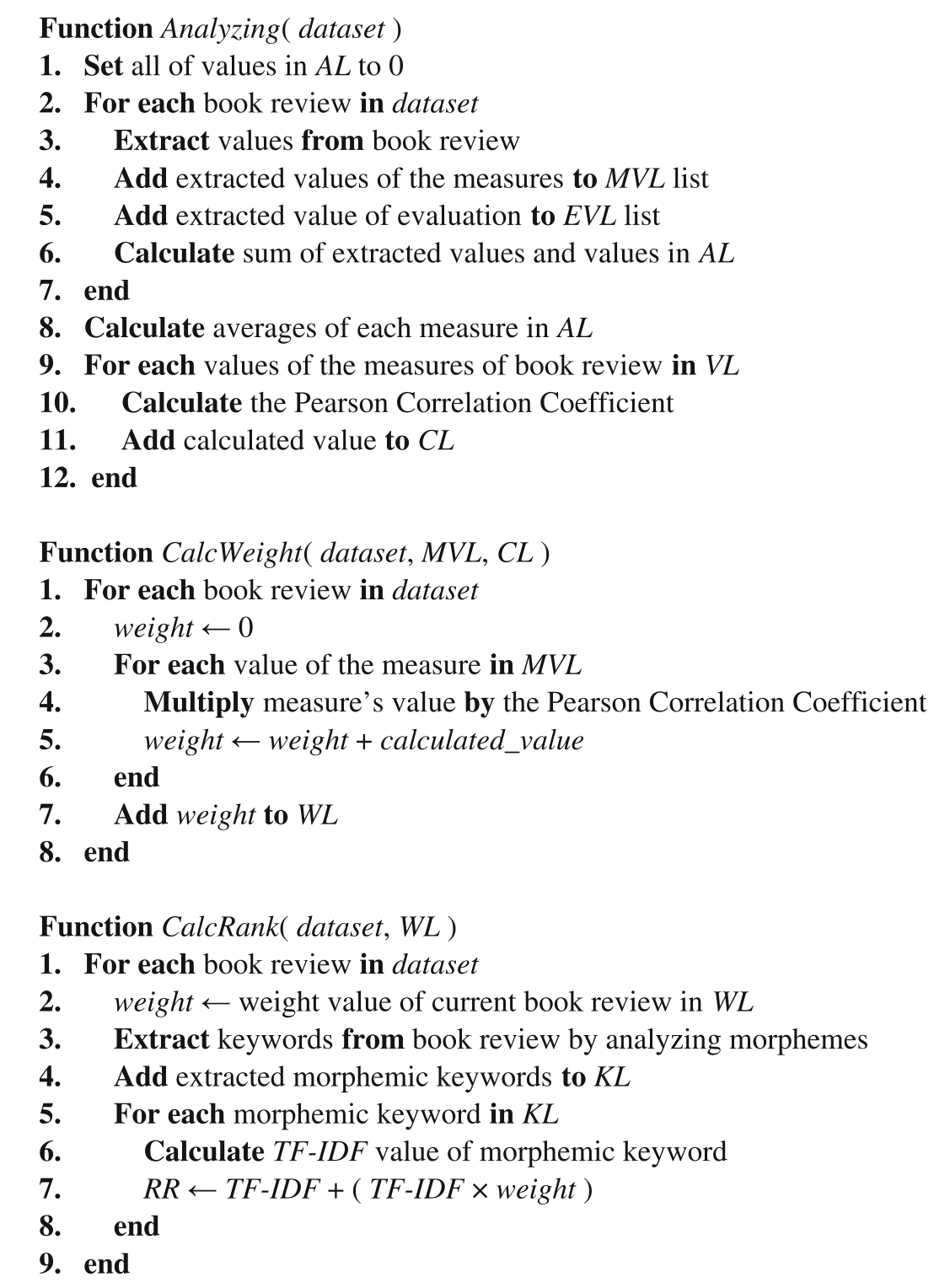
The final ranking score is not just a keyword match. It uses an augmented TF-IDF formula:
Ranking = TF-IDF + (TF-IDF * ReviewRank)
This ensures that even if two reviews have the same keyword density, the one with better community feedback wins.
Experimental Performance
The researchers tested ReviewRank against 110,000 reviews from Amazon and Goodreads. They compared it against three baselines: Standard TF-IDF, LengthRank (which only considers review length), and Google Search.
Precision and Recall
The results were conclusive. ReviewRank achieved higher precision across varied search queries (e.g., "History," "Toll," "Time").
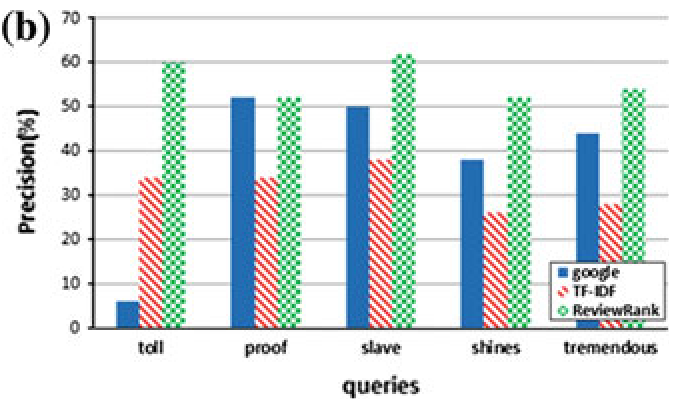
One of the most impressive findings was that ReviewRank outperformed Google for specific book review searches. This is because Google’s general-purpose algorithm is "polluted" by site-wide authority signals, whereas ReviewRank focuses on the intrinsic quality markers of the review itself.
Critical Insight: The "Potential" Factor
The most valuable contribution of this paper is the concept of Potentially Important Reviews. By identifying the characteristics of reviews that the crowd typically likes (high reply-to-length ratio, etc.), ReviewRank can promote high-quality new reviews that haven't had time to accumulate thousands of "Helpful" votes yet. This solves the "Cold Start" problem in review ranking.
Conclusion & Future Outlook
ReviewRank proves that collective intelligence is a viable replacement for link-based authority in niche domains. As we move toward a more decentralized web where "communities" matter more than "hyperlinks," this correlation-based approach to ranking offers a blueprint for building more human-centric search engines.
Limitations: The current model relies heavily on the presence of replies. In platforms with low user engagement, the "Collective Intelligence" signal might be too weak, requiring a shift toward other metadata like dwell time or scroll depth.