
CI-Based QA: Bridging the Gap Between Inspection and Risk Assessment in MDE
Collective Intelligence-Based Quality Assurance: Combining Inspection and Risk Assessment to Support Process Improvement in Multi-Disciplinary Engineering
The paper proposes a Collective Intelligence-Based Quality Assurance (CI-Based QA) approach tailored for Multi-Disciplinary Engineering (MDE). It integrates Software Inspection with Failure Mode and Effect Analysis (FMEA), utilizing a Collective Intelligence System (CIS) to bridge knowledge silos and significantly improve defect detection and risk assessment performance.
TL;DR
In the complex world of Multi-Disciplinary Engineering (MDE), specialists often work in silos, leading to fragmented Quality Assurance (QA). This paper introduces CI-Based QA, a framework that combines Software Inspection (early defect detection) and FMEA (Failure Mode and Effect Analysis) using a Collective Intelligence System (CIS). By creating a feedback loop between these two previously isolated methods, the approach ensures that captured knowledge from one discipline directly improves the quality and risk management of the others.
The Silo Problem in Multi-Disciplinary Engineering
Modern engineering projects—like building a hydro power plant—require a symphony of mechanical, electrical, and software engineering. However, these disciplines usually follow a sequential process with isolated QA activities.
The authors identify a critical gap:
- Inspections find defects but don't always assess their long-term risk.
- FMEA identifies risks but often relies on the implicit "gut feeling" of experts rather than systematic defect data.
- The Result: Valuable engineering knowledge is lost once a project ends, and the wheel is reinvented in every new project.
Methodology: The Core Architecture of CI-Based QA
The heart of the paper is the integration of traditional QA techniques via a CIS mediator.
1. The Inspection-FMEA Feedback Loop
The proposed process creates a bidirectional flow of technical intelligence:
- Forward Path: The "Team Defect List" generated from structured inspections (using techniques like Perspective-Based Reading) serves as the primary input for FMEA workshops.
- Backward Path: The Risk Priority Numbers (RPN) and countermeasures identified during FMEA are used to update inspection checklists and reading techniques for future cycles.
2. The CIS as the Knowledge Hub
The Collective Intelligence System serves as the repository for both explicit and implicit knowledge.
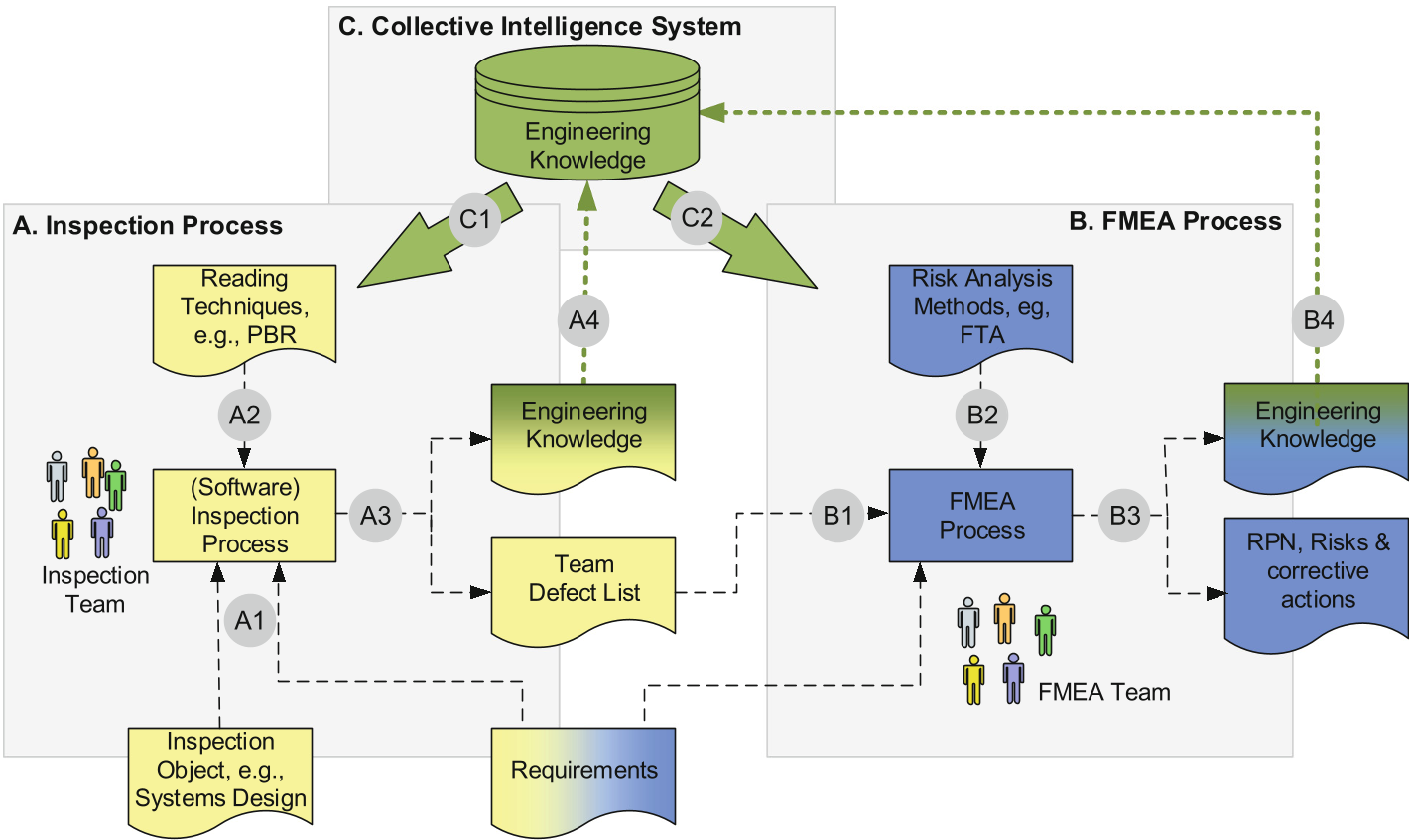
The architecture shows how Inspection (A) and FMEA (B) feed into the CIS (C), which then disseminates improved guidelines (C1) back to the practitioners.
Experimental Performance & Evaluation
The authors conducted a conceptual evaluation against traditional methods. The results, validated by industry experts, suggest that combining these methods addresses the "Reuse of Knowledge" bottleneck that plagues individual QA approaches.
Key Comparison Table
| Needs/Capabilities | Traditional Inspection | Traditional FMEA | CI-Based QA |
|---|---|---|---|
| Defect Detection Performance | ++ | - | ++ |
| Risk Assessment Effectiveness | o | ++ | ++ |
| Reuse of Experience | - | - | ++ |
| Systematic QA | o | o | ++ |
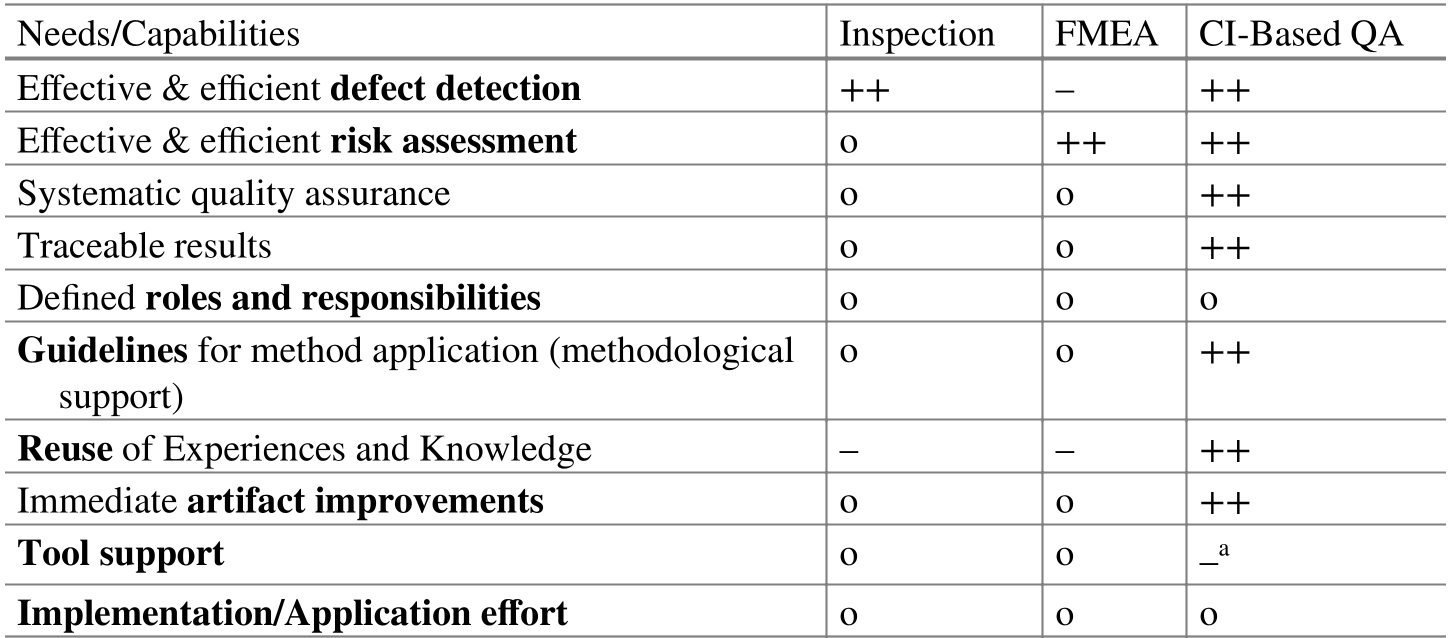
Performance comparison highlighting the superior capability of CI-based QA in experience reuse and traceability.
Critical Analysis & Conclusion
Takeaway
The synergy between Software Engineering best practices (Inspections) and Systems Engineering standards (FMEA) is not just a process change—it is a data integration challenge. By using a CIS, organizations can transform "tribal knowledge" into a structured asset that improves the performance of even less-experienced engineers.
Limitations & Future Work
While the conceptual framework is robust, the paper acknowledges that:
- Full-scale tool support is still under development.
- Industrial evidence is currently limited to pilot studies and expert discussions.
- Future research will focus on the semantic integration of these data models to automate the "learning" part of the CIS feedback loop.
In conclusion, this work provides a roadmap for moving beyond "check-the-box" QA toward a truly intelligent, data-driven engineering culture.