
Collective Intelligence: A Robust Approach to Autonomous Bushfire Spotting
Collective intelligence and bush fire spoing
The paper presents a collective intelligence algorithm for coordinating multiple Unmanned Aerial Vehicles (UAVs) in bushfire spotting tasks. It combines principles from Particle Swarm Optimization (PSO) and Ant Colony Optimization (ACO) to enable autonomous search without centralized control, achieving proportional surveillance coverage based on area priority.
TL;DR
Researchers have developed a decentralized coordination algorithm for UAV swarms that mimics the behavior of ants and particles to monitor bushfires. By using stigmergy—a mechanism where agents interact through environmental signals (artificial pheromones)—the system ensures that high-risk areas are surveyed more frequently than low-risk ones, all while remaining resilient to communication noise and hardware failure.
Context: The Search vs. The Survey
Bushfires in remote regions like the Australian outback are a race against time. While UAVs are ideal for spotting, most swarm research focuses on "seek and destroy" missions—finding a specific target and stopping. Monitoring a fire, however, is a persistent survey problem. The entire map is a potential target, and areas must be re-visited periodically.
The core challenge is coordination: How do you prevent 10 drones from looking at the same gully while another ridge burns unnoticed—especially when central communication is unreliable?
The "Ant-Swarm" Hybrid Methodology
The authors propose a unique blend of two heavyweights in evolutionary computation: Particle Swarm Optimization (PSO) and Ant Colony Optimization (ACO).
1. Pheromone Maps (ACO Logic)
Each UAV carries its own internal map of the terrain. Every cell in the map accumulates "pheromone" over time.
- High-priority areas (dry gullies) have a high pheromone growth rate.
- Low-priority areas (bare rock) grow slowly.
- When a UAV surveys a cell, the pheromone is reset to zero.
2. Physical Dynamics (PSO Logic)
The UAVs aren't just data points; they have momentum and repulsion.
- Repulsion: If two UAVs get too close, they physically repel each other in the simulation to avoid redundancy.
- Attraction: UAVs are attracted to cells with the highest pheromone levels (the most "overdue" spots).
3. Emergent Coordination
When two UAVs come within communication range, they don't "talk" in the traditional sense. Instead, they merge their maps. They exchange pheromone data and update their internal maps to the lowest value (meaning "someone has already checked this place recently").
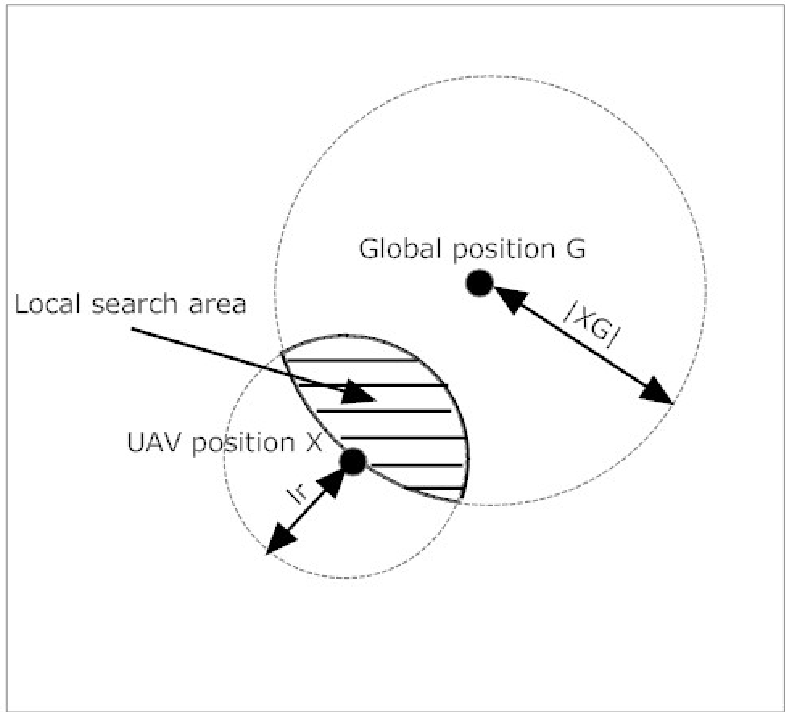 The local search area (shaded) ensures the UAV addresses survey needs along its path toward the global target G.
Experimental Proof: Strength in Numbers
The algorithm was tested on both simple uniform maps and complex grids with varying priorities (High:Medium:Low in a 4:2:1 ratio).
- The Power of Communication: Without collective intelligence, a single drone is overwhelmed. However, as the communication range increases, the "lateness" of surveys drops dramatically.
- Efficiency: In a complex map, the algorithm naturally allocated drones such that high-priority areas were visited exactly four times as often as low-priority areas, matching the user's requirements.
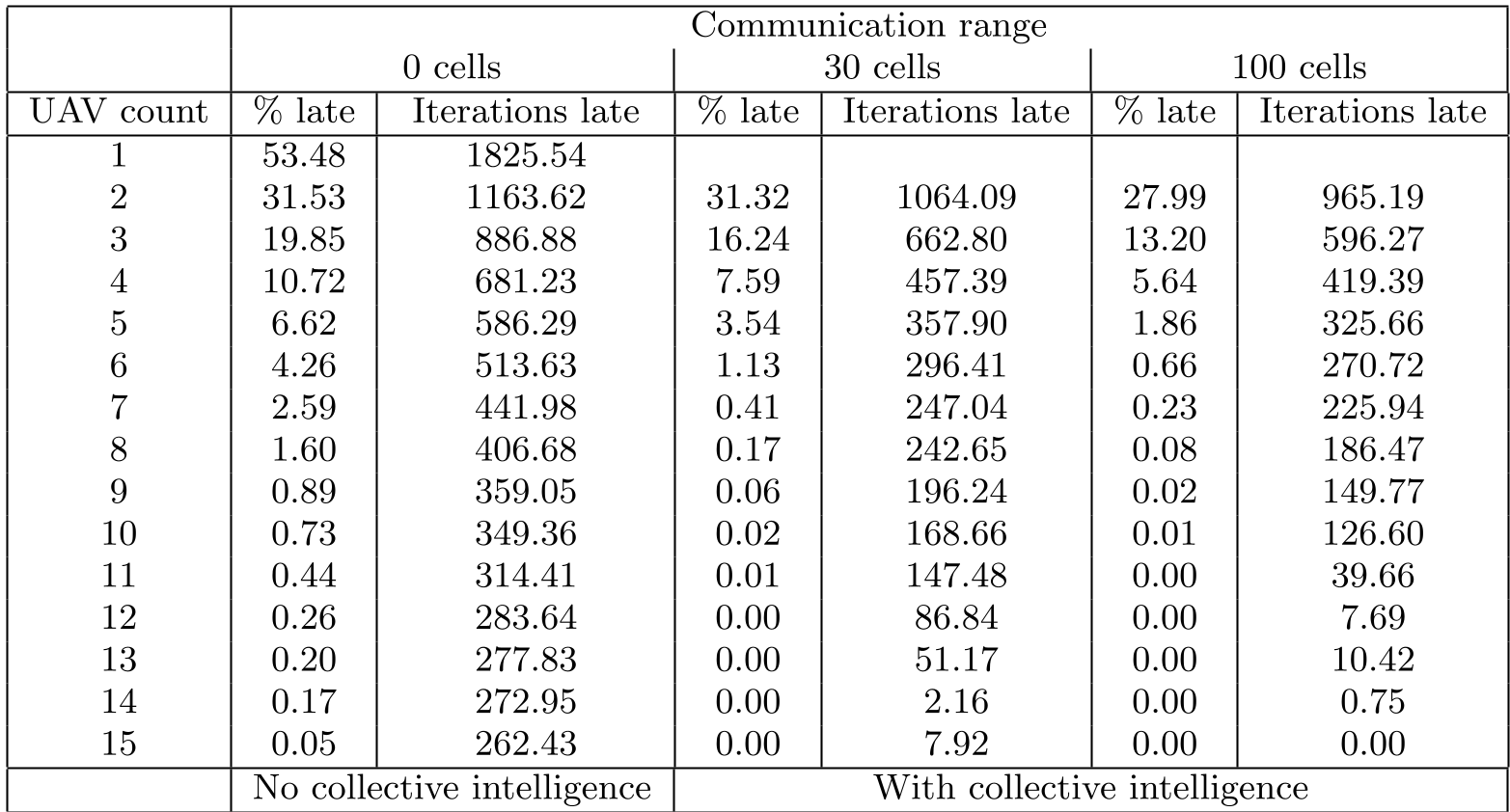 Table 1 illustrates that with a communication range of 100, 15 UAVs achieve a perfect 0% lateness rate, whereas non-communicating agents fail to cover the area effectively.
Resilience Against "Mad" Drones
A standout feature of this research is the Robustness Test. The authors simulated a "malfunctioning" UAV that broadcasted random, incorrect pheromone data. Surprisingly, the system absorbed this noise. While it led to slight over-surveying of high-priority areas, the overall mission success remained intact.
Critical Insight
The brilliance of this approach lies in its simplicity. By avoiding a "Global Master" controller, the swarm becomes an "organism" that can lose individual parts without losing its mind. For real-world deployment in harsh, smoke-filled environments where GPS and radio signals might flicker, this de-centralized pheromone-based logic is far more practical than rigid centralized planning.
Limitations & Future Work
The study assumes a 2D plane and does not yet fully account for battery constraints (returning to base for fuel). However, the authors argue that since the algorithm is inherently dynamic—handling "lost" drones easily—adding refueling cycles would simply be treated by the swarm as temporary agent loss, which the system is already proven to handle.
Takeaway
Collective intelligence isn't just a buzzword; it's a structural insurance policy for multi-agent systems in unpredictable environments.