
AllFlock: Modeling Airline Alliances through the Lens of Swarm Intelligence
Collective Intelligence and Collaboration: A Case Study in Airline Industry
The paper introduces AllFlock, a novel adaptation of the Cucker-Smale (C-S) flocking algorithm to model the collective intelligence and collaborative dynamics of airline alliances. By integrating Cooperative Game Theory (Shapley Value) and Reinforcement Learning, it simulates how airlines decide to join, stay, or leave strategic alliances, achieving a convergence behavior analogous to biological flocks.
TL;DR
Why do airline giants like Delta or Lufthansa stay in alliances for decades while others drift away? This paper proposes AllFlock, a computational model that treats airline alliances as "flocks" of birds. By re-engineering the classic Cucker-Smale algorithm with Reinforcement Learning and Shapley Values, the researchers created a simulation that accurately mirrors the real-world stability of global networks like SkyTeam and StarAlliance.
Problem & Motivation: The Complexity of Cooperation
In the hyper-competitive airline industry, collaboration isn't just a choice—it's a survival strategy. However, understanding why these alliances form and persist is challenging. Traditional economic models often ignore the social dynamics and collective intelligence that emerge when organizations act as a group.
The authors argue that an alliance is essentially a "flock" moving toward a common financial goal. The pain point lies in quantifying "influence" and "learning" within these groups. How do you measure an airline's "position" in a digital landscape of partnerships?
Methodology: From Birds to B-Models
The core of the paper is the translation of biological flocking rules into corporate strategy using the Cucker-Smale (C-S) framework.
The Three Pillars of AllFlock:
- Position (): Not geographical, but a "Choice" vector representing which partner an organization wants to follow to maximize gains.
- Velocity (): Represented by the performance delta (growth in net income) between time steps.
- Influence (): Calculated via the Shapley Value, a concept from cooperative game theory that determines the "fair share" of the total gains each member brings to the alliance.
The Learning Mechanism
Unlike static models, AllFlock uses Reinforcement Learning. Organizations adapt their behavior based on a reward () and an amortization rate (), refining their choices through interaction.
 The evolution of choice () integrates previous experience, alliance influence, and individual growth.
Experiments & Results: Simulating the Sky
The authors utilized NetLogo to run 100 simulations across five different configurations, varying parameters like the "exploration vs. knowledge" rate and evaluation time.
Key Findings:
- Convergence: The model showed clear evidence of "flocking behavior," where airlines eventually reached a consensus on cooperation.
- Real-world Validation: The simulated permanence rates (the percentage of airlines that stay in the alliance) were remarkably close to reality. For instance, the model's high-stability configuration yielded ~79%, almost identical to the real-world SkyTeam (79.17%).
- The "Time" Factor: Configurations that allowed for longer "evaluation times" (Config 2, 3, 5) resulted in much higher stability than those that demanded quick results.
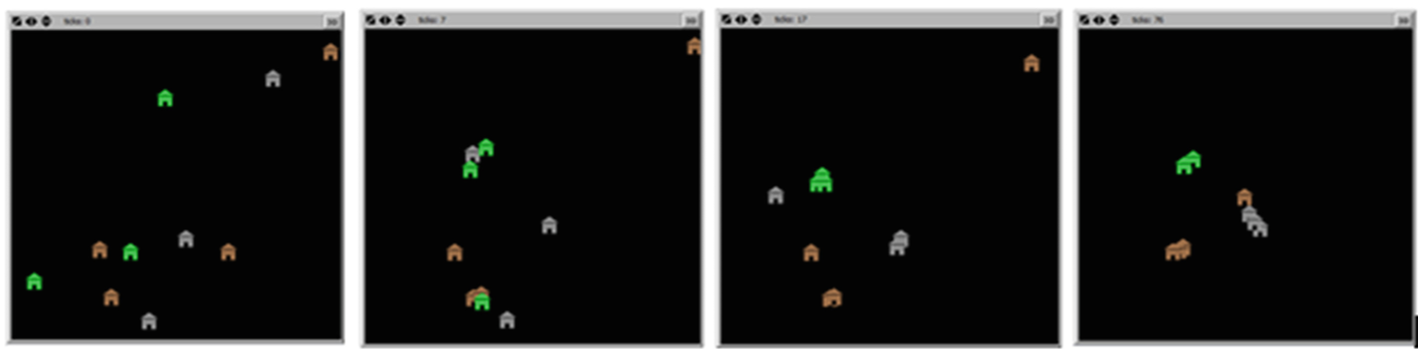 Visualizing the emergence of organization clusters (flocks) at different simulation intervals.
Critical Analysis & Conclusion
Takeaway
The research successfully bridges biology and business. By using Agent-Based Modeling, it demonstrates that collective intelligence is not just a human trait but a structural outcome of strategic rules and rewards.
Limitations & Future Work
The current AllFlock model has two primary "blind spots":
- Exclusivity: It doesn't allow an airline to leave one alliance and immediately jump to another.
- Sub-Alliances: It ignores the "inner circles" or bilateral agreements that often exist within larger alliances (e.g., joint ventures).
Predicting the future of airline alliances might soon rely less on intuition and more on the mathematical beauty of the flock.