
CoopSched: Bridging Swarm Intelligence and Multi-Agent Cooperation for Dynamic Manufacturing
Collective intelligence on dynamic manufacturing scheduling optimization
This paper introduces CoopSched, a hybrid Multi-Agent System (MAS) that integrates Swarm Intelligence (ACO and PSO) with a novel cooperation mechanism to optimize Extended Job-Shop Scheduling Problems (EJSSP) in dynamic manufacturing environments. The system achieves significant reductions in makespan and improves resource utilization rates by transitioning from selfish agent behavior to collective intelligence.
TL;DR
The manufacturing industry is shifting from static planning to high-speed, dynamic environments. This paper presents CoopSched, a framework that combines the biological inspiration of Ant Colony Optimization (ACO) and Particle Swarm Optimization (PSO) with a structured Multi-Agent System (MAS). By introducing a post-optimization "Cooperation Mechanism," the researchers successfully transformed selfish local schedules into globally optimized manufacturing plans, significantly reducing idle times and makespan.
Problem & Motivation: The Chaos of the Factory Floor
In modern engineering, a "perfect" schedule lasts only until the first machine breaks or a priority order arrives. Traditional Job-Shop Scheduling Problems (JSSP) are NP-hard and usually treated as static puzzles. However, the real world involves:
- Dynamic Perturbations: Constant arrival/cancellation of jobs.
- Complex Dependencies: Multi-level assemblies and alternative machines.
- Selfish Agents: In many MAS, agents only care about their local machine, often creating bottlenecks elsewhere in the chain.
The authors' insight was simple: local "Swarms" (ACO/PSO) are great at finding local optima, but they need a Social Layer to negotiate and resolve global conflicts.
Methodology: The CoopSched Architecture
The system treats every machine as a Resource Agent. The workflow follows a hierarchical but collaborative path:
1. The Swarm Layer (Local Optimization)
Each Resource Agent employs either ACO or PSO:
- ACO: Mimics ants depositing pheromones to find the shortest path.
- PSO: Particles "fly" through the solution space, balancing their private best position with the global best of the group.
2. The Cooperation Mechanism (Global Refinement)
This is the core innovation. Once agents submit their "selfish" plans, a coordinator analyzes the gaps.
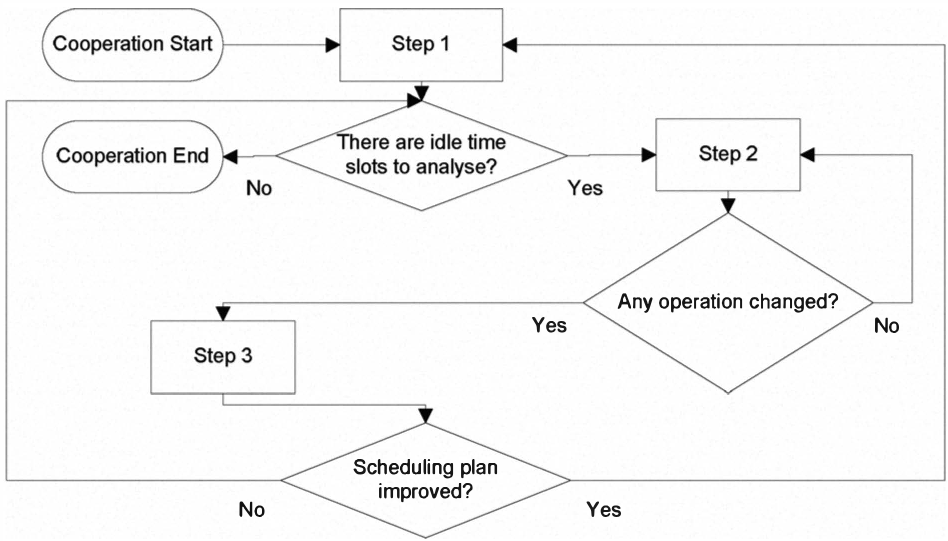
The algorithm follows three steps:
- Step 1: Analyze resources for idle times between operations.
- Step 2: Test "what-if" scenarios—exchanging delayed operations or swapping precedences.
- Step 3: Reconstruct a new, denser scheduling plan.
Experiments: SOTA Benchmarks
The authors tested their system against classic benchmarks like Fisher & Thompson (FT) and Lawrence (La) instances.
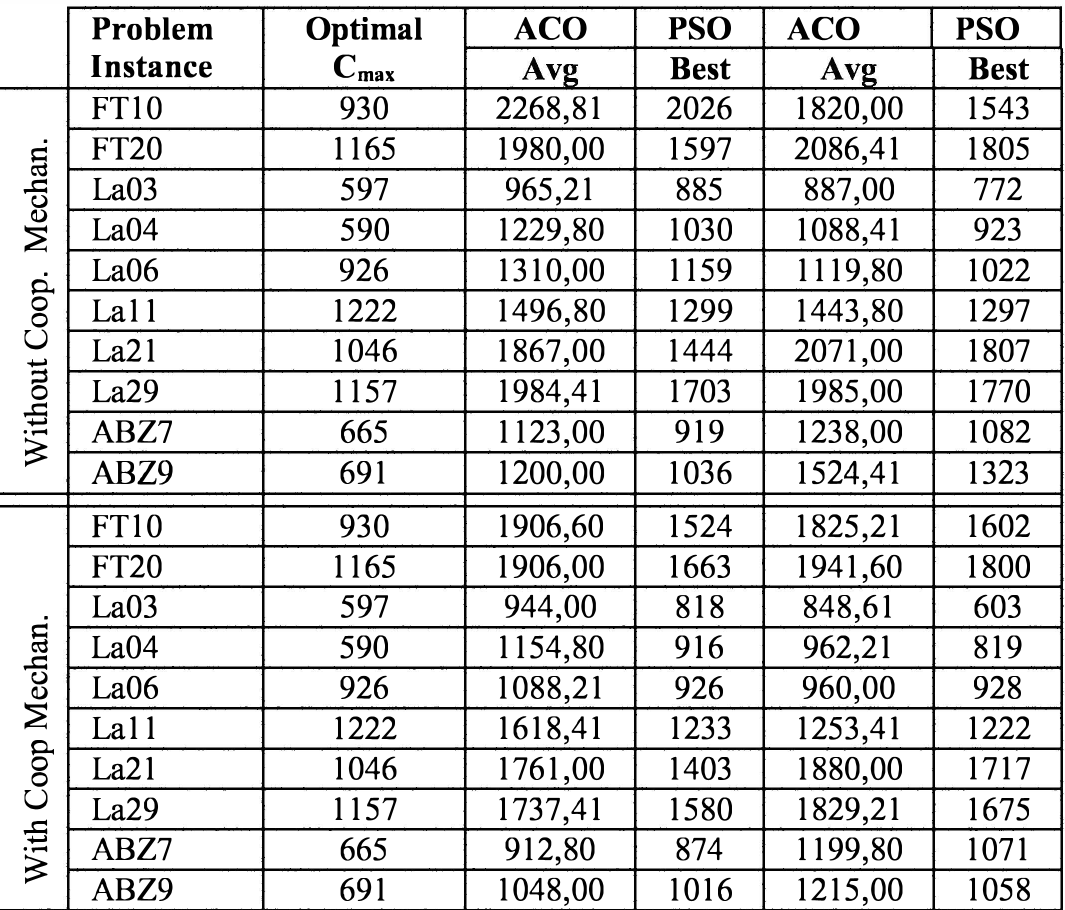
Key Findings:
- Cooperation Value: In the La11 instance, adding the cooperation mechanism brought the PSO best result from 1297 down to 1222 (matching the theoretical optimum).
- ACO vs. PSO: A fascinating technical takeaway is that PSO generally dominated smaller instances (FT10, La03), while ACO scaled more gracefully to larger, "big-problem" instances like ABZ9 and La29.
- Utilization: Beyond finishing faster (makespan), the system significantly increased the "Busy Time" of machines, reducing wasteful energy consumption.
Critical Insight & Conclusion
The true value of this work lies in the hybridization of AI paradigms. While pure Swarm Intelligence can get stuck in local minima when inter-agent constraints are tight, the "Meta-Cooperation" layer acts as a global heuristic that repairs these deadlocks.
Limitations: The current study relies on a centralized UI Agent for coordination. In extremely large-scale distributed manufacturing (Industry 4.0), move toward a fully decentralized negotiation protocol (peer-to-peer) would be a logical next step to avoid a single point of failure.
Final Takeaway: Optimization is no longer just about the best math; it's about the best communication between intelligent entities.