
Empowering Municipalities: A Collective Intelligence Framework for Free Software Adoption
Collective intelligence approach for free soware adoption by municipalities
This paper proposes a Collective Intelligence (CI) approach to enhance Free and Open Source Software (FOSS) adoption within small and medium-sized Brazilian municipalities. Leveraging data from the Brazilian Public Software (BPS) Portal, the authors identify key community "facets" and variables that drive successful implementation and sustainable local innovation ecosystems.
TL;DR
Modernizing public administration in small and medium-sized municipalities often fails not due to lack of software, but due to a lack of collaborative "intelligence." This research introduces a Collective Intelligence (CI) approach based on the 5W1H framework to bridge the gap between software availability on the Brazilian Public Software (BPS) Portal and its successful adoption by local governments.
The "Implementation Gap" in Public Software
The Brazilian government has been a pioneer in promoting Free and Open Source Software (FOSS). However, the authors observe a troubling paradox: while the number of registered users on the BPS Portal is growing, active participation (posts and engagement) is declining in nearly half of the hosted communities.
The root problem lies in the structural isolation of municipalities. They lack the human resources and digital culture to navigate complex repositories. Without a clear understanding of which communities are "healthy" and which service providers are active, software remains "shelfware"—available but ignored.
Methodology: Mapping the Ecosystem's DNA
To solve this, the authors moved beyond descriptive statistics to Faceted Analysis. They categorized BPS communities by:
- Trend & Rate: Is the community growing faster than the portal average?
- Offerer Type: Is it backed by the government, academia, or a private entity?
- Software Importance: Is the solution critical for tax, education, or general administration?
Identifying Key Relationships
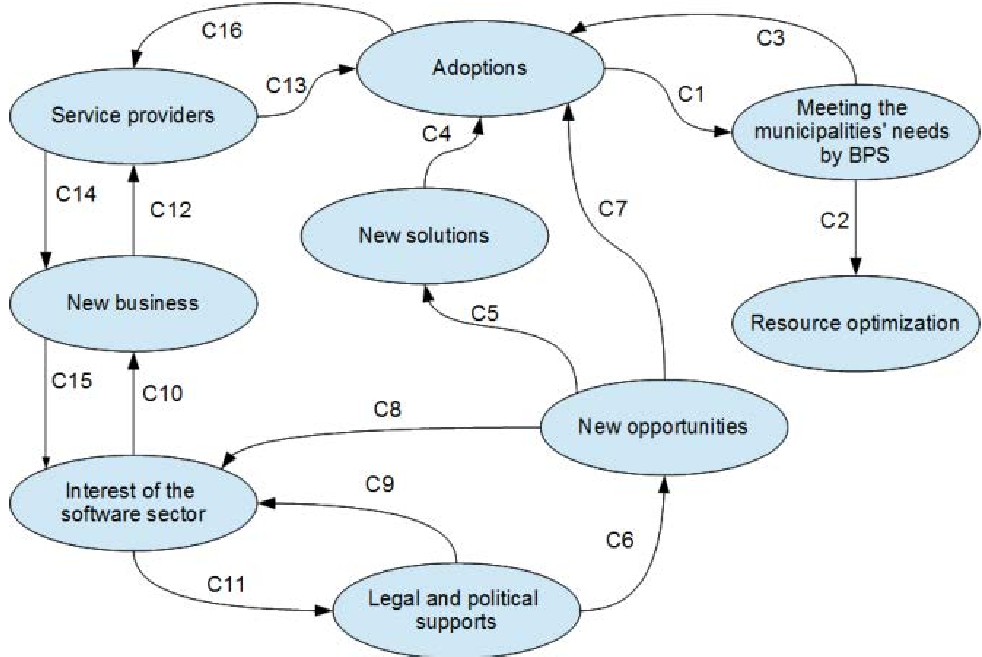
The research posits that adoption is a "virtuous cycle." For instance, an increase in Service Providers (key variable C10) leads to more Successful Adoptions (C1), which in turn generates New Business Opportunities (C8) and increases Satisfaction (C5).
Core Insights: What Makes a Community Successful?
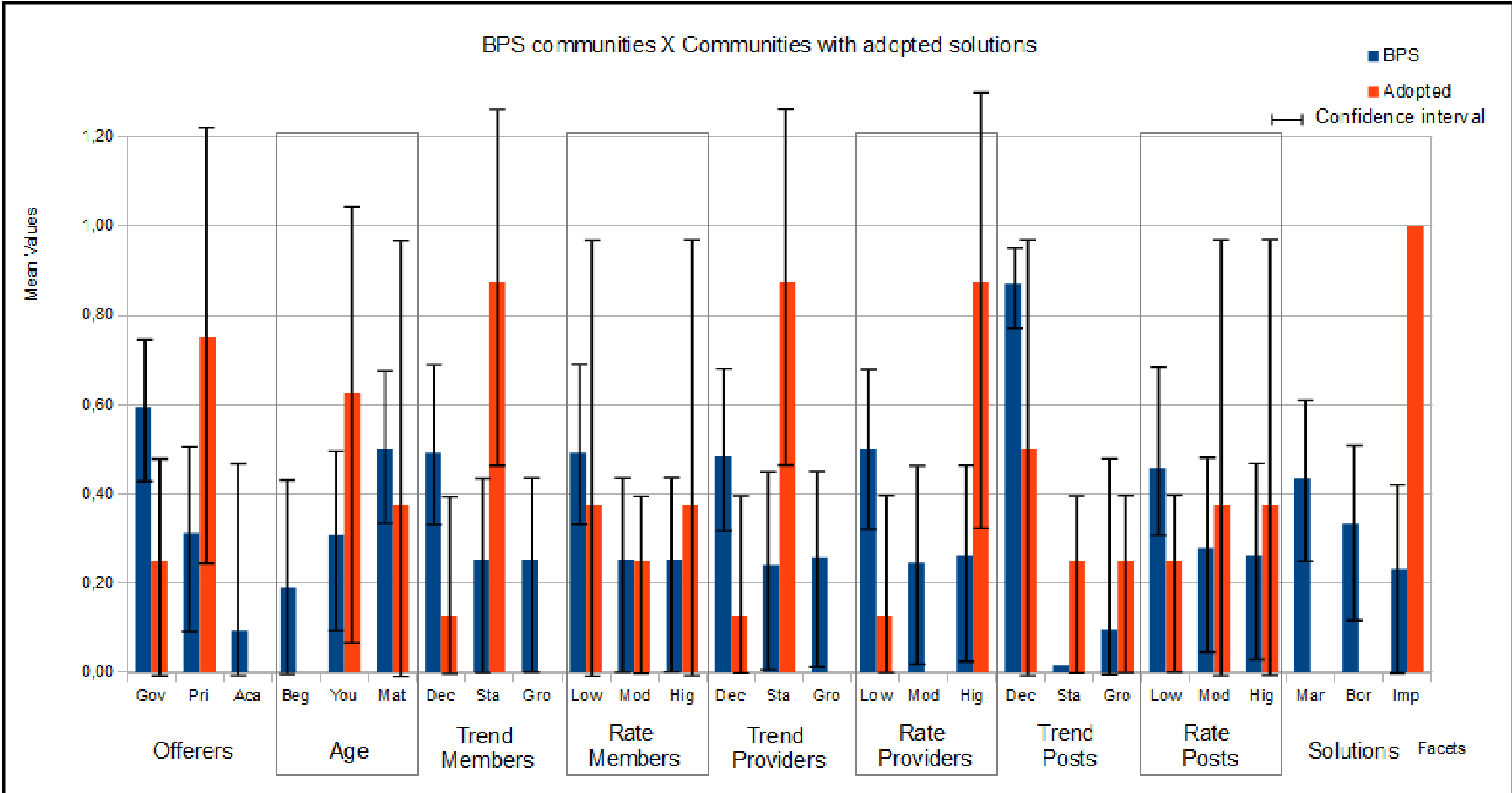
By comparing "general" communities with "successful" ones (those with high adoption like e-Cidades), the authors found distinct Success Facets:
- Private Sector Synergy: Successful software is frequently offered by private companies or individuals rather than strictly government agencies, suggesting a more agile support model.
- The "Young" Advantage: Surprisingly, "Young" communities (middle-aged in the portal's lifecycle) often outperformed "Mature" ones in terms of dynamism and adoption.
- Geographic Proximity: Adoptions are significantly higher in regions close to the software's origin or the service provider's headquarters.
The CI-Approach: 5W1H as a Decision Tool
The authors propose organizing community knowledge using the 5W1H (Who, What, Why, Where, When, How) framework. This allows a public manager to evaluate:
- Who: Which municipality needs the solution?
- What: Which software manages tax (e-ISS) or education (i-Educar)?
- How: What are the specific community facets (e.g., stable trend, high service provider rate) that ensure the project won't be abandoned?
Conclusion and Future Outlook
The paper concludes that Collective Intelligence is the emergent phenomenon that occurs when a community successfully solves problems through collaboration. For the BPS Portal to thrive, it must transition from a simple file-hosting repository to a knowledge-rich ecosystem where best practices and deployment experiences are shared as systematically as the code itself.
Takeaway for Policy Makers: Don't just fund the code; fund the ecosystem. Support for local service providers and the creation of regional "innovation clusters" is more likely to yield long-term digital transformation than simply mandating the use of free software.