
Collective Intelligence in Genetic Programming: Making Macroeconomic Forecasting Readable
Collective Intelligence of Genetic Programming for Macroeconomic Forecasting
2011-01-01
Summary
Problem
Method
Results
Takeaways
Abstract
This paper introduces a collective intelligence framework using Genetic Programming (GP) to forecast macroeconomic indicators. By employing multiple agents utilizing Gene Expression Programming (GEP), the system generates symbolic mathematical models that achieve performance comparable to Artificial Neural Networks (ANN) while maintaining human-readable transparency.
## TL;DR
While AI in economics is often dominated by "black-box" Neural Networks, a new study explores **Genetic Programming (GP)** as a way to generate accurate, human-readable mathematical formulas for macroeconomic indicators. By using a collective multi-agent approach, the researchers evolved symbolic models for Poland's GDP, loan rates, and investments that match the accuracy of Neural Networks while allowing human experts to "see" the underlying logic.
## The Interpretability Gap in Economic Policy
Strategic decision-making in a volatile macroeconomic environment requires more than just a raw number; it requires a rationale. Currently, policy makers face a dilemma:
- **Econometric Models**: Highly interpretable but often delayed and rigid.
- **Artificial Neural Networks (ANN)**: Extremely accurate but opaque. A CEO or Prime Minister cannot easily trust a forecast if the "why" is hidden behind millions of weight parameters.
This paper argues for the "Third Way": **Genetic Programming**. This evolutionary approach doesn't just tune numbers; it evolves the very structure of the mathematical equation itself.
## Methodology: Evolution of the Fittest Equation
The researchers utilized **Gene Expression Programming (GEP)**, a sophisticated variant of GP. In this system, potential solutions are treated like biological chromosomes that undergo crossover and mutation to "evolve" into the most accurate forecasting formula.
### A Collective Multi-Agent Strategy
The innovative core of this paper is the **Collective Intelligence** approach. Instead of running one single evolution, the authors deployed multiple "agents." Each agent operates with different constraints—such as different sets of mathematical operators (addition, square roots, etc.)—generating a "pool" of candidate models.
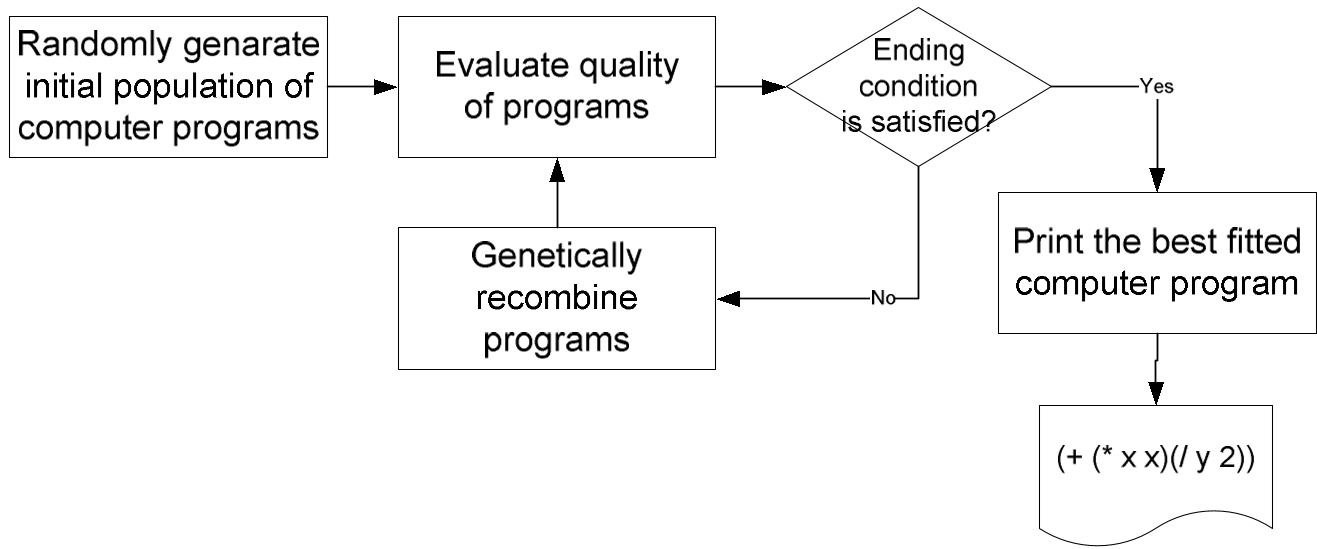
*Figure 1: The standard GP workflow where populations evolve through genetic recombination.*
## Experiments: Decoding the Polish Economy
The authors tested their framework using 50 quarterly indicators from the Polish economy (1995–2008). The results for three key areas were striking:
### 1. Gross Domestic Product (GDP)
The system evolved a model for GDP using 13 variables.
**Result:** $R^2 = 0.998$ (GP) vs $R^2 = 0.997$ (ANN).
The evolved model was not just a curve-fit; it utilized lagged variables (t-4) for components like money supply ($M2$) and industrial production ($SPI$), providing a symbolic view of economic momentum.
### 2. Commercial Loan Interest Rates
The model for loan rates achieved an $R^2$ of 0.994, utilizing 17 variables including inflation indices ($PPI$, $CPI$) and stock market capitalization ($WSC$).
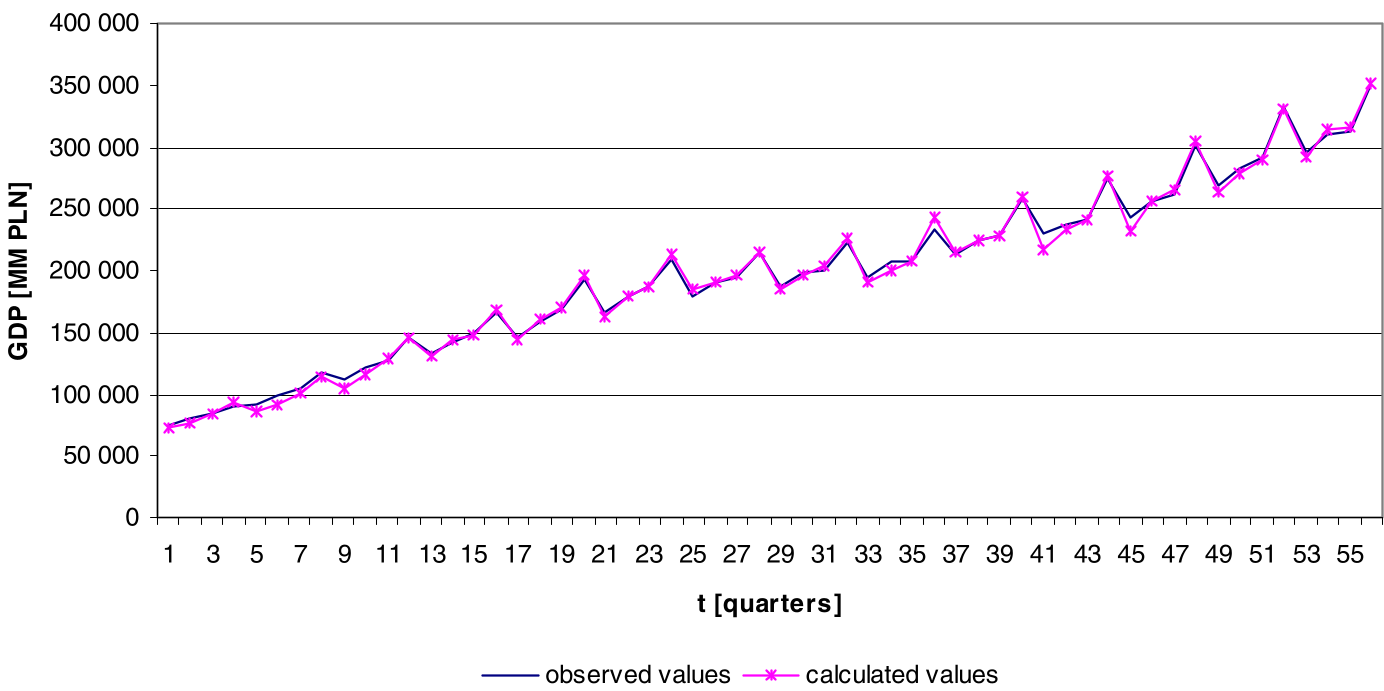
*Figure 2: The tight fit between predicted values and actual GDP data demonstrates the precision of symbolic evolution.*
## Critical Insight: Why This Matters
The fundamental advantage of this work isn't just the high accuracy—it is the **Inductive Bias** control. Because the output is a standard algebraic formula, a human economist can perform an "Ablation Study" of their own:
- If the model suggests $GDP$ is driven by a variables that makes no sense theoretically, the decision-maker can discard it and choose the *second-best* model from the agent pool.
- This provides a "Human-in-the-loop" capability that deep learning models generally lack.
## Conclusion & Future Outlook
The paper proves that Genetic Programming is no longer just a theoretical curiosity; it is a viable competitor to Neural Networks in complex time-series tasks.
**Limitations**: The authors acknowledge that the selection process for the "best" model needs more automation—relying on a human to manually pick from a pool can be subjective.
**Future Path**: The next frontier involves testing these models against "black swan" events like the 2008 financial crisis (which was just beginning at the end of their dataset) to verify if symbolic models are more robust to regime shifts than their neural counterparts.
---
*Reference: Duda, J., & Szydło, S. "Collective Intelligence of Genetic Programming for Macroeconomic Forecasting." AGH University of Science & Technology.*