
The Collective Intelligence Heuristic: Why Humans Cooperate More When Things Get Harder
Collective Intelligence Heuristic: An Experimental Evidence
This study investigates collective intelligence through an experimental "Crowdsourcing Game" involving 216 participants. It demonstrates that humans employ a "Collective Intelligence Heuristic," where cooperation significantly increases as task complexity rises and group size decreases.
TL;DR
Researchers from the University of Florence have identified a "Collective Intelligence Heuristic": a mental shortcut that triggers high-level cooperation when individuals perceive a task as too complex to solve alone. Through a custom-built "Crowdsourcing Game," the study proves that while we might compete on easy tasks, we instinctively band together when faced with high-stakes complexity, especially within small, balanced groups.
Background Positioning: This work bridges the gap between theoretical statistical physics (modeling agents) and social psychology. It moves beyond the "Wisdom of Crowds" as a passive aggregation and treats it as an active, evolved survival strategy.
Problem & Motivation: The Rationality Paradox
Traditional Game Theory and evolutionary models (like the Prisoner's Dilemma) often suggest that as groups get larger or tasks get harder, "free-riding" increases and cooperation collapses. However, human history tells a different story—we build cathedrals, solve global crises, and develop complex software through massive collaboration.
The authors noticed a contradiction: Computational models using "perfectly rational agents" predicted that cooperation should decrease with task difficulty. The researchers suspected that human psychology contains a "social hard-wiring" that these models miss—a tendency to seek the group precisely when our individual limits are reached.
Methodology: The Crowdsourcing Game
To test this, 216 participants were put into an anonymous virtual environment.
The Architecture
- Population: 12 players per session.
- Dynamics: Players chose to either Cooperate (low individual payout, but increases group success probability) or Compete (high potential payout, but high risk of failure).
- Variables: The experiment varied group sizes (1, 3, 6, or 12 people) and task "simplicity" (R-values from 0.1/complex to 0.9/easy).
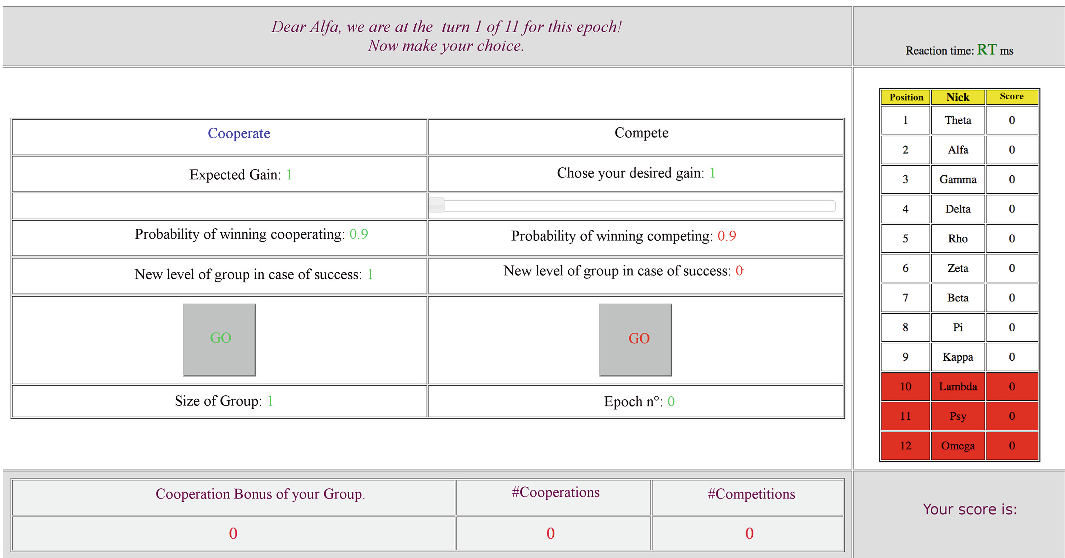
The genius of this setup is that it captures the SIDE (Social Identity Model of Deindividuation Effects). By keeping participants anonymous, the researchers could isolate whether behavior was driven by individual personality or the social context created by the group size and task difficulty.
Results: The "Golden Ratio" of Group Dynamics
The findings yielded three major insights:
- The Complexity Trigger: Unlike virtual agents, humans cooperated more as tasks became harder. This is the "Collective Intelligence Heuristic" in action—complexity signals a need for the group.
- The 50/50 Split: Both individual and group scores hit a peak when the 12-person community was divided into two groups of six.
- De-individualization: Surprisingly, psychosocial variables (like anxiety or personality traits) had very little impact compared to the group structure. The environment's rules outweighed the individual's personality.
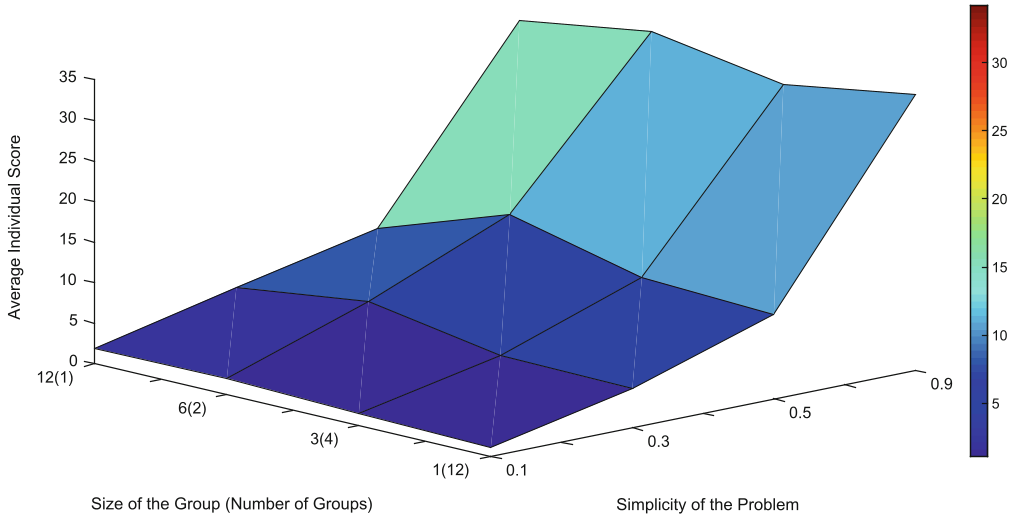 Fig 3: Note the peak in individual gain when group size is halfway (n=6), particularly as tasks become more manageable.
Critical Analysis & Conclusion
Takeaway
The study provides empirical proof that "Crowdsourcing" isn't just about having a lot of people; it's about the architecture of their interaction. If you want to solve a hard problem, don't just dump it on a massive forum. Instead:
- Break the crowd into small groups.
- Ensure groups are balanced (competing against another group of equal size).
- Increase the perceived challenge to trigger the natural cooperative heuristic.
Limitations
As a Senior Editor, I note two main caveats. First, the sample was heavily skewed toward young university students (mostly female), which might have higher baseline social cooperation than a general population. Second, the "Collective Intelligence Heuristic" is currently a descriptive label for the observed behavior; the specific neuro-cognitive mechanisms that "flip the switch" from competition to cooperation remain to be mapped.
Future Outlook
This research has massive implications for Digital Ergonomics. As we move toward AI-human hybrid teams, understanding that "difficulty" is a feature that promotes unity—rather than a bug that causes friction—could change how we assign tasks in platforms ranging from GitHub to citizen science projects like Foldit.