
Measuring the Invisible Hand: A Collective Intelligence Approach to Market Efficiency
Collective Intelligence Approach to Measuring Invisible Hand of the Market
The paper introduces a multi-agent market simulation system (MAMSS) designed to quantify Adam Smith's "Invisible Hand" using the Social Collective Intelligence Quotient (IQS). By integrating microeconomic theories of utility and Pareto efficiency into agent behaviors, the authors demonstrate that decentralized market interactions lead to a measurable increase in macroscopic Gross Domestic Product (GDP).
TL;DR
Can we actually calculate the "intelligence" of the free market? This paper proposes a Multi-Agent Market Simulation System (MAMSS) that treats Adam Smith’s "Invisible Hand" as a measurable computational process. By comparing the collective output of interacting agents against isolated individuals, the study quantifies market efficiency using a metric called IQS (Social IQ), showing that decentralized trade can more than double societal wealth (GDP).
The "Invisible" Difficulty: From Metaphor to Math
For centuries, the Invisible Hand has been a powerful metaphor for how individual greed translates into public good. However, in mainstream economics, it often remains just that—a metaphor. The challenge lies in the micro-macro gap: how do we prove that a specific set of individual behaviors (micro) is the direct cause of an efficient economy (macro)?
The authors argue that the missing link is Collective Intelligence. If we view every market transaction as a "communication act," the entire market becomes a social brain solving a resource allocation problem.
Methodology: Building the Artificial Market
The authors construct the MAMSS (Multi-Agent Market Simulation System) based on three pillars:
- Microeconomic Motivation: Agents use the Cobb-Douglas utility function to define their preferences. They don't just "trade"; they seek Pareto Improvements—exchanges where at least one person gets richer/happier and no one gets poorer.
- M-Agent Architecture: Each agent is autonomous, possessing its own production capabilities, assets, and "interaction radius" (how far it can see other traders).
- The IQS Metric: This is the paper's secret sauce. They define the intelligence of the market as: where represents a "Robinson Crusoe" economy where everyone produces only for themselves.
Note: The system defines space as a 2D mesh where agents navigate to find better trading partners, simulating a topological market.
Experiments: The Impact of "Visibility"
The researchers ran simulations with 200 agents divided into two classes with complementary needs. The variable they tested was the Interaction Radius ().
Key Findings:
- The Interaction Leap: Moving from zero interaction to even a small radius () caused a massive spike in GDP.
- Saturation Point: As the radius increases (allowing agents to see further), the GDP continues to grow, but the rate of improvement slows down, suggesting a "diminishing returns" law for market connectivity.
- The Genius Market: The reached values over 1.0. In psychological terms, a 100% increase in "social IQ" represents a leap from average intelligence to an "ultimate genius" level of coordination.
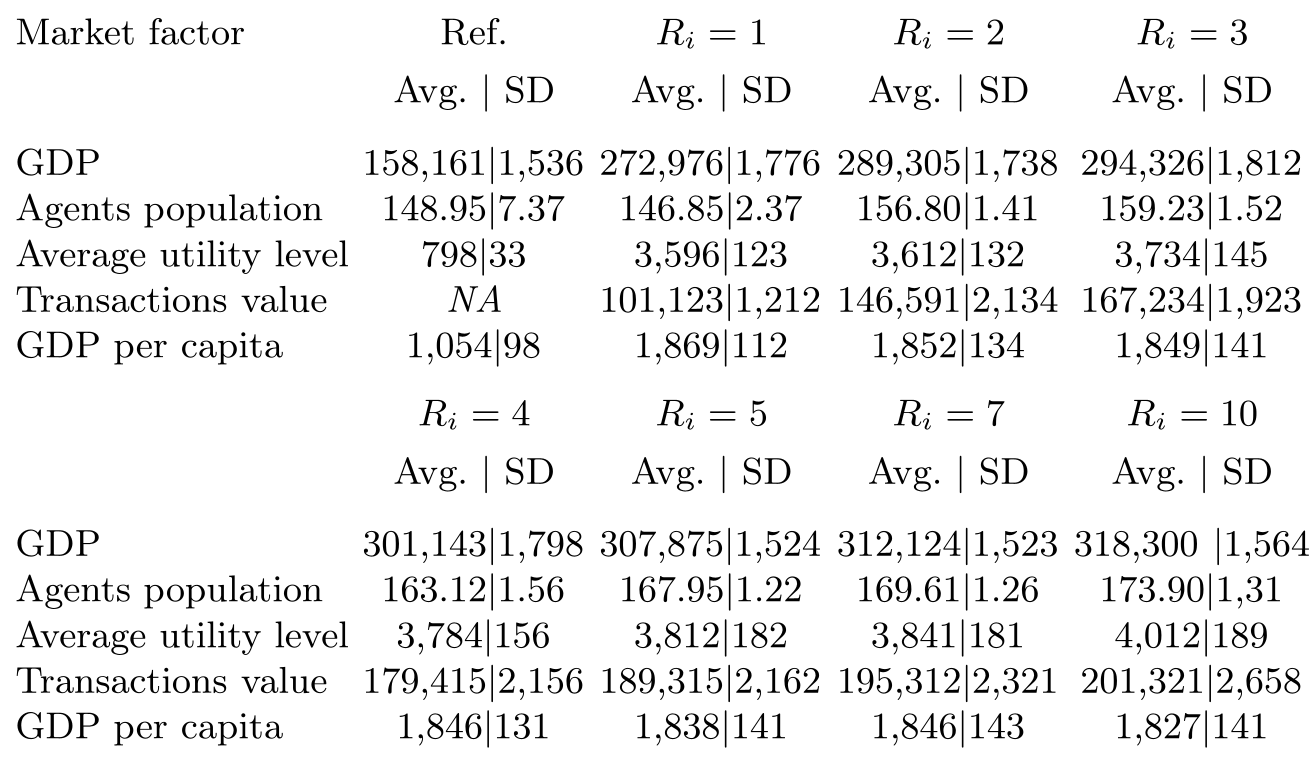 As shown in Table 1, the GDP and Average Utility Level scale significantly with the interaction radius, proving that decentralized communication is the engine of value creation.
Critical Insight: Why This Matters
The most profound takeaway is that Market Intelligence is a function of Communication. By formalizing the Invisible Hand through the lens of Collective Intelligence (IQS), the authors allow us to test "what-if" scenarios:
- What happens if we introduce "money" to reduce transaction friction?
- What happens if we change the migration costs?
The paper successfully bridges Theory of Utility and Multi-Agent Systems, providing a laboratory to study the efficiency of social structures.
Conclusion & Limitations
While the model is robust, it assumes agents are perfectly rational hunters of Pareto efficiency. Future work could benefit from introducing "noisy" agents, market shocks, or the concept of currency, which might further increase the "social IQ" by reducing the complexity of bartering.
Ultimately, this work suggests that the "Invisible Hand" isn't magic—it's a computational result of a high-functioning social algorithm.