
Structuring Innovation: Harnessing Linked Data for Collective Intelligence
Collective intelligence-based idea platform with linked data
This paper proposes an enhanced Collective Intelligence-based Idea Platform that integrates Crowdsourcing with Linked Data (LD) technologies. By utilizing RDF and Semantic Web standards, the framework transforms unstructured public contributions into machine-readable knowledge, significantly improving the efficiency of idea selection and transformation within open innovation ecosystems.
TL;DR
Innovation often fails not because of a lack of ideas, but because we cannot process them. This paper introduces a Crowdsourcing-based Idea Platform that solves the "Big Data bottleneck" by integrating Linked Data (LD). By converting messy, unstructured public input into a structured RDF-based knowledge network, organizations can automate idea interpretation and accelerate the path from raw concept to commercial solution.
The "Crowd" Paradox: More Ideas, More Problems?
Open innovation has shifted from a closed-door strategy to a democratic process. However, as the paper points out, traditional crowdsourcing suffers from a paradox: the more diverse the contributors, the more complex the "Big Data framework" becomes.
The current pain points are:
- Interpretation Deficit: High-quality ideas are buried under noise.
- Resource Drain: Evaluating thousands of unstructured text entries costs excessive time and energy.
- Siloed Knowledge: Ideas remain isolated rather than evolving through mutual collaboration.
The author argues that the missing link is a capability for idea interpretation and distribution—a problem that Big Data alone cannot solve without a semantic layer.
Methodology: The Five-Step Evolution of an Idea
The core of this research is a move toward "Smart Data." Instead of just collecting volume, the proposed model focuses on the Crowdsourcing Mobilization Process.
1. The Architecture of Intelligence
The framework utilizes Semantic Web standards (HTTP, RDF, URI) to ensure every idea is machine-readable and interconnected.

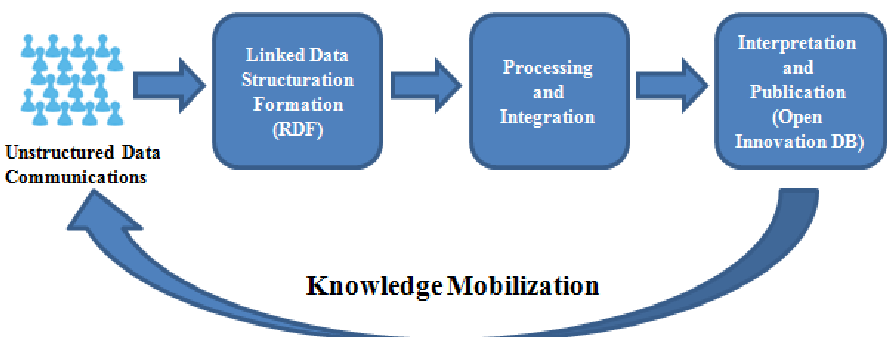
2. The Cyclic Mobilization Model
The paper breaks down the transformation into a distinct pipeline:
- Unstructured Collection: Gathering raw input via interactive interfaces.
- Structuration (The RDF Bridge): Applying ontologies to make ideas machine-understandable.
- Integration & Analysis: Using preprocessing and potentially machine learning to find hidden patterns.
- Visualization: Turning data into "interpreted knowledge" that stakeholders can actually act upon.
- Mobilization: Allowing the community to access this database, run complex queries via SPARQL, and participate in a "knowledge cycle."
Why Linked Data is the "Secret Sauce"
Why use Linked Data instead of a standard SQL database? The author highlights several Semantic-level advantages:
- Contextual Linking: An idea about "solar energy" can automatically link to existing datasets on "battery storage" or "urban planning" via URIs.
- Reduced Variability: RDF standardizes how we describe objects, making it easier to filter "noise" in Big Data environments.
- Transparency: The accessibility of LOD encourages higher collaborative engagement from the public, as the data value chain becomes visible.
Experiments & Real-World Implications
The study positions this framework within the context of Living Labs—user-centered research environments. By utilizing the RDF/SPARQL stack, platforms can enable "Knowledge Discovery" rather than just "Data Storage."
While the paper focuses on the conceptual framework, the implications are clear:
- Efficiency: Significant reduction in human-led "first-pass" screening of ideas.
- Quality: Improved selection of "Best Ideas" through semantic validation and consistency checks.
Critical Insight: Beyond the Binary of Human vs. Machine
This paper offers a sophisticated middle ground. It doesn't suggest that AI should replace human evaluation; rather, it suggests that Linked Data acts as the connective tissue that allows Collective Intelligence to scale.
Limitations to Consider:
- Adoption Barrier: Managing RDF and Ontologies requires more technical sophistication than a standard web form.
- Dynamic Knowledge: As the author notes, crowd communication changes rapidly, and static ontologies may struggle to keep up with slang or emerging trends without frequent updates.
Conclusion: Toward a Web of Ideas
The transition from an "Idea Platform" to a "Knowledge Mobilization Platform" is the next frontier of Open Innovation. By treating ideas as Linked Open Data, we move away from a "tournament" style selection (where only one wins) toward a "collaborative ecosystem" where ideas co-evolve into innovative solutions.