
Decoding Collective Intelligence: Why OSS is Built by "Selfish" Individuals
Workings of Collective Intelligence within Open Source Communities
This paper explores the mechanics of Open Source Software (OSS) development through the lens of Collective Intelligence. By analyzing large-scale data from SourceForge and CVS repositories, the authors demonstrate that OSS is primarily an emergent phenomenon driven by disjoint groups of developers fulfilling individual, work-related needs rather than a shared ideological "community" goal.
TL;DR
Is open-source software (OSS) a labor of love for a global community unified by a digital ideology? According to Everett Stiles and Xiaohui Cui, the answer is largely no. By meticulously tracking developer behavior on SourceForge, they prove that OSS is actually a byproduct of Collective Intelligence—an emergent phenomenon where thousands of developers, mostly unknown to each other and working on tiny, isolated "needs," create a functional whole that rivals commercial products.
The "Community" Myth vs. Disjoint Reality
For years, academia and enthusiasts have hailed OSS as the triumph of "social interactions" and "group influences." We like to imagine a "Cathedral" or a "Bazaar" where everyone is talking. However, this paper identifies a starkly different reality:
- Isolation: Most developers are "lone wolves" regarding their project involvement.
- Transience: The majority of contributors show up, fix a single bug that affects their day job, and never return.
- The 85% Rule: Statistics show that 85% of developers on active projects are only involved in one project.
The authors argue that the "community" we see is actually an illusion created by a very small group of Long-Term Contributors (LTCs) who act as the "connective tissue," while the vast majority of the code comes from people who don't care about the project's "ideology"—they just want the software to work for their specific task.
Methodology: The Macro and Micro View
The researchers didn't just speculate; they looked at the data in two stages:
- Macro Level (Community Context): Using a massive dump from the Notre Dame OSS database, they tracked the participation of over 246,000 developers across years of history.
- Micro Level (Code Context): To see how much a developer actually knows about a project, they used CVS (Concurrent Versions System) logs. If you only edit 2 files in a 100-file project, your "knowledge scope" is only 2%.
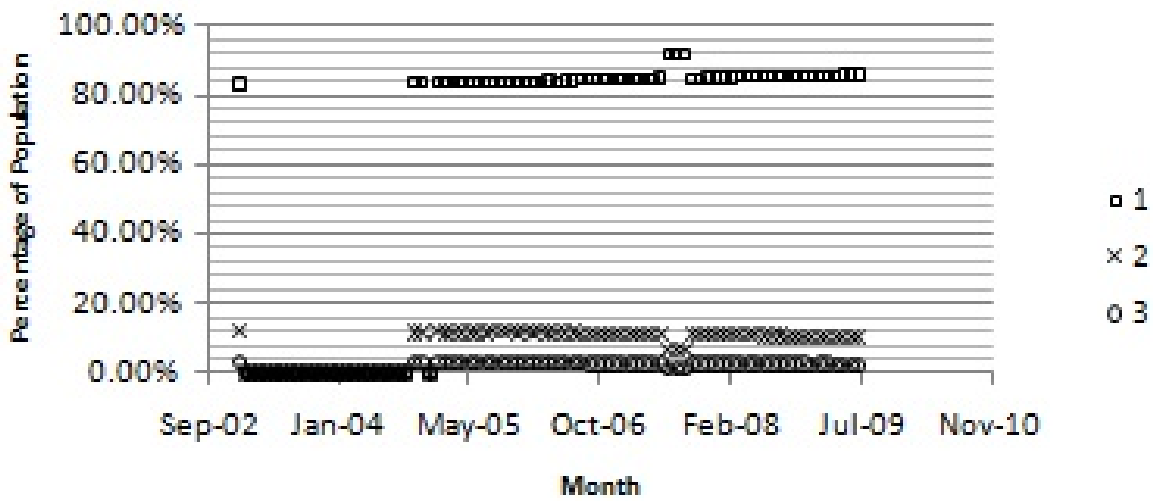 The chart clearly shows a rising trend: more developers are focusing exclusively on single projects, debunking the idea of a highly interconnected "global developer social network."
Core Insight: Emergence and Collective Intelligence
The paper’s most profound insight is the comparison of OSS to biological collective intelligence (like an ant colony).
- An individual ant doesn't know the "master plan" for the nest.
- A developer doesn't need to know 90% of the project's code to improve it.
- By solving a personal, work-related need, the developer adds an "increment" of value.
When hundreds of these "selfish" increments are curated by a few LTCs, useful functionality emerges.
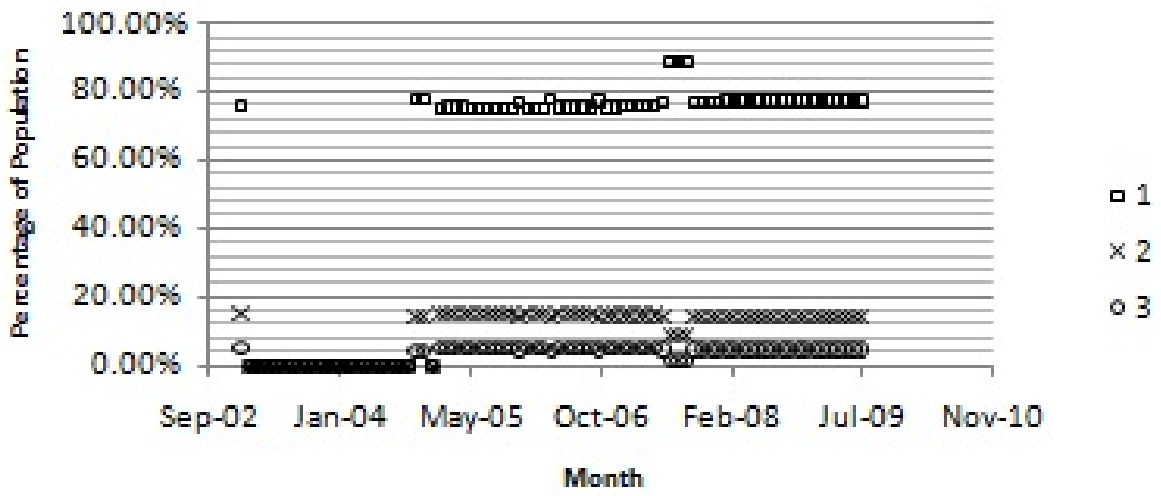 Table 1 illustrates that in the most popular projects, the average developer's knowledge is incredibly narrow—often contributing to only a tiny fraction of the total files.
Critical Analysis & Conclusion
This work provides a necessary reality check for OSS project managers. If you want your project to grow:
- Don't rely on ideology: People contribute because they have a "work-related need" (Shah, 2006).
- Reduce Friction: Since most contributors only want to fix one thing, the barrier to that first contribution must be as low as possible.
- Support the LTCs: While the masses provide the "intelligence," the Long-Term Contributors provide the structure. Without them, the disjointed contributions would never coalesce into a marketable product.
Limitations: The study focuses on SourceForge and CVS, which have since been largely superseded by GitHub and Git. Modern "social coding" features might have increased developer interconnectedness, but the core "Collective Intelligence" model likely still holds true for the vast "Long Tail" of software development.
Takeaway: OSS is not a commune; it’s a highly efficient ecosystem of individual problem-solvers.