
Collective Intelligence: Turning Digital Noise into Decision-Making Gold
Using collective intelligence for opinion analysis and tendency determination
This paper introduces the Collective Intelligence based Opinion Analysis and Tendency Determination System (CIOATDS), a framework designed to synthesize diverse group opinions into actionable decision-making insights. By decomposing text-based feedback into 17 distinct components and applying semantic analysis, the system achieves a 100% accuracy rate in determining the integrated final tendency of opinions.
TL;DR
In an era of information explosion, the challenge isn't finding opinions—it's figuring out which way the wind is actually blowing. This paper presents CIOATDS, a system that uses "Collective Intelligence" (CI) to analyze free-form text opinions and distill them into a single, intelligent "tendency." By weighting opinions based on the poster's background and the strength of their evidence, the system proves that the crowd's integrated view can outperform even the smartest individual experts.
The Motivation: Why Experts Aren't Enough
For decades, we’ve operated under the assumption that the best decisions come from the "experts" in the room. However, research into Collective Intelligence suggests that even experts have blind spots. The authors argue that a decentralized community—where individuals provide diverse, independent assessments—can produce a "tendency" that is more accurate than any single professional.
The problem? Most online comments and corporate feedback are "unstructured noise." To make the Wisdom of Crowds work for decision-makers, we need a way to format, weight, and converge these disparate voices.
Methodology: The Anatomy of an Opinion
The core innovation of this work lies in how it deconstructs a simple sentence. Instead of treating a comment as a single data point, the authors break it down into 17 components, categorized into:
- Opinion Poster: Who is talking? (Metadata like age, seniority, and education).
- Opinion Support: Why should we believe them? (Evidences, benchmarks, and examples).
- View of Opinion: What is the actual verdict? (Positive, negative, or indefinite conclusions).
Architecture of Opinion Representation
The system uses a statistical model to identify these components based on their starting position and string length within the text.
 Figure 1: An overview of the architecture framework for the representation of opinion contents model.
The Weighting Formula
Unlike simple voting, this system applies a weighted average. The "importance" of an opinion is calculated by:
- User Status: Averaging the normalized factors of age, education, and seniority.
- Evidence Density: Counting how many supporting components (like "Case Studies" or "Benchmarks") the user provided.
Experiments & SOTA Performance
The authors tested the methodology using data from Yahoo! Answers, comparing two scenarios: area-specific opinions versus general opinions.
Key Results
- Accuracy of Integration: While individual component extraction was difficult (reflecting the inherent messiness of human language), the system's ability to determine the Entire Tendency of Integrated Opinions achieved a staggering 100% accuracy.
- Tendency Accuracy: Once opinions were correctly formatted, the system identified the correct sentiment (Positive/Negative/Indefinite) with 80% to 100% accuracy.
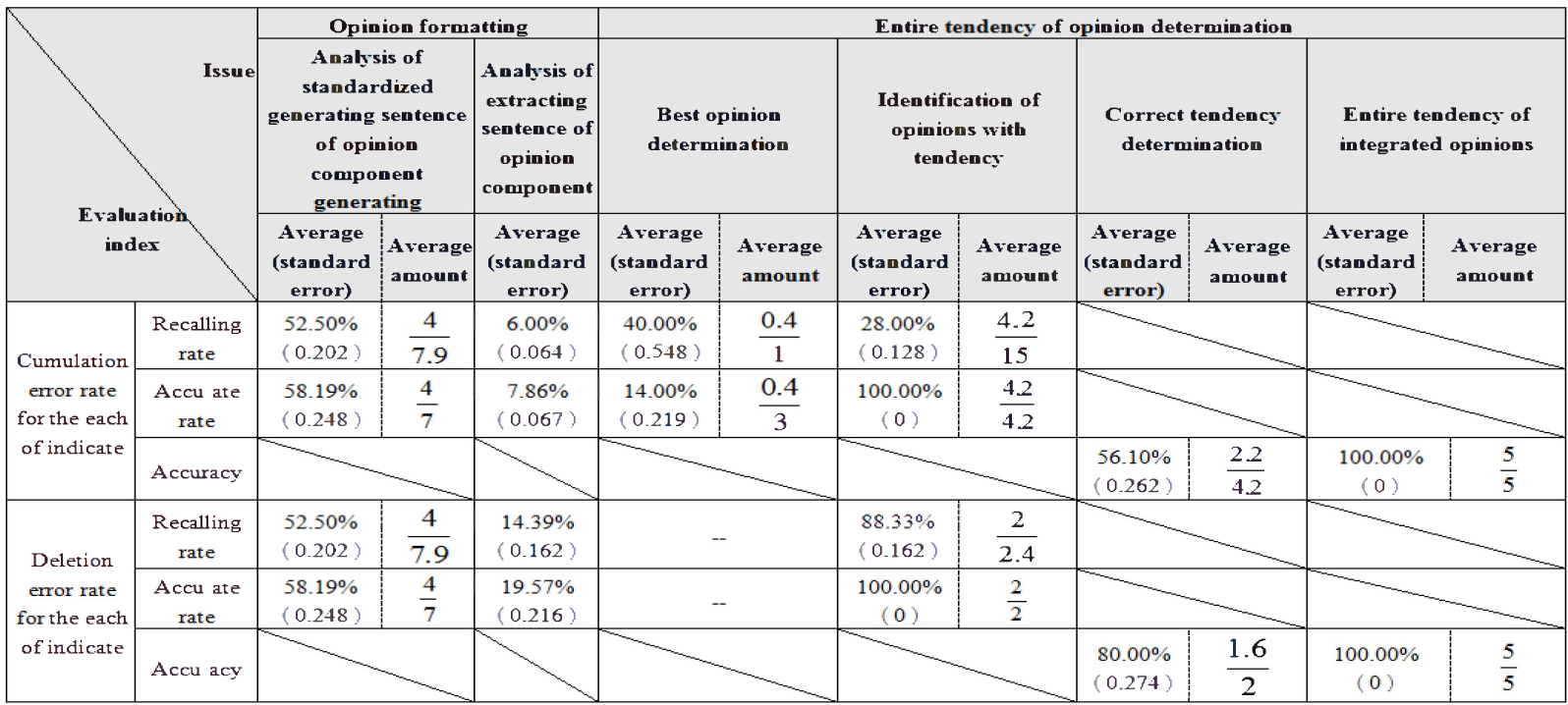 Table 1: Performance evaluation results showing the high accuracy of integrated tendency determination.
Deep Insight: Beyond Simple Sentiment Analysis
Most current sentiment tools just tell you if a group is "happy" or "sad." This CI-based approach goes deeper. It treats the community as a distributed computer. By looking at the structure of the argument (is there a benchmark? is there an effect of example?), the system distinguishes between a "loud" opinion and a "valuable" one.
Limitations & Future Work
The research acknowledges that "Opinion Formatting" remains the bottleneck. In 2026, we might see this improved by integrating LLMs for the initial component extraction phase. Furthermore, the reliance on metadata (like age and education) as a proxy for weight is a neutral approach but may need adjustment for specific fields where technical expertise is irreplaceable.
Conclusion
This paper provides a robust blueprint for any organization looking to implement "Crowdsourcing" for strategy. It reminds us that intelligence isn't just about how much you know—it's about how effectively you can combine what everyone knows.