
Mapping the Evolution of Collective Intelligence: A 2012-2015 Retrospective
Research and trends in the studies of Collective Intelligence from 2012 to 2015
This paper presents a systematic content analysis of Collective Intelligence (CI) research published between 2012 and 2015. By analyzing 119 relevant peer-reviewed papers, the authors categorize the evolution of the field into three pillars: Learning, Technology, and Decision-making.
TL;DR
This study provides a comprehensive content analysis of Collective Intelligence (CI) research during its "foundational technology era" (2012-2015). By distilling hundreds of publications, the researchers reveal that CI is no longer just about groups of people; it is a convergence of Learning, Technology, and Decision-making facilitated by Web 2.0 and semantic systems.
Background & Motivation
Collective Intelligence—the synergy between groups and machines—has shifted from a sociological curiosity to a technological necessity. However, with the explosion of scientific literature, identifying the "signal" within the "noise" became a challenge. The authors sought to answer: Where is the research momentum actually going?
They argue that CI is the modern engine of knowledge societies, yet its growth is unevenly distributed across different technical domains. To map this, they utilized a rigorous content analysis methodology to synthesize trends from high-impact journals.
Methodology: The Analytical Framework
The researchers utilized a three-stage filtering process based on the Zott Approach:
- Broad Search: 1,724 papers identified in Science Direct, Web of Science, etc.
- Refined Selection: 215 papers where CI appeared in the title/abstract.
- Final Inclusion: 119 papers where CI was a non-trivial contribution.
They categorized the literature into three critical groups (C1, C2, C3) to evaluate the "Computing Domain Knowledge":
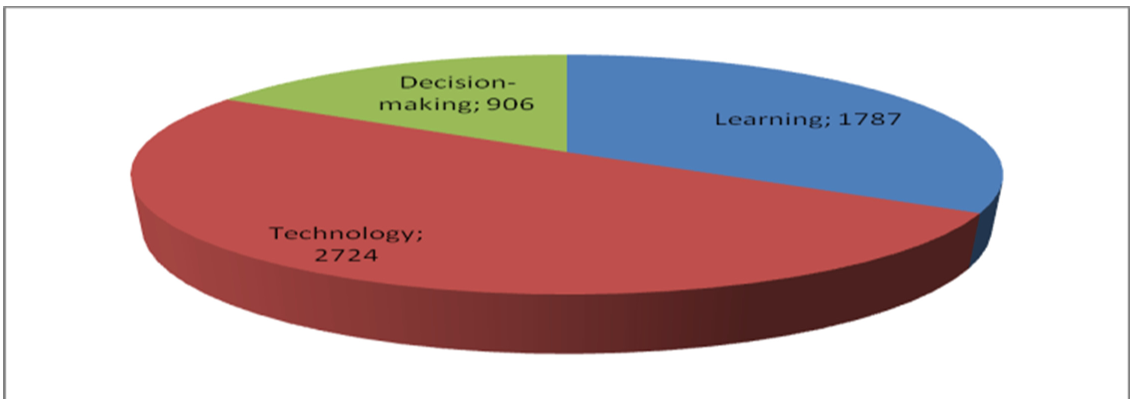
Core Pillars of Collective Intelligence
1. Education & Learning (C1)
The research highlights that CI creates a "learning space" where members contribute to solving complex problems. Key insights include:
- Crowdteaching: Using tools like the Instructional Architect to share and reuse educational resources.
- Collaborative Literacy: Web 2.0 provides the framework for students to experience CI as a new form of creativity and knowledge acquisition.
2. The Technological Backbone (C2)
Technology was found to be the most dominant category. The paper identifies a shift toward:
- Semantic Web: Facilitating the exchange of structured information to achieve "Web-scale" intelligence.
- Hybrid Models: Integration of NKRL (Narrative Knowledge Representation Language) with HARMS (Humans, Agents, Robots, Machines, and Sensors).
- Adaptive Systems: User-centric learning systems that leverage item response theory and crowd feedback.
3. Decision-Making & Consensus (C3)
One of the most impactful findings is the application of CI in specialized fields like medicine.
- Medical Diagnosis: Using the "wisdom of crowds" to build consensus-based Support Systems for more accurate clinical outcomes.
- Social Cohesion: Systems like the Millennium Project organize input from experts and the public to support strategic national decision-making.
Experimental Analysis: Data Distribution
The authors categorized the keywords and themes to see which areas were gaining the most traction.
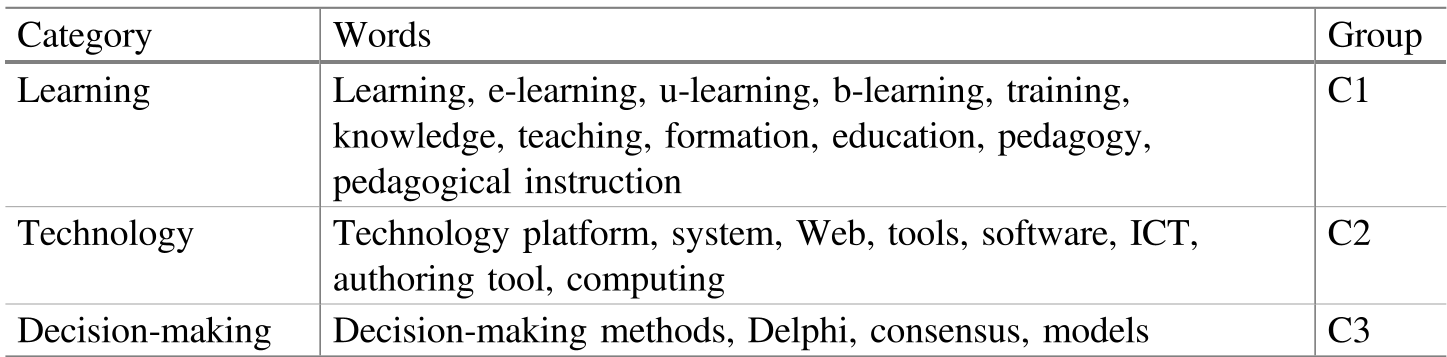
The results confirm that CI is heavily reliant on Technology (C2) as the enabler for both Learning and Decision-making. Without the "Platform" and "Software" tools, CI remains theoretical rather than functional.
Critical Insight & Conclusion
This paper serves as a vital "timestamp" in CI research. It marks the transition where CI stopped being about "human groups talking" and started being about "human-machine feedback loops."
Key Takeaways for Future Research:
- Synergy is Mandatory: Future CI systems must integrate human expertise with software agents (HARMS model).
- Consensus over Volume: The value of CI isn't just "more data," but the ability to reach a consensus for quality assurance (e.g., CorpWiki).
- Future Roadmap: While this study focuses on 2012-2015, the trends point directly toward the modern era of Large Language Models (LLMs) and decentralized AI, which are the spiritual successors to the "Semantic Web" and "Web 2.0" CI frameworks discussed here.
Limitations
The authors acknowledge that using only four databases (Science Direct, WoS, SpringerLink, Wiley) may have omitted some sociology-centric studies, and the classification of themes remains somewhat subjective. However, the rigor of the Zott method provides a highly reliable snapshot of the era's technical progress.